Wednesday, August 22, 2012

WE GO TO THE OLYMPICS - ANCIENT OLYMPIA AND THE MOUNTAIN VILLAGES OF PELOPONNISOS, THEN BACK INTO THE ISLANDS

As our blog is usually a couple of weeks behind real time I'm going to start from now mentioning our current location at time of posting. Now we are in Levkas marina, Levkas Island, Greece.
We never leave Envoy unattended at anchor overnight, but frequently leave her a whole day while we do a bit of shore-side touring. This would only be in calm conditions, in winds under 20 knots, with good holding for the anchor, plenty of room to swing, and without too many other yachts nearby. The biggest danger we have to consider is another boat anchoring nearby, snagging our anchor, and not re-laying it correctly causing Envoy to drag. When going ashore we lock the boat (although security never seems to be an issue), leave nothing running, turn off the fresh water supply (in case a fresh water hose should burst or develop a leak, and pump all the fresh water into the bilge), leave the bilge pumps on, leave the windlass power on (so that in case of a problem, crew from another cruiser can still operate our windlass). Strictly speaking we should close all below waterline seacocks, but with a total of 12, there are too many to make this practical.
Ancient Olympia was a must to visit, particularly this year with the London Olympics. It’s a large site covering probably about 100 acres, covered in ruins. Actually there is not much that is recognizable, and this site in our view mainly comes into the category of rubble more than ruins, but it has a special significance, and there are some reasonably well preserved sections including Roman Emperor Nero’s Villa.
This area was first populated from 3,000 BC, and fully developed by the end of the 4th century BC, devoted to the God Zeus. The first Olympic Games were held in 776 BC, and continued every four years until AD 426, when pagan religions (ie worshipping Zeus) were suppressed. Women were not allowed to compete in, or even to watch the Games.

Brian, Carol and Laurie in front of the reconstructed ruins of Olympia

The first Olympic Stadium with stone starting blocks and seating for 45,000 people on the grassy slopes

The most recognizable ruin is Emperor Nero’s Villa

We more enjoyed visiting the medieval mountain villages of Langadia, Dimitsana and Stemnitsa. This included a great lunch of goat soup. In retrospect we would have loved to stay overnight in one of the villages.

The medieval village of Langadia flows down the steep hillside

Picturesque lane in village of Dimitsana

Dimitsana’s main square and clock tower

Laurie exploring a Steminitsa lane

Last port of call for Brian and Carol was Killini, a very ordinary port where ferries come and go to the nearby Greek islands of Cephalonia and Zakinthos.
Initially we thought about mooring Envoy in the harbour, but as we slowly cruised in we couldn’t understand their buoyage system marking the channel, and when I saw the depth sounder reading 1.8 metres (Envoy draws 1.5m) we reversed out and anchored nearby. Local knowledge was definitely needed to enter this harbour, and it turned out there was a deep 4 metre channel, in a not-so-obvious position, marked by a brown buoy and a yellow fender (now anybody should know what they mean!)
We then headed away from mainland Greece to anchor off the seaside village of Pessades on the southern side of Kefalonia Island, altering course en route to avoid a loggerhead turtle swimming on the surface directly ahead of us.
Initially this anchorage was fine, with a gentle offshore wind and a very slight onshore swell, but as sunset approached the onshore swell inexplicably built up to about a metre causing us to roll very uncomfortably, while the nearest alternate anchorage was about two hours cruising away. As there was very little wind we laid out an anchor from Envoy’s stern to hold us stern-to the swell, and deployed our flopper-stoppers – these are stainless steel hinged plates which are suspended from our paravanes at a depth of five metres below the surface, which reduce and dampen Envoy’s rolling motion. The result was we were able to enjoy a comfortable night’s sleep.
Stern anchors are an essential equipment item for cruising, and best laid using the RIB after the main anchor is set.
TECHNICAL - Our stainless steel boarding ladder developed a crack and we got this welded up while in Agia Efemia for what we thought a high cost of Euro 80 (about NZ$121). This is important aboard Envoy as it’s almost impossible to get out of the water without it. But this is not a permanent fix and we’re going to need to get it strengthened.


Monday, August 13, 2012

THE MANI REGION OF PELOPONNISOS

The central of the three peninsulas of the Peloponnisos is called the Mani, and the local Maniote people are very hardy, independent and isolated, claiming to be direct descendents of the Spartans. Historically many of them were pirates, operating from the region’s many hidden coves, riddled with caves. The Manis have different clans who used to live in fortified castle-like houses with large central towers. Many of these are still used as hotels or Greek holiday homes.
With Brian and Carol still aboard we anchored off the village of Porto Kayio in beautiful clear, clean water, and went ashore for dinner. As our RIB approached the shore a lady came out of a taverna and invited us to use a small jetty attached to her taverna. It’s often quite difficult to know quite where to leave your RIB, so this was an easy option for us, and we had a delicious meal for four consisting of bread, aubergene dip, grilled fresh local fish that tasted like tuna, a colourful Greek salad, water melon for dessert, and ample local white wine for 82 Euros (about NZ$124).

Envoy’s larger RIB alongside taverna’s makeshift jetty in Porto Kaiyo

Typical taverna menu showing prices in Euros

There sure are loads of castles in this area, and there was yet another at the small town of Koroni, where we anchored with a little shelter from a breakwater.

Envoy anchored off Koroni

Koroni’s jumble of waterfront buildings, taken from Envoy at anchor

Koroni castle as Envoy approaches harbour

Laurie, Carol and Brian amid greenery of Koroni’s main square

Colourful local cottages built into wall of Koroni castle

This quaint door at a hostel in Koroni caught our eye

Primitive building method of stone and earth wall, plastered over

We found a fish shop and decided to check if they had any fresh tuna. The shop was the typical primitive set-up with no refrigeration, and fish laid out in boxes of ice. The shopkeeper had no tuna, but offered us fresh dolphin, which we politely declined.
Monemvasia (mentioned in last post) and Methoni were strategically two of the most important Venetian towns and castles, as they protected the trade route from the Ionean to the Aegean, and for that reason these towns were called “the eye of the Republic”.
We spent four nights anchored at and around Methoni, and here met up with a New Zealand couple from Northland, Roland and Consie Lennox-King, on their yacht, Restless of Auckland. One of these nights there was a 30 knot northerly forecast, and there was some swell coming into Methoni, so rather than stay anchored with about 15 other boats at Methoni itself, we moved to a nearby more sheltered bay with no other boats anchored, and had a peaceful night in the strong wind.

Originally Methoni’s castle was protected by a sea water moat, but over time the sea level dropped, and it’s now all dry.

The Turks conquered Methoni and added this Turkish-style tower to the fortifications.

The next day we headed further north to Pilos, and there was quite a sizeable swell of about thee to four metres running, so our Naiad stabilisers were sure appreciated.
Pilos is in the large well protected bay of Ormos Navarinou, where in 1827 the Battle of Navarinon took place - a combined British, French and Russian fleet of 26 ships destroyed a combined Turkish, Egyptian, Tunisian and Algerian fleet of 78 ships (only 8 remaining afloat), killing around 3,000 in the process, while losing only 181 dead. This was the last major naval battle fought entirely by sailing ships.
As Envoy approached to moor alongside a jetty, a fuel tanker driver helped us with our lines, and we took the opportunity to buy 700 litres of diesel at Euro 1.59 (about NZ$2.41) per litre, or about US$7.33 per gal.
Normally we prefer to anchor Envoy, and not use town jetties, because you generally can’t swim in harbours, and you have to report to the Port Police to have your Transit Log stamped (not necessary when anchored). The Port Police are always courteous and helpful, and we paid a typical Euro 20 (about NZ$30) for our stay of two nights.
We rented a car for a day and made a visit to the Fortress of Mystras, a World Heritage site near the town of Sparta. Here the legendary, militaristic Spartans dominated the region from around 850BC, although little remains to be seen. We passed through the spectacular rugged Langada gorge, about 50km long, and climbing to 1,524m, where the Spartans are reputed to have left any children too weak or unfit for military service to die.
The Mystras fortress was built much later in 1249 by the Franks, although the Byzantines took it over soon afterwards. Then ownership passed back and forth between them and the Turks. Although Lonely Planet says a half-day is needed to see this site properly, we were all a bit “castled-out” by this time, and although the site is very impressive found that about two hours sufficed.

Brian enjoys a drink of pure water from a spring in the Langada Gorge

Di and Laurie at entrance to Mystras fortress

Laurie outside Mystras Fortress wall

Looking down on modern-day Sparta from Mystras Fortress

Laurie and Brian a bit "ruined-out"

Ninety per cent of the places we go to are absolutely great - but not all, and next we encountered two very ordinary places in a row.
After leaving Pilos we sheltered at anchor inside the harbour wall of Kiparissia. Although we saw a turtle swimming here, the water was too dirty to swim, and even at a nearby beach the water was also not very clean. We went out for dinner that night, at the only taverna we could find, and they only had “house wine”, which was totally undrinkable (and there’s not much that Brian and I can’t drink!)
The next day we moved north to anchor outside Katakolon harbour, and the whole area was infested with huge jelly fish making swimming impossible.
From here we got a rental car to visit ancient Olympia – see next blog.
TECHNICAL - Nothing to report.
LOG - Up to 20 July had spent 111 days aboard, and cruised 953 miles for 177 engine hours.


Thursday, August 02, 2012

THE UNSPOILED ISLAND OF NISOS KITHERA

The island of Kithera lies off the south-eastern coast of Peloponnisos, and is one of the most unspoiled of all Greek islands.We spent the first night at Dhiakofti, which is not particularly interesting ashore, but the anchorage is delightful – a large bay about 5 metres deep with crystal clear, calm water, and we were the only boat there.

Greek holidaymakers enjoy the sandy beach and crystal clear water of Dhiakofti

Envoy anchored in Dhiakofti, and a stern view of Envoy as the sun sets

Brian watches the sunset as our RIB returns to Envoy from cocktails ashore


Just outside Dhiakofti is the wreck of the cargo ship Nordland, and as author Rod Heikell says it looks like her skipper attempted to perch her atop the islet

Kithera’s main port, at the southern tip of the island, is Kapsali, and a beautiful bay to anchor in. It’s a bit rolly as exposed to the south, but our flopper-stoppers did their thing in reducing the effect of the swell. Again it was very quiet with only one other boat anchored here.

Envoy anchored in Kapasali with Venetian fortress in background

Great shot taken from the fortress showing Envoy in the main Kapsali harbour, with the fishing boat harbour in the background


Laurie and Brian investigate five rusting cannons in Kapsali’s Venetian fortress

Here we rented a car to explore the interior of Kithera – the usual hilltop Chora and castle and some very pretty mountain villages.

No this wasn’t our rental car, and not the latest in convertibles either, but an interesting local mode of
transport

This beautiful bougainvillea-clad grotto in Milopotamus is fed from a mountain stream, and we had lunch at an adjacent old converted winery

Tranquil waterfall reached by short walk from the village of Milopotamus

One of Kithera’s attractions is the now abandoned medieval Venetian village of Kato, with it’s mysterious crumbling ruins

The winged lion was the symbol of Venice, and this photo also shows the solid structure of their stone archways, still standing after hundreds of years

Brian drove our rental along the very narrow roads of Kithera. Twice the side of the car brushed firmly against shrubs on the side of the road, making quite a noise inside the car of scraping metal. Later Brian checked the car and there were a few scratches in the paint, but we managed to make them look better with a rag, some water, and a little toothpaste to use as cutting polish.
Next day Diane and I decided to have a little joke at Brian’s expense. I rang our regular Greek phone, using a spare phone and Diane answered it with the conversation going something like this:
Diane: Hello Paniotis (the rental car man) how are you …… oh really ……. OK well sorry about that, I’ll get Laurie for you
Laurie: Hello Paniotis …….. scratches, no we didn’t see any scratches ……. what …. you’re saying the passenger side doors are badly scratched and will need repainting…… no I’m sure we didn’t do that …. but look I’ll put you onto Brian as he was driving the car
Brian (look of horror on his face): hello Paniotis …… hello Paniotis
Then we let Brian in on the joke.
TECHNICAL - Nothing much to report. We’ve heard that our new house batteries have arrived in Corfu for us to install when we arrive there next week. Our smaller RIB has developed an air leak, needing to be inflated every couple of days, and will need to be repaired in Corfu too.
LOG - Up to 9 July had spent 101 days aboard, and cruised 773 miles for 143 engine hours.


Tuesday, July 24, 2012

THE ROMANTIC MEDIEVAL CITADEL OF MONEMVASIA

A particularly interesting and romantic place is the medieval Byzantine town of Monemvasia, located on a steep fortified island rising dramatically from the sea, and connected by a causeway to the mainland.

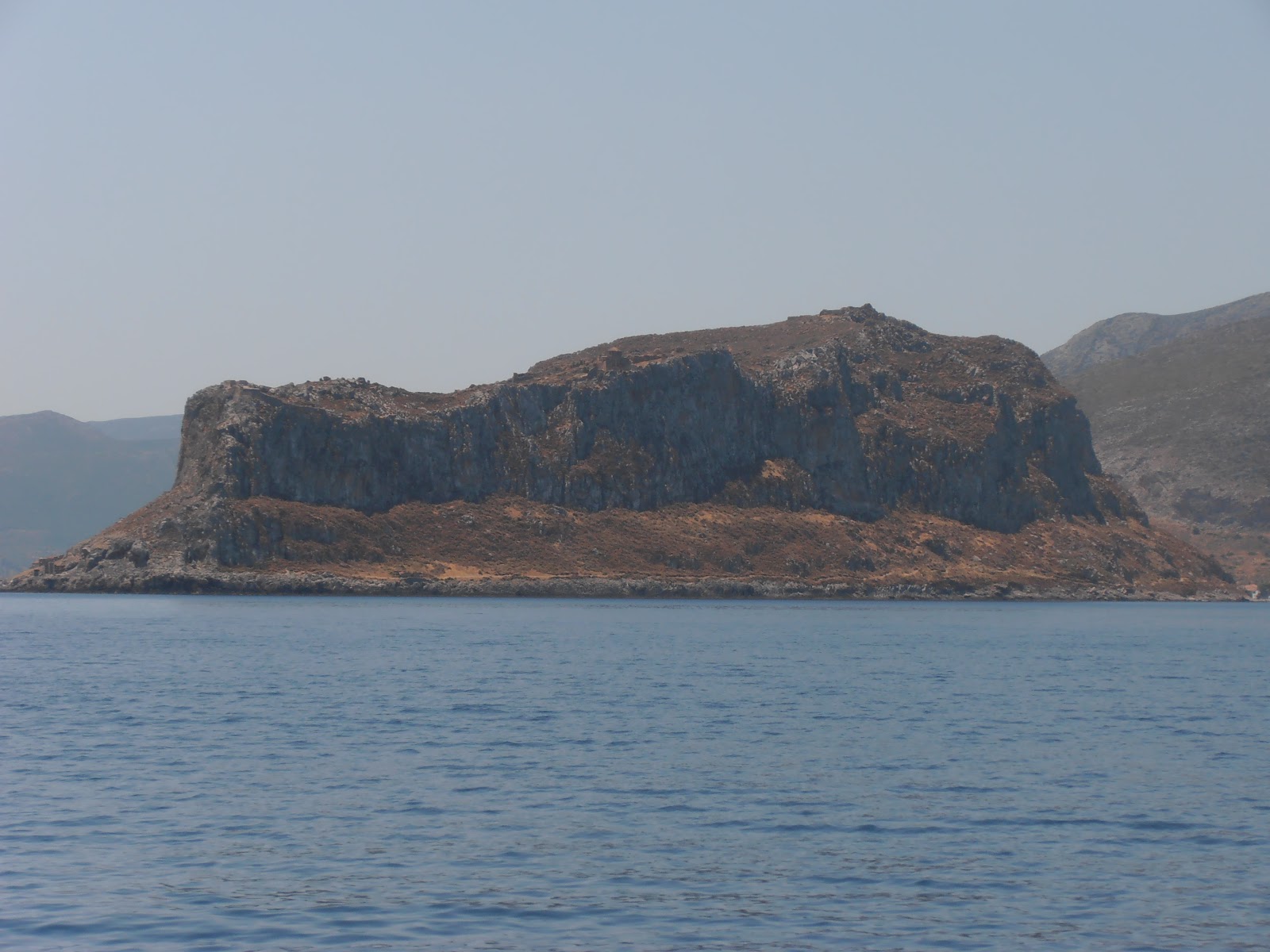
Impressive Monemvasia Island is known as the “Gibraltar of Greece”

Several churches here were built in the 12th century and still in-use, although during the long period of Turkish occupation they were used as mosques. Now many formerly ruined houses in the narrow cobbled lanes have been rebuilt as holiday homes, small hotels, tavernas and shops, while retaining all the former charm and character.
This was a substantial town of 40,000 people during the Middle Ages.
Part of the town’s violent history is that its Turkish inhabitants were massacred when they surrendered to the Greeks after a three month siege during the War of Independence.

Brian, Carol & Laurie with Envoy anchored stern-to the causeway to Monemvasia.

Medieval fortified village of Menemvasia

The romantic lanes of Monemvasia

Brian looking at local produce shop in Monemvasia

The church of Ayia Sofia on the island’s summit dates from the 12th century

Looking down on Monemvasia from the hilltop castle

We found this great little cove to moor our RIB while we explored Monemvasia

This impressive traditional sailing cruise ship anchored close-by at Monemvasia

We still encounter very few other cruisers, and mostly when we anchor there are only about four or five other boats around – mostly Greek, but also British, French, Italian, Dutch, Swedish & German. We haven’t seen and New Zealand, Australian or American boats for some time.
TECHNICAL
Nothing to report
LOG
Up to 7 July have spent 100 days aboard, and cruised 756 miles for 139 engine hours.


Saturday, July 14, 2012

CRUISING THE EASTERN PELOPONNISOS

The Peloponnisos is the southernmost mainland area of Greece. Strictly speaking it’s not an island, but it is separated from the rest of Greece by the Corinth Canal. This area is quite sizeable being roughly 350 miles from NE to NW. The famous areas of Sparta and Olympia are located here. The eastern side is on the Aegean Sea and the western side on the Ionian. On the southern side are three peninsulas, each about 24 miles long, forming two large gulfs. The tips of these peninsulas are known as the “Cape Horns of the Med”, due to strong winds and rough seas often encountered here but so far we’ve had only very light winds and smooth seas. The strong winds are very often katabatic winds coming down from the mountains that rise to 2,400m.
Brian and Carol arrived safely in Nafplio by bus from Athens.
The cruising guide said that Nafplio harbour had a faint smell of sewage, and it wasn’t wrong – the town sewage gets discharged into the harbour and the odour is very noticeable. Here we laid alongside a rough concrete jetty, which had old tyres fixed in position to act as effective buffers. These were needed as the harbour isn’t well protected from NW winds and had quite a slop.

Envoy lying alongside jetty in Nafplio

View of the Nafplio waterfront with castle walls in background

During our second day in Nafplio a catamaran was trying to berth alongside the jetty ahead of us, but came too close and hit our port for’ard stainless steel rubbing strake. No damage to us, but this was the second time in as many weeks that we’ve been hit by other vessels.
When visitors join us for more than a few days we report to the Port Police to get our Transit Log updated with our visitors’ name and passport details. This is very simple and involves filling out a few forms and paying a small fee of usually around 20 Euro, which includes a night’s stay in the harbour.
In Nafplio we also took on 600 litres of diesel at Euro 1.49 (about NZ$2.40) per litre. There is no fuelling berth, so the diesel is delivered by a small tanker. Although I’m not in favor of bio-diesel, this was in fact bio-diesel, but blended with our existing fuel the bio content will be minimal.

Brian, Carol and Laurie enjoying a beer in taverna in Porto Kheli

View of Porto Kheli taken from Envoy at anchor

View of Kiparissi taken from Envoy at anchor

Ieraka is a small, sleepy village in an inlet, completely hidden from seaward. Here we anchored in a depth of 5 metres and could see the anchor and chain on the seabed. Shortly after anchoring a large loggerhead turtle swam close by and looked at us curiously. Since then we’ve seen several more turtles up to about 1.5m long.

A loggerhead turtle swimming close to Envoy

Envoy at anchor in Ieraka (2)

Photo of Envoy at anchor in Ieraka shows the small harbour

A strange looking three wheel car we found in Ieraka

In Ieraka we met Nikos cruising from Piraeus to the Ionian on his distinctive converted 1945 coastal trader, looking rather like a pirate ship.

TECHNICAL
All going well and nothing to report, so let’s talk about Envoy’s main engine – a “Lugger”, made by Northern Lights Marine, Seattle, USA.
This text is largely borrowed from Robert Senter, commonly known as “Lugger Bob”.
The Lugger starts out as a John Deere industrial engine block (as in John Deere tractors), and then the specific marine parts are designed, engineered and installed at the Northern Lights Seattle factory. These parts include the wet exhaust manifold, turbocharger (where applicable), exhaust elbow, air intake system, after cooler (where applicable), cooling system surge tank, heat exchanger, seawater pump, auxiliary drives, gear oil cooler, front accessory drives, engine mount brackets, mounts and wiring harnesses.
The Lugger is quieter than a John Deere because its specific pieces are typically large, heavy, extremely overbuilt castings whereas John Deere marine engines are usually welded and fabricated lighter sheet steel parts. That gives John Deere a lighter, less expensive engine, which is a good thing, competitively speaking.
Luggers are not competitive in weight or price, but only in fuel efficiency and long term value. The only people who buy them are commercial operators who bet their lives and business on the extra durability ….... or, passage making cruisers who consider the additional cost a small price to pay for peace of mind when they are thousands of miles from land.
Although Envoy is a heavy boat, weighing over 30 tonne, she is round bilge full-displacement, and easily driven. Our Lugger engine is rated at 143 hp, but mostly we’re cruising along at about 1,500 rpm, using much less than 143 hp, and consequently running very economically. Your rpm and speed has a huge effect on fuel consumption and cruising range – for example at 6 knots Envoy uses about 1.08 USG/hr, and has a range of about 6,100 miles, while at 8 knots she uses about 4.05 USG/hr reducing her range to about 2,200 miles. So there’s really no point in trying to go 2 knots faster when burning nearly four times as much diesel.
LOG
Up to 5 July have spent 97 days aboard, and cruised 720 miles for 132 engine hours.