Wednesday, January 28, 2015

LOOKING BACK ON SIX YEARS OF LIVING THE DREAM - CRUISING THE MED (Part 3 of 5)

Envoy is currently in Lefkas Marina, Greece, until April,

This is part three of a five part summary of Envoy’s six years Med cruising to date. The full article will shortly be published in Pacific Motor Yacht magazine.

The Ionian Sea
The Ionian Sea incorporates the east coast of Sicily (mentioned last posting), the east coast of the “boot” of Italy, the south coast of Albania, the west coast of Greece and the many Ionian Islands. The Gulf of Corinth would also logically be included here.
Time required – one season.

Map of Greek section of Ionian Sea

The Ionian's Italian coastline has little to offer the cruiser with few anchorages and long distances between marinas

Envoy alongside wharf at Chiro, Italian boot

However Gallipoli, in the Gulf of Taranto, is an excellent stopover with its stunning medieval Old Town, and the marina at Santa Maria di Leuca is a safe and strategic stopover when cruising to or from Corfu or her nearby islands.

Gallipoli has a great Old Town

Albania is safe, economical and fascinating to visit with friendly curious people and stunning inland places to visit. Importantly it is also one of the few remaining non-EU countries in the area, and if your boat is not “VAT-paid” you will need to leave the EU once in every 18 month period to avoid paying it.

Envoy (left) alongside Sarande jetty, Albania

The main Ionian islands of Corfu, Paxoi, Levkas, Meganisi, Ithaca, Cephalonia and Zakinthos are all fabulous offering good sheltered anchorages and interesting places ashore to visit.

Envoy anchored in Assos, Cephalonia

The adjacent mainland Greek coast also has some great places to visit such as Mourtos, Parga, Preveza and the Gulf of Amvrakia.
The Gulf of Corinth offers an excellent route to the Aegean via the Corinth Canal and on the way make sure you stop at historic Navpaktos and at Itea for an inland visit to ancient Delphi, regarded in ancient times as the centre of the world.

The medieval walled port of Navpaktos

Ruins of Dephi's gymnasium

The alternate route to the Aegean is slightly longer, but our preferred one of cruising south and then east around the Peloponnisos taking in Pilos, Methoni, Koroni, and the island of Kithera along the way. Interesting inland trips can be made to ancient Olympia and to several historic mountain villages in the area where Spartans formerly roamed.

The Adriatic Sea
The Adriatic Sea incorporates the north-east coast of mainland Italy, Slovenia, Croatia, the islands off Croatia, Montenegro and the north coast of Albania.
Time required – at least one season.

Albania is great to visit as already mentioned. Montenegro is also very interesting and can be visited in about two weeks due to its short coastline. Here a cruiser can purchase very cheap tax-free fuel immediately prior to departure.

Stunning Kotor in Montenegro

Croatia will require the longest period of time to explore and can be expensive as many anchorages have been converted to mooring areas where a charge is made to moor or anchor. Nevertheless Croatia is stunning as are her offshore islands; 79 of them have an area over one square kilometre with the most popular ones being Korcula. Hvar, Brac, Vis, Kornati, Cres and Krk. Don’t miss cruising up the Krka River inland waterway to Skradin and the Krka National Park.

Envoy in great anchorage of Zaklopalika in Croatia

Krka National Park, Croatia

Croatia's Konati Islands offer many anchorages

Kortula is one of Croatia's highlights

In the Italian Adriatic a visit to Venice is a must and offers a choice of several marinas. We plan to visit there during 2015.
To the south, the east coast of Italy has little to offer with very few anchorages and the ports mainly industrial in nature. ………… continued next posting

Sunday, January 11, 2015

LOOKING BACK ON SIX YEARS OF LIVING THE DREAM - CRUISING THE MED (Part 2 of 5)

Envoy is currently in Lefkas marina, Greece until April.
This is part two of a five part summary of Envoy’s six years Med cruising to date. The full article will shortly be published in Pacific Motor Yacht magazine.

THE MED’S STUNNING CRUISING AREAS
The Med consists of eight major seas and we’ve extensively cruised four of them on the Med’s eastern side. Although there are many great places to see along the coast it’s important to realise there are many other stunning places to see inland, reached by bus, train or rental car after leaving your boat safely in a marina. Our great places won’t necessarily be yours, so keep an open mind, do your research, talk to other cruisers and explore.
There is also a question of cruising philosophy – do you want to cover a lot of area quickly to get a flavour of each, or do you want to immerse yourself in each area and really experience it? We prefer the latter option and our time recommendations for each area are based on this, including some allowance for cruising to that area from your Med home port.
It’s not within the scope of this article to describe the destinations, and for this you should refer to the cruising guides published by Imray.

The Tyrrhenian Sea incorporates the east coasts of Corsica and Sardinia, the central and south-west coasts of mainland Italy and the north coast of Sicily. In practice most cruisers would include the whole of Corsica (French), Sardinia (Italian) and Sicily (Italian) in their plans.
Time required – at least one season.

The Tyrrhenian Sea is a superb cruising area

Although we haven’t yet cruised in Corsica or Sardinia they are said to be stunning with excellent anchorages.
Cruising down the west coast of Italy there is little of great interest except the islands of Ponza, Ischia and Capri (which are extremely crowded in summer). Naples is far from idyllic but should be visited to see the ruins of Pompeii. Most cruisers would consider an inland trip to Rome a must, possibly from the marina at Ostia. We suggest bypassing Italy’s mainland coast south of Scario and heading directly across to Stromboli, the active volcanic island which is the part of the Aeolian Islands group. Bear in mind Stromboli has no marinas or all weather anchorages.

The Aeolian Islands are stunning and deserve two weeks

Allow a week or two to visit the Aeolian Islands of Salina, Lipari and Vulcano, all of which have both anchorages and marinas.

Envoy anchored off Gelso, Vulcano Island

The north coast of Sicily offers few anchorages sheltered from the prevailing northerly wind but Cefalu’s Porto Nuovo is great and reasonably sheltered with nearby Cefalu’s Old Town being particularly delightful.

Envoy anchored in Porto Nuovo

Sicily's Cefalu is one of our favourite towns

Further east, Castellamare is a truly atmospheric marina while nearby Trapani offers an excellent base to explore the stunning Egadi Islands of Favignana, Marettimo and Levanzo off Sicily’s north-east coast. 

A magnificent anchorage at Favignana Island

Sicily’s east coast has some stunning anchorages including historic Syracuse, while the south coast is also interesting making a circumnavigation worthwhile. From Sicily’s south coast many cruisers also make a side trip to Malta.

Waves breaking outside Siracuse harbour

Exploring inland Sicily reveals a treasure trove of sites like the Temple of Concord

Sicily has many amazing mountain villages, natural features and historic sites making some inland travel a must. ………… continued next posting


Monday, December 29, 2014

LOOKING BACK ON SIX YEARS OF LIVING THE DREAM - CRUISING THE MED
Envoy is currently in Lefkas marina for the Med winter.
This is part one of a five part summary of Envoy’s six years Med cruising to date. The full article will shortly be published in Pacific Motor Yacht magazine.

The Med surprises
With an area of 2.5 million square kilometres the Med is slightly larger than the Tasman Sea and twice as wide at 2,400 miles. From north to south it varies from just nine miles at the Strait of Gibraltar to 990 miles, and has an average depth of 1,500 metres with a greatest of 5,267 metres. It is surrounded by three continents - Europe, Asia and Africa and 22 countries having a total population of about 500 million with highly diverse cultures, languages, cuisines, standards of living; their histories representing the cradle of western civilisation. It has thousands of islands with nine having areas over 1,000 square kilometres; the largest, Sicily, is home to over five million. Contrary to perception the Med can get mighty rough. 

Beginnings
 In late 2004 under cloudless blue skies with a gentle breeze we are ghosting across the sparkling turquoise sea aboard my brother’s 12 metre yacht, Acrobat, cruising southern Turkey’s stunning Kekova Roads area. Shaded by the billowing genoa Diane and I relax on the foredeck, where the only sound is Acrobat’s bow slicing through the sea as she creates a small bow wave of white foam. Cooled by drops of spray, we inhale the ozone as we reflect on how much we’re enjoying our brief holiday; a tantalising combination of stable summer weather, fascinating ancient history brought to life by easily-accessible ruins, great anchorages and the unique and exotic Turkish culture. In one of those memorable moments Diane and I decide, “we should do this full time”, and then and there commence our planning to live aboard in the Med.

Castle ruins at Kekova

Looking down from castle across Kekova Roads

We had cruised extensively in New Zealand, but work commitments restricted our adventures to four weeks duration, and we’d always dreamed of enjoying great destinations until we tired of them rather than meeting timetables. We had adult children living overseas, no health issues, and wanted to cruise while circumstances permitted. Boating experience was no issue, having always worked well as a team on four power boats we’d owned during 30 years.
Most types of boat are suited to cruising the Med, but after two years of extensive research and planning we decide to buy a heavy displacement mono-hull passagemaker providing future options for long-range cruising, possibly back to New Zealand. We want to cruise comfortably, not “camp on the sea”, and our decision to buy a Nordhavn 46 (14 metre) is based on a combination of size, legendary passage-making capability, classic lines, pricing and comfortable accommodation for two couples.
When we purchase Envoy in Ostia, Italy, we are thrilled with her trans-Atlantic pedigree and that she is immaculate and fully-equipped, needing only consumable stores added to commence our new life.

Changing Envoy's sign writing in Ostia marina

Launching Envoy for our first time at Ostia marina

The Med cruising season
We typically stay in the Med for eight months each year, starting around early-April, when it can still be a little chilly and showery, through to mid-November. The Med generally has consistent warm stable weather during June to September with clear skies, little or no rain and winds rarely above Force 7. The hottest and busiest months are July and August when Europeans take their summer vacations. In the winter months it can be cold, often with snow on surrounding mountain areas and with more frequent gales. During this period most cruisers hibernate in marinas or return home. ………… continued next posting

Friday, December 19, 2014

WINTERISING ENVOY FOR OUR RETURN TO NZ SUMMER

Our last post before Xmas so Merry Christmas and a very Happy New Year. Next year we'll be finding new areas in the Greek Ionian to cruise as well as spending more time in Albania, central to northern Croatia, Venice and the east coast of Italy - so there will be lots of exciting things to read about.
Meanwhile we still have plenty of cruising matters to post.
Envoy is currently in Lefkas marina for the Med winter.
This posting is all technical.
Before leaving Envoy to return home to Auckland we do all of our normal lay-up procedures including running fresh water and then glycol through the generator, wing engine and all seawater cooled pumps. The main Lugger engine doesn’t need this as it’s cooled with a keel cooler, so no sea water is used.
The generator’s leaking sea water circulation pump, last re-built 2 years ago was stripped and new bearings, seals and impeller fitted. But on re-installation and testing it still leaked so it was removed again and the “shaft modified” - exactly how or why was lost in translation, but this has fixed it.
We replaced two below water level seacock hoses. These were both polyester yarn reinforced pvc hose and apart from the fact they were over eight years old, pvc is not recommended for use below the waterline. These have been replaced with new stainless steel wire reinforced pvc hoses which will be much stronger and which Sailand say are commonly used below waterline in Greece. I have some reservations about using any form of pvc (a long term problem is embrittlement caused by the pvc’s plasticiser leaching out) but for one of the seacocks the default position is off, and the other it is easily accessible.
We towed our large RHIB in to the marina so that it could be taken out of the water for a full service of the Yamaha outboard, service of faulty bilge pump and to get a new sounder transducer fitted.

Racor filter cartridge after a season’s use (left) and clean (right). We only need to change these annually

Envoy in the marina with her snug winter cover

We organised some jobs to be done while we’re back in New Zealand:
- The Lugger alternator rumbles when spun by hand, even though the unit was re-built last winter, so this will be checked. Sailand think the problem is with its shaft, not bearings
- The Lugger’s gearbox oil will be changed and suction strainer cleaned
- The Lugger’s prop shaft coupling and shaft alignment will be checked
- The Lugger’s two interchangeable Racor fuel filters will be removed, cleaned and have their drain seals replaced
- The wing engine has developed a little rust on the fuel pump and adjacent fuel lines so this will be cleaned up as well as checking the source of the corrosion which appears to be from small amounts of salt water dropping down onto it
- The wing engine’s mountings will be renewed
- The air cleaners and cooling hoses on all three engines will be checked
- The generator’s starter motor and solenoid will be serviced and its cooling system including the exhaust elbow will be cleaned and checked
- A hairline crack in the GRP base of the main shower will be repaired
- The electric windlass motor will be removed and checked
- Nikos of Ionian Safety now tells us (contrary to what he said in April) that he can certify our Halon-based engine room fire extinguisher, and will remove it for a thorough visual and weight check. Although Halon can no longer be used (for environmental reasons), Nikos believes it’s still the best system but Halon extinguishers can’t be refilled so eventually ours will have to be replaced
- The s/s wire strop that we use to lift our large RHIB (weighing about 320kg) out of the water is being renewed with a strop made from Spectra (ultra-strong plastic rope)

Saturday, December 13, 2014

MOSTLY ABOUT ENVOY'S AC POWER SYSTEM AND REFRIGERATION

Envoy is currently in Lefkas marina for the Med winter.
This posting is nearly all technical.
During this year’s cruising the main Lugger engine ran 346 hours and the Yanmar wing engine just 3.2 hours. Next year we’ll make a point of running the Yanmar for much longer periods, using it for passages on some calm days when the stabilisers are not needed (the stabilisers being driven from the Lugger).
Engines need to be used both regularly and for periods long enough to bring them up to normal working temperature to keep injectors and other components clean. Although Envoy only cruises at about 3.5 knots using the Yanmar, time is not an issue for us and most days our cruising distances are short.
Our biggest technical issue this year was the failure of our ancient Lugger-driven SeaPower 120 volt AC generator, which provided power for refrigeration anytime the Lugger was running (our AC refrigeration being powered only by 120 volts on board or 220 volts shorepower). The SeaPower was beyond repair and replacement would have cost about NZ$9,000, so we decided to cruise this year using the generator as our sole means of powering refrigeration while at sea (in fact very few vessels use engine-driven AC generators as most use inverters for low AC loads and generators for higher loads). This worked extremely well and interestingly we ran the generator for 334 hours, only 25 hours more than in 2013 and in fact 70 hours less than in 2012 - many less hours than we expected, so why?
1. Our cold plate, R12-based refrigerator and separate freezer are very efficient and typically only need to run about two hours per day – a little longer up to three hours in mid summer or with visitors aboard, and a little less – down to 90 minutes in cooler weather or with just two of us aboard.
2. It’s harder to keep the fridge cold than the freezer because the fridge is opened much more frequently. Many days the freezer isn't opened at all! Our freezer is rarely more than half-full of food so this year we regularly froze large bottles of water and put those in the refrigerator to help keep it cold, changing bottles around every couple of days.
3. This year we spent more time than usual in marinas on shorepower, particularly in parts of Sicily where safe anchorages were limited.
4. At anchor we generally run the generator for about 45 minutes in the morning and the same in the evening EVEN WHEN the SeaPower was working, so in reality we only need to run the generator for an additional half hour or so daily without the SeaPower.
5. We always have to run the generator when using the water maker and therefore run refrigeration at the same time. Water making takes several hours and this gives the refrigeration system temperatures a good chance to pull down.
So we now have no plans to change this system of using the generator to power refrigeration.

Tuesday, December 02, 2014

ENVOY'S LAST CRUISING DAYS OF 2014

Envoy is currently in Lefkas marina for the Med winter.
Although our 2014 cruising has come to an end we have plenty of interesting material for updates to our blog re Envoy and cruising for the foreseeable future until we return to Envoy.
In late October with rain and 25 knot winds forecast we cruise into the Lefkas marina having so far spent 202 days aboard and cruised 1,732 miles, sharing those times with family – Amy; John and Alice and Lily; Sharon and Doug and special friends Chris, and Doug and Mary. It’s always a great feeling to finish your cruise without incident (barring my foot being lacerated in Marina di Portorosa when a paving stone collapsed under me) and without any major technical issues with Envoy.
Although the sea is still 21d and we’ve been swimming right up to now, it’s definitely much cooler with daytime temperatures around 20d, periodic snow on the peaks of distant mainland mountains, and being too cold to sit outside after sunset.
Back in the marina we have plenty of time - nine days to organise leaving Envoy for the winter.
We’re surprised to find that our first full day back is a public holiday – “Ochi” day commemorating Greece’s refusal to surrender to Italy in 1940 during WW2. Lefkas only has a population of about 15,000 and we’re amazed to find many thousands of patriotic people celebrating.

Lefkas’s town band marching along the waterfront

Even the priests are out for the occasion

We’re amazed at the size of the crowds

Patriotic children wave their Greek flags

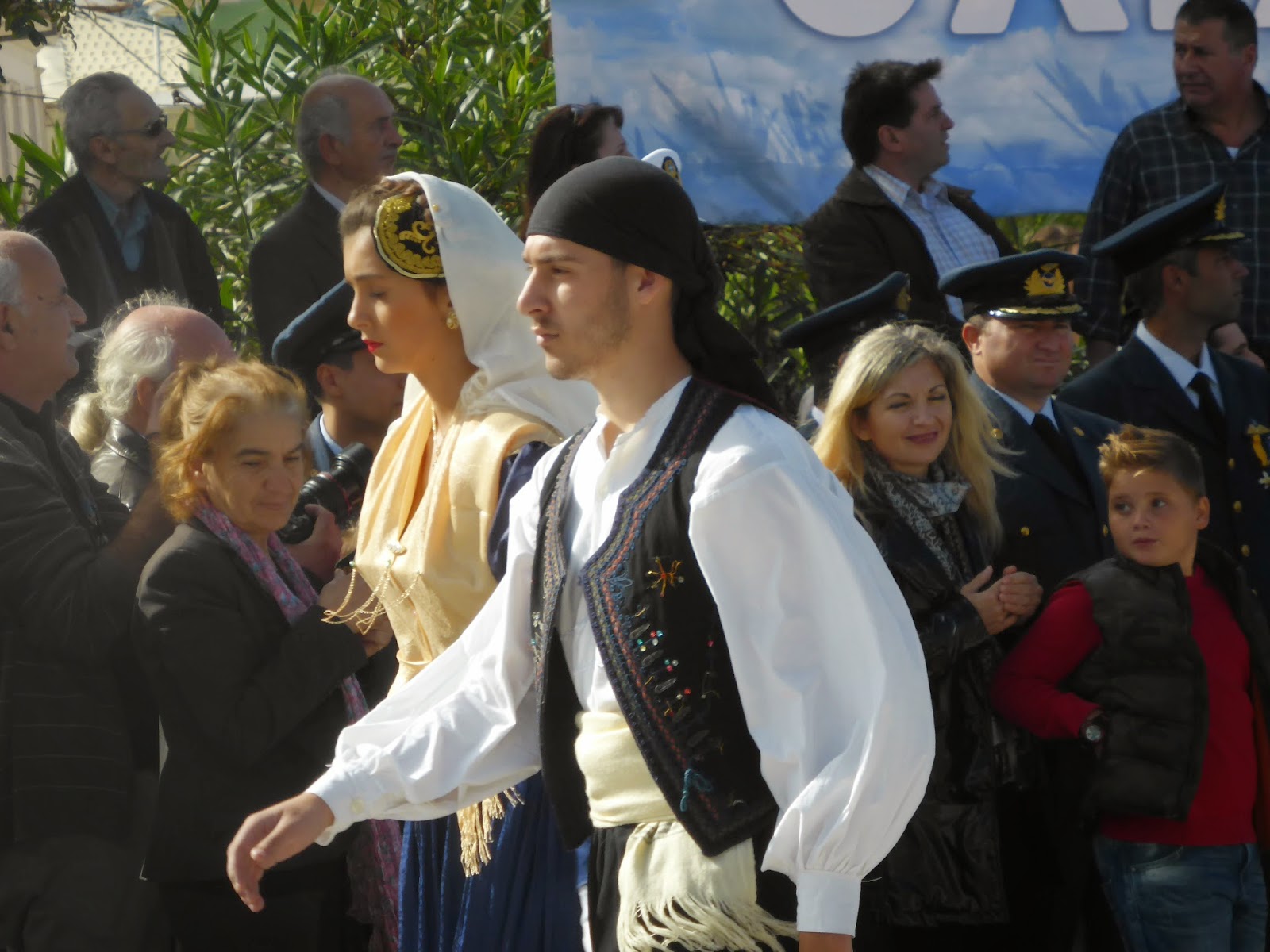
Girls march in traditional Greek costume, followed by the not-so-traditional

A pretty Greek girl marches with her handsome partner

We find the marina fees are unchanged from last year and pay 2,337 Euros (NZ$3,769) for 186 days averaging 12.56 Euros (NZ$20.40) per day. There are cheaper options available but we like this marina’s excellent shelter from winter storms, the technical infrastructure and the atmospheric town. Like last year Envoy is in the water, not on the hardstand and this is 30 per cent cheaper.

Map showing how the very sheltered Lefkas marina is reached off the Lefkas Canal (passing through salt marshes) making it immune from waves and surge

We meet with our agent, Yvonne, of A1 Yachting to arrange the necessary paperwork for Envoy’s stay during the winter. Our Transit Log is given to Customs for this period and Envoy is deemed to be in bond and exempt from the 18 month restriction on staying within the EU without paying VAT. Yvonne also advises good news that the Greek Cruising Tax has been temporarily suspended while the Government figures out what system it will use in future – for the last couple of years any cruising boat visiting Greek water for more than 90 days has been levied this tax.

TECHNICAL
We use a water filter when filling Envoy’s water tanks from the shore

This image shows the water filter housing (right) and its cartridge (left) after seven months use. The cartridge started life white and is now brown, proving that it’s definitely worth using to filter out excessive dirt and minerals present in town water supplies. Our water maker is powered by the generator so we load water from the shore whenever it’s available to reduce needing to use the generator for long periods. The water maker produces about 80 litres per hour, and including use of the washing machine our daily water usage averages about 60 litres, but with guests aboard this more than doubles. Envoy’s three water tanks hold a total of about 980 litres, normally supplemented with about 200 litres carried in plastic drums on deck, these drums also being used to bring water from the shore using one of the RHIBs.

Tuesday, November 25, 2014

ENVOY HEADS SOUTH IN THE IONIAN SEA

Envoy is currently in Lefkas marina for the Med winter.
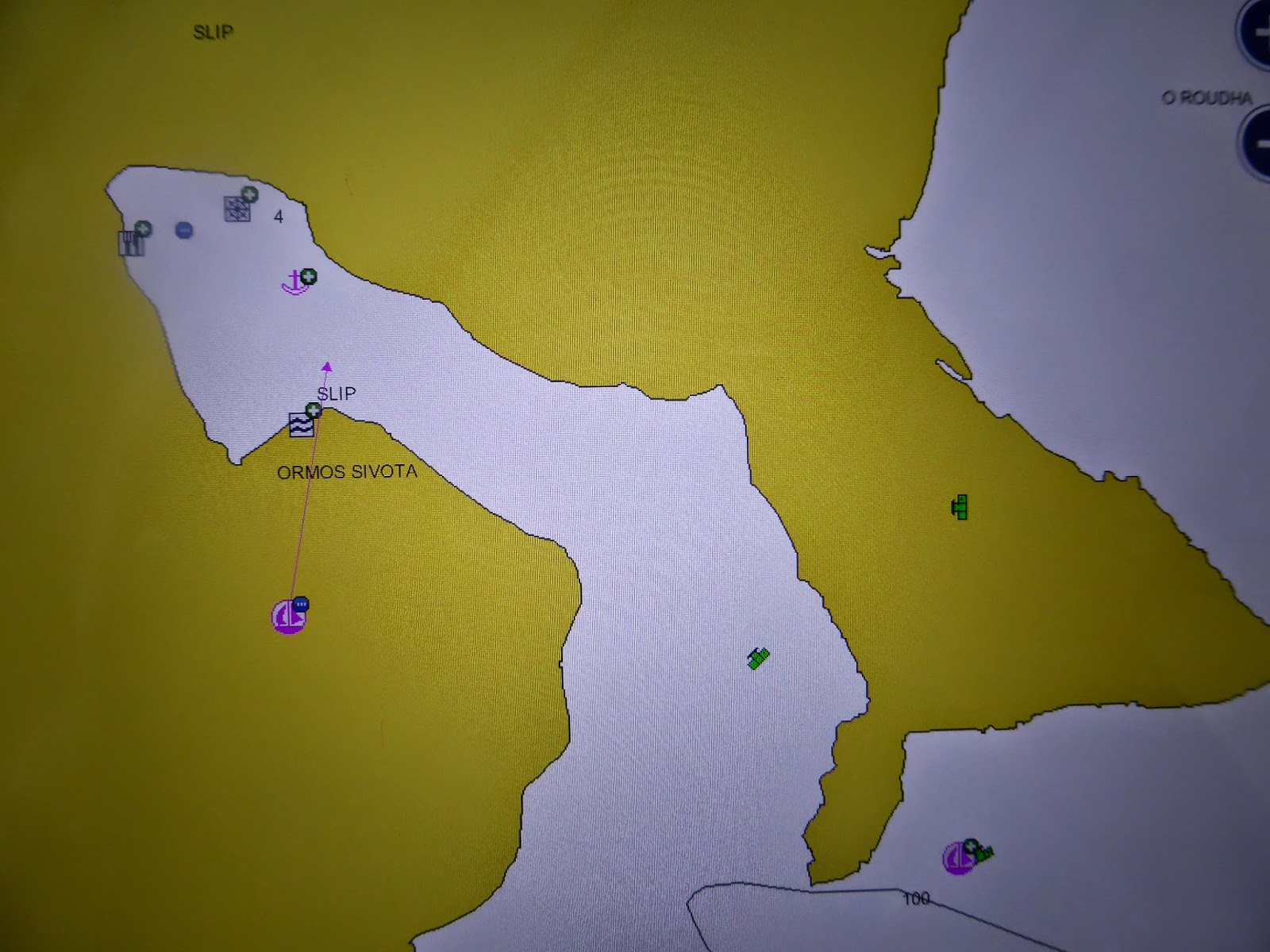
With our washing machine working well we finally leave Gouvia Marina and spend six days cruising south, stopping at some of our favourite anchorages – Mourtos on the mainland, Lakka on Paxoi Island, Ormos Vlikho and Sivota on Lefkas Island and Fiskardho on Cephalonia.
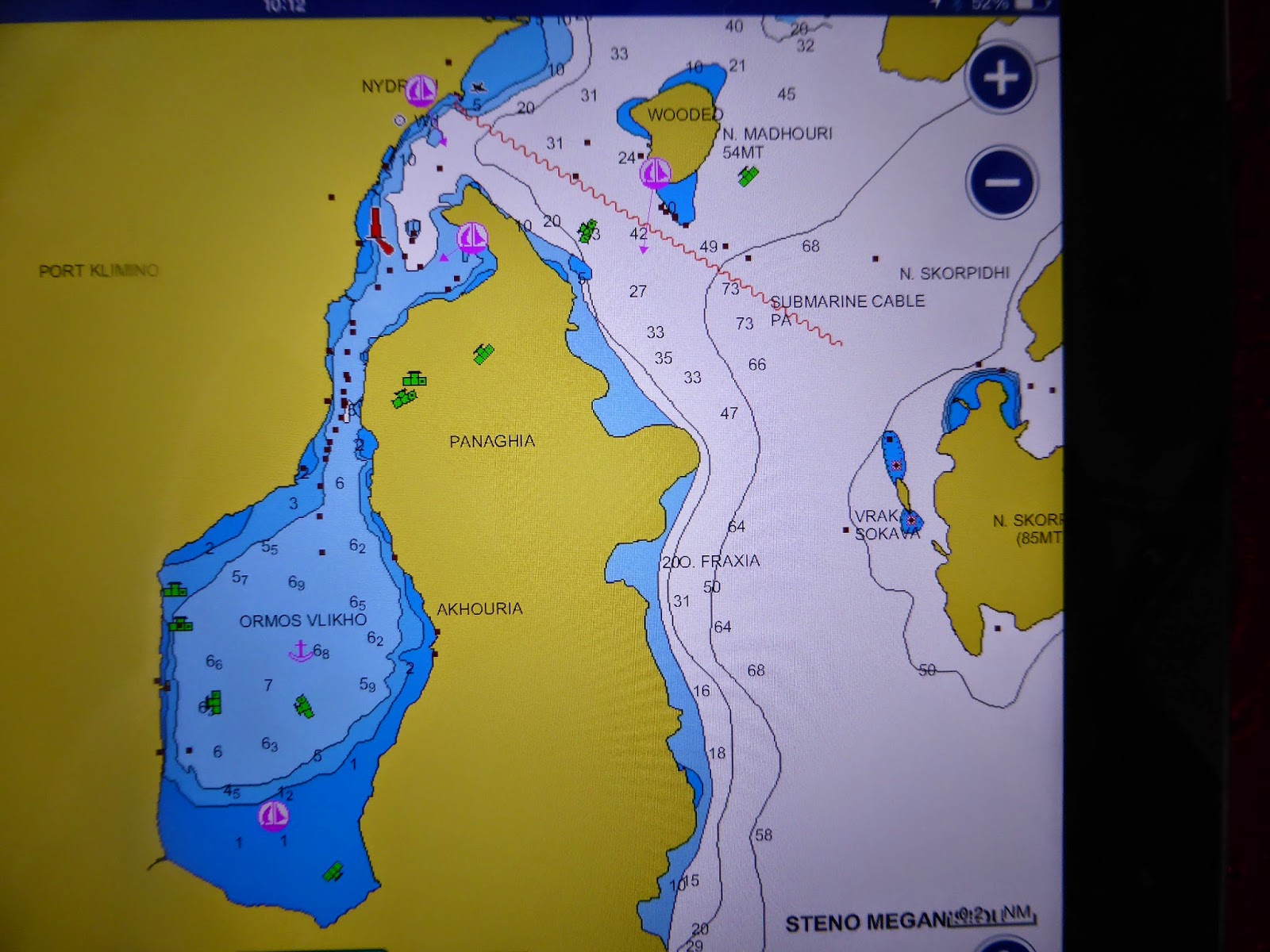
We’ve started including more maps on the Blog as we think boating people would like to see what type of shelter is offered by some of the places we mention. These anchorages are far more protected than we found in Sicily.

Map of Lakka

Sivota is a great bay with excellent shelter


Map of Sivota

Map of Fiskhardo

Then we get another bad forecast – heavy rain, thunderstorms and winds to 30 knots, so head into Ormos Vlikho to sit this out. Ormos Vlikho is a perfectly sheltered bay, a little under a mile wide, about seven metres deep with good holding and no swell. But it’s surrounded by high hills and subject to katabatic gusts – it is here that a 12 metre catamaran was capsized at anchor by strong winds several years ago. So we sit out three days of rain, thunderstorms and winds up to 34 knots.

Map of Ormos Vlikho

In the NW corner of Ormos Vlikho several wrecks are grounded - note heavy cloud cover

Our last couple of days spent anchored first in Port Atheni and next close to the mainland town of Palairos are stunning with sunny skies as we enjoy our last swims of the season.

Mainland village of Palairos

TECHNICAL Every morning I do various checks in the engine room including the level of water in the bilges. Normally the bilges are virtually dry so any water present indicates some sort of problem. While anchored in Sivota I find some water present in the aft bilge. Next check – is it fresh water, seawater or engine coolant? It’s seawater. Next check – is it coming forward from the lazarette? No – a towel placed over the lazarette drain to the engine room is still dry. Next check – remove the generator front insulation panel to expose the engine and inspect the seawater circulation pump. Yep that’s it – water leaking. As we only have a few days before we go into the marina for winter we can leave it until then, and meantime the generator should run OK with a slight water leak.
Our Toshiba laptop used solely for navigation isn’t always switching on correctly – it powers up OK and sometimes the screen illuminates immediately, while sometimes I have to try a few times for the screen to come on. Checking on the Internet I see it could possibly require a new inverter board or a new screen. I email a computer repair specialist back in Auckland, and they think it’s repairable so I’ll bring it back home. Toilet problems again - the guest head holding tank’s high level indicator light is not working again and the main head works fine if discharging into its holding tank, but won’t discharge directly overboard when its diverting valve is moved. Both of these issues we’ll resolve in Gouvia early next year.
While investigating the main head issue I find that the holding tank’s air vent tube has kinked, effectively blocking air from the holding tank. Any fuel tank, water tank or holding tank needs an air vent so that air can be displaced from the tank as it’s filled or sucked in as it’s emptied. To fix this requires the section of kinked tube to be cut out and replaced with an elbow fitting – a Lefkas marina winter job.

Sunday, November 16, 2014

DIANE DELIGHTED AS ENVOY'S WASHING MACHINE FINALLY GETS FIXED

Envoy is currently in Lefkas marina for the Med winter.
The Miele washing machine servicemen now decide to order a new pump from the US, so while waiting for that to arrive we head out again, this time anchoring in Avalaki, a bay on Corfu’s northern coast very close to the delightful village of Kassiopi.

Envoy anchored off Avalaki

Avalaki has a great beach, even though a bit stony

Kassiopi is overlooked by castle ruins

Enjoying breakfast in a taverna overlooking Kassiopi
These complete breakfasts only cost 5 Euros (NZ$8) - about half the typical price in NZ
 
We have a couple of past-use-by-date Walter Kidde USA A/B/C 1 kg fire extinguishers and decide to discharge these ashore for some practice. Although they’re in excellent condition and the contents gauges indicate they’re OK, this type of extinguisher with a plastic nozzle thread can’t be serviced and re-certified. As we know they’re at least 10 years old, for safety’s sake we’ve replaced them with new larger 2 kg extinguishers of a type that can be re-certified. The Kidde extinguishers are rated for a discharge time of 8-12 seconds, and although they last close to 12 seconds we’re surprised how short this time seems. We’re also surprised how much white “smoke” they discharge, and even in the open air this takes some time to dissipate – an interesting exercise.

These extinguishers with plastic nozzles can’t be tested and re-certified
Even though the gauge indicates they are OK, they needed replacement

Our fire extinguisher test

While anchored at Avalaki we finally we hear that our new washing machine pump has arrived and head back to Gouvia marina.

TECHNICAL
Back in the marina we get a sail maker, Qantum, to patch up some worn and damaged covers; every year some of our many covers need some maintenance. Qantum do a great job with a fast two day service.
Since our washing machine was removed it has been sitting in Envoy’s cockpit, and the Miele servicemen arrive to install the new pump.
Greek engineers are generally clever and forward thinking, and make a modification so that in future the pump can be removed just by pulling the machine forward in its space, without complete removal. In the new pump goes, then it takes three of us to maneuver the heavy machine down the stairs into its position, on goes the power and water and … it doesn’t work. But the good news is now we only need to pull the machine forward to remove the pump, which the engineers take back to the workshop.

Our washing machine pulled out of its cavity in Envoy's stairwell leading from the pilothouse to forward cabin

Next day they’re back again and tell me that although the new pump states that it’s 120 volt, it is in fact only for 24 volt and will have to be sent back. My face drops as we’ve already been waiting three weeks. But they go on to say that using the plumbing parts from a new Miele pump and the 120 volt motor from our old pump they’ve built a perfectly good pump. That goes in and tests fine, and it’s still fine after several washes.
Our electrician, Leon, is able to source a replacement hand held infra-red thermometer. This is useful to record the normal operating temperatures of engine room equipment such as oil filters, alternators, vee-belts, hydraulic and electric pumps, gearbox, propeller shaft housing etc so that I know their normal operating temperature range. Then during engine room checks I’m able to determine if anything appears to be running too hot – often an early warning sign of future problems.
Our Maxwell windlass works extremely well except that the anchor has never free-fallen correctly. It’s useful to free-fall an anchor (in a controlled way) to get it on the bottom quickly, especially in deep water. This also saves wear on the windlass motor. It’s over a year since I’d last dismantled and greased the above deck components of the windlass (eh Frank), and this time I’m far more liberal with grease on the clutch cones than previously. In addition I remove the pulpit anchor roller from its stainless steel shaft and grease that too. Now the anchor free-falls very easily, while after tightening the clutch it raises without any problems too. So the trick is – more grease required.