Thursday, February 27, 2014

THOUGHTS ON NAVIGATION AND HOW OUR iPAD HAS PROVEN A TREMENDOUS ASSET ABOARD ENVOY

Envoy is wintering in Lefkas Marina, Greece, and we are home in New Zealand, returning 23 March.
The Jan/Feb issue of Passagemaker magazine has an interesting article concerning navigation and paper charts. They posed a question to a panel of recognised cruising gurus: are paper charts redundant nowadays with the array of GPS-based navigation aids? Perhaps surprisingly the over-whelming response was no, and that paper charts should still be used in consultation with electronics.
Particular issues highlighted were:
- easier voyage planning when you can usually see the entire voyage on a large scale chart and keep it in view.
- the ability to record regular position checks on your chart and retain this information in the event of equipment failure, or in the event of abandoning ship.
- insurance against the possibility of a Murphy’s Law equipment failure at a time when precise navigational information is required (this happened to us when our anchor dragged during a night storm in Turkey).
- the importance of eye-balling your intended course while cruising close-to-shore or in hazardous areas (for example many close-to-shore rocks and shoals aren’t noted on either electronic or paper charts, and in some cases their positions aren’t precisely accurate - we have found this on numerous occasions.)
- it’s not necessary to have a complete set of charts, just sufficient to get by in event of equipment failure. It’s also considered impractical to regularly renew charts or to correct them.

Aboard Envoy we always keep a particularly sharp lookout close-to-shore (e.g. within 0.25nm), use charts as a back-up when we have them for that area, and use the Cruising Guides as our hard copy when we don’t have charts, as well as for all harbours and anchorages. Although Cruising Guides always have a disclaimer stating they are not suitable for navigation, their level of detail for harbours and anchorages is generally greater than charts provide, and in the Med you get coverage of a whole country in one guide, whereas it would be impractical and cost-prohibitive to have charts for all areas of the main Med countries. Most Cruising Guides also have annual online updates, and we print these out for consultation. While night cruising or during daytime when we are away from visual land references (and with Med visibility this can be as little as 10nm offshore) we note down our lat/long at least hourly.

iPads
We initially purchased our iPad solely in case of failure of our laptop-based C-Map navigation system, but have found it terrific to have aboard - it fulfills our original objective, is now loaded with other useful cruising apps, is easy to take ashore to Wi-Fi cafes, can take reasonable photos and has multiple other uses.
We already described the Marine Traffic app in detail – see posting 13 March.
Although there are about three very good navigation apps, after talking to users and doing a bit of research we opted for Navionics. We can use this anywhere around or even away from Envoy, and it’s not hard-wired to the boat, so in the event of any power problem we still have a navigation system (at least until the iPad battery runs out). IPad versions 3 and later also have inbuilt GPS so they’re not reliant on internet or phone connectivity.

Laurie planning tomorrow’s cruise from the comfort of Envoy’s saloon armchair

On top of that an iPad is a fraction of the cost of having a conventional chartplotter as a back-up system (we wouldn’t consider using a tablet-based app instead of a conventional chartplotter as our prime system). We’ve found Navionics provides excellent chart detail and graphics, in many cases better than the version of C-Map we’re using, and chart updates are free. We have found Navionics (like C-Map) doesn’t show every close-to shore rock or shoal so usual caution and non-total reliance on GPS is required.
It’s very easy to change the chart scale using pinching and spreading or on-screen + and – buttons.
Your vessel’s position is indicated on screen by an icon with your current heading shown as a red line and your speed displayed. If you start a track, the ground covered shows as a yellow line and your average and top speeds are displayed.

View of Navionics on iPad

Some negatives are Navionics doesn’t show your current heading numerically, and doesn’t interface with your autopilot in any way. Neither is your lat/long continuously displayed, but can be found by placing a cursor over the vessel icon. There is also a lack of comprehensive user instructions although Navionics have a comprehensive FAQ section on their website.
Navionics allows you to measure the distance between any two points on the chart, create and edit waypoints, plot a track, display distance and time to go to reach your destination and automatically calculate and plot a safe track with multiple waypoints after you enter start and destination points.
If you load Navionics with your typical cruising speed and fuel consumption data it will display your estimated fuel usage to destination.
Units and several aspects of the display can be customised, for example a user-selected depth is shaded lighter blue to make shallower water areas more conspicuous.
The screen has a moveable cursor that enables the user to ask questions about any chart feature positioned under the cursor, and you can place an icon on screen with your own descriptive text attached. You can read other cruisers’ public comments posted to the charts, and if you are on-line you can post your own public comments, display photos or videos that either you or other cruisers have added, and overlay Google Map to view land features.
There are numerous other features that would be of interest to the more computer-savvy than we, and we definitely recommend Navionics as an additional and backup navigation system (of course without replacing hard copy backup).

Wednesday, February 19, 2014

FIRST RECENT ACT OF PIRACY IN THE MED

In the first recent case of piracy in the Med that we’ve heard of, a 17m (54ft) Garcia trawler called Armageddon was hijacked by a group of four armed pirates off the Ilots des Moines, near Bonaficio, Corsica. The owner, his wife and a friend were initially tied up and then set adrift unharmed but shocked in a lifeboat, eventually reaching shore. So far the trawler hasn’t been found. Let’s hope this isn’t the start of a trend. French authorities don't dispute the facts but say this is not "piracy" because the crew were not held for ransom. They are saying this is a marine version of luxury car theft. There has been little media coverage of this incident.

Sunday, February 16, 2014

PREPARING ENVOY TO BE LEFT DURING WINTER

Envoy is wintering in Lefkas Marina, Greece, and we are home in New Zealand, returning March – just four weeks to go.
After leaving Envoy we made the five hour bus trip to Athens to catch our flight home. This was our first time staying in Athens and it was interesting there was little sign of any economic doom and gloom in the downtown area of Plaka, and shops, bars and cafes were full of people. Athens is amazing and we enjoyed climbing to the summit of the Acropolis to visit the Parthenon, viewing priceless friezes from the Parthenon in the Acropolis museum, seeing the Parliament guarded by soldiers in traditional garb, and visiting several ruined temples as well as just soaking up some great local atmosphere. We saw no sign of any protests or demonstrations and local people told us that the occasional protests are largely peaceful and greatly exaggerated by foreign media.

Soldier in traditional uniform guards Parliament Building

Laurie with Greek guard

Changing the Guard

The Parthenon atop the Acropolis - I was last here with my parents in 1960

 TECHNICAL
Our last two postings mentioned special year-end technical projects. This posting details the numerous routine winterising measures we take to increase Envoy’s safety during our absence and reduce maintenance upon our return - only technical aficionados are likely to be interested in reading on about these details.
Each year we leave Envoy for about four months of Med winter and arrange someone to regularly check on Envoy, particularly following any severe weather. They also periodically charge our battery banks and run our dehumidifier. Before leaving Envoy it takes about a week to complete the process and we always think it’s much more fun getting Envoy ready to cruise at the beginning of the season.
- seacocks - we close, except for bilge pump, sink and shower outlets.
- water maker - we pickle with storage chemicals to protect the high pressure membrane.
- engines and pumps - it’s not considered good practice to run diesel engines during winter layovers because they don’t reach their correct operating temperature. We flush the engines and all seawater pumps with fresh water for 10-15 minutes and then run glycol into their systems. This takes about three hours including genset, wing engine, two aircons, refrigeration, seawater wash down and Naiad stabilisers.
Engines must not be run with pressurised water directly from the supply, so we connect a hose to the strainers and adjust the water flow as required.
- engine master switches - we turn off.
- engine oil - unless it’s near new we change it along with oil filters for Lugger, genset and wing. We briefly run the engines on new oil to circulate it.
- drive belts - we slacken the tension and on return remove them to check condition. Many we replace annually regardless of condition.
- engine room and lazarette - we liberally spray everywhere with CRC Longlife, avoiding vee-belts and pulleys.
- main engine exhaust - we clean the stainless steel and fit its winter cover to keep out moisture.
- engine water pump impellors - we leave the genset and wing impellors in place and replace them on return. - start and house battery banks - we isolate them, leave fully-charged and arrange for monthly charging.
- dry cell batteries - we remove from all equipment.
- main breaker panel - we spray its interior with contact cleaner. On return we spray again and tighten all terminals.
- fuel tank, engine oil and coolant levels - we record these so that on return we can check for leaks.
- iron fuel tanks - we spray their tops with WD40 to reduce corrosion. We fill the tanks to 75-85% with conditioner added. Any unpolished fuel is processed through our polishing system to remove any water and microbes.
- engine fuel filters - we leave the old ones in place and replace them on our return (because immersion in fuel effects the lifetime of filters).
- fuel tank breathers - some like to block these off with masking tape to prevent the ingress of moisture. We prefer to let the tanks breathe.
- heads - we drain our holding tanks and fill them with fresh water, and leave fresh water in the bowls to keep seals moist.
- refrigerator and freezer - we empty and clean them and leave their doors open with gaskets not touching anything to avoid deformation.
 - washing machine - we leave the door open with its gasket not touching anything as above.
- galley sink waste disposer - we run plenty of water through to clean it thoroughly.
- sinks - we clean and leave plugs in to stop water vapour coming into the boat.
- mosquito nets on doors - we spray zips with silicone lubricant, spread the lubricant out using the zips, remove the nets and store below.
- interior timber - we apply a coat of our usual timber polish.
 - exterior timber - we ensure it’s all free of salt.
- navigation instruments, radios etc - we clean and fit plastic covers.
- bow thruster and windlass - we turn master power switches off and strip, check and grease the above deck areas of the windlass as well as electrical connections. Fit windlass cover.
- anchor chain - we wash with fresh water when retrieving it for the last time and check its condition in case re-galvanising is needed. Each year we turn the chain end for end to even its wear.
- fresh water tanks - we fill and add chlorine bleach to each tank.
- fresh water manifold and taps and showers - we leave turned off.
- hinges for doors and cupboards - we wipe with oil.
- locks and padlocks - we lubricate with light oil.
- stainless steel - we was exterior s/s with fresh water to remove salt. Any corrosion is removed with metal polish, then we protect the s/s with WD40.
- BBQ - we clean it (takes ages!) and stow below.
- large RHIB – we remove the seats, wash and dry them and store below. We leave the fuel tank at a low level as petrol degrades over time. We remove the battery and take it ashore for regular charging.
- small RHIB - we clean and store under cover on our foredeck.
- outboard engines - we add fuel stabiliser to the petrol and run it through the system, flush the engines with fresh water (not done during the year when using daily), and spray them with WD40. The small Honda is stored below.
- cockpit shower hose and seawater wash down hose - we drain the water out to avoid algae growth and store below.
- boat hooks - we clean and spray with WD40 to prevent seizure.
- bilge pumps - we leave on.
- mattresses - we store upright to avoid mildew.
- saloon chairs - we fit their protective covers on.
- ventilation - we leave all drawers, cupboards and doors slightly open to allow air circulation as well as leaving one saloon engine room hatch off for the same reason.
- lpg bottles and fittings - we turn off and spray with WD40.
- deck storage boxes - we secure with padlocks.
- boom winch controls - we remove and stow the remote sensor box, spray the winches and cables with WD40 and wrap them in plastic film to protect them from damp.
 - flags - we remove and store inside.
- cockpit chairs - we clean and store inside.
- cockpit sun shade - we remove, clean and stow below.
- flares - we check expiry dates and if needed replace on return.
- fire extinguishers - we visually check each year and get them professionally tested every 5 years.
- storage cover - we cover the entire boat ensuring full protection from the elements - takes most of a day.
Thank goodness we don't have sails to wash, dry, fold and stow.
If you’ve read this far you deserve a medal!

Wednesday, February 12, 2014

LEFKADA'S SANTA MAURA CASTLE AND ENVOY WINTER PROJECTS

Envoy is wintering in Lefkas Marina, Greece, and we’re home in New Zealand returning March.
The canal adjacent to Lefkas marina has a long history, the original one built by the Corinthians around
700 BC. Being of great strategic importance it was protected by several castles and we took some time away from working on Envoy to visit the Santa Maura Castle protecting the canal’s northern approaches. Workmen were busily clearing and burning scrub within the castle walls, and the smoke haze and smell provided an eerie authentic atmosphere to the scene.
Looking down on the castle’s interior from the ramparts we were able to visualise an impression of how the castle may have originally functioned - supplies being moved in carts, guards checking people entering through the sturdy gates, the din of blacksmiths and the aroma of baking bread. There were so many old cannons lying around that many haven’t even been placed on display. Even one of these would qualify as a treasure in New Zealand.

Ruins of buildings inside Santa Maura Castle

Prison cell inside Santa Maura Castle

Narrow and shallow northern approaches to Lefkas Canal viewed from castle walls

Cannon with maker’s name clearly visible

Discarded cannons in castle car park

Ruins of bridge across the moat to main entrance

TECHNICAL
Great news is that our leaking diesel tank has been fixed and is now partly filled with 700 litres of diesel. The Sailand engineers had to cut away a section of the tank to give internal access, then welded a large plate over the area of the leak, and closed the hole in the tank with a welded patch.

Continuing from last blog with details of non-routine technical year-end projects:
Master Head: was not activating its supply of fresh water upon flushing. This was an easy fix – just a failed plug-in wiring connection to the solenoid which starts the fresh water pump.
Bilge pump: our back-up bilge pump has been working on manual but not automatic, and I wasn’t happy to leave Envoy in the water for the winter with this situation. The pump was removed and found to have a faulty water level sensor, which has been replaced.
Lugger engine injectors: although the Lugger has been running fine we decided to check the injectors for the first time since new ones were fitted in 2004. On removal they appeared to be quite carbonized and when checked by a specialist shop, were found to all need replacing. I guess that’s not bad for nine years.
Lugger engine valve clearances: again these have not been checked since 2004, but were found to need only very slight adjustment.
Lugger engine starter motor and solenoid: these had not been serviced since 2004 so we decided to get them checked. There hasn’t been any particular problem except that very occasionally the engine doesn’t start with the first turn of the key. I suspected this was a sticking solenoid. The motor was found to be in good condition and only needed a clean. The solenoid was also stripped and cleaned, and hopefully won’t stick any more.
Lugger engine cooling system hoses: the two main hoses were replaced last year, but there are two small hoses (about 100mm long) which haven’t been removed and checked for at least seven years, partly as they’re very difficult to access. Sailand checked them and are satisfied they’re OK.
Lugger engine diesel leaks: one slight leak was fixed from a fuel pipe coming from the injector pump. Our lift pump had a slight leak and was replaced with a new one.
Portholes: One of our bedroom portholes has been leaking in heavy spray or wind-driven rain. Sailand are going to re-silicone the exterior where the housing meets the hull and replace the rubber seals on the inside of the closing section. The closing tension is adjustable using allan screws so that wear on the seals can be compensated for.
Next post will detail the more routine winterisation technical topics.

Wednesday, February 05, 2014

ENVOY IN LEFKAS MARINA FOR WINTER

Envoy is currently wintering in Lefkas Marina, Greece, and we are home in New Zealand, returning March. Lefkas Marina is very sheltered and runs off a canal not the open sea, so isn’t subject to surge that many other marinas are prone to. Envoy is moored in an excellent position stern-to a smooth concrete jetty and not a floating pontoon. This is great because in severe storms floating pontoons can come adrift and cause damage to boats moored to them. Lefkas town, just minutes walk away, is delightful and the area has a reasonable infrastructure of shops and technical resources, including the company Sailand that we use to assist us. The marina’s hardstand area is full so this year is the first time we’re leaving Envoy in the water during winter, making our usual routine is a bit different and much simpler. Staying in the water is also 30% cheaper and the marina’s cost is what we consider a reasonable 12.40 Euros (NZ$20.40) per day including power and water. We will have to pay additional for hauling out in March for washing, antifouling and underwater maintenance. Fortunately our full storage cover can also still be used as its lashings are above waterline level. There are big advantages when you can cruise and then return to the same marina, for example some equipment we don’t need all the time can be left ashore (like our bulky winter storage cover).

Envoy in Lefkas Marina - it's best to be moored to concrete, not floating pontoons

TECHNICAL We’ve recently started using an in-line water filter when refilling water from the dock to reduce the chance of microbial growth in our water tanks. We’ve noticed that we never get any growth in plastic containers stored on deck filled with water from the water maker because it’s so pure, but sometimes we see a bit of green slime start to appear in containers filled with dock water. Often we add a little chlorine bleach to dock water to kill any microbial matter as well. Hopefully the filter will eliminate algae in dock water supplies.

Laurie with in-line water filter

Apart from our usual routine winterising jobs (which will be detailed in a forthcoming post) the projects we tackled were:
Leaking diesel tank: the iron tank had been filled with old anchor chain to act as ballast to keep Envoy’s trim, so the first task was to take this out.

Laurie behind huge pile of anchor chain ballast removed from leaking fuel tank

While we’re away Sailand are going to weld a patch on the area of the leak and reinforce this with a section of angle iron. Then they’ll progressively fill the tank with diesel to check that it no longer leaks.
Seapower generator: after being reconditioned in Croatia and running well for only 193 hours this has been working only intermittently for the last few weeks. I imagined there would be some minor fault like a bad wiring connection, but it turned out the “reconditioning” had been done very poorly using brushes which didn’t fit correctly and Chinese-made bearings which were already starting to rumble. The cause of the intermittent running was a temperature sensing wire that had been incorrectly installed and was sometimes rubbing on the casing during operation causing the unit to incorrectly sense an overheat condition.

To be continued next posting.

Saturday, January 04, 2014

STUNNING VILLAGE OF ASSOS DURING IONIAN “INDIAN” SUMMER

Happy New Year for 2014. The Blog will now get back to more regular postings.
Envoy is currently wintering in Lefkas Marina, Greece, and we are home in New Zealand.
On Kefalonia’s wild west coast is the stunning village of Assos with its tiny harbour barely 200 metres by 100 metres. Overlooking the harbour are the ruins of a huge Venetian Fortress, dating from 1593, with impregnable walls totaling 2km long making it one of Greece’s largest. Originally built for protection against Turks and pirates the fortress became a seat of local power until it eventually became a prison. It was used as such by the Germans during WW11, but eventually closed in 1953 after a devastating earthquake, although people continued to live there until the late 1960s.

Envoy anchored in Assos Harbour

The Venetian fortress overlooking Envoy anchored in Assos

Inside the fortress walls is a huge area of fertile land

People lived in the castle until the late 1960s.
During the earthquake much of Assos was badly damaged, but later restored with financial aid from the city of Paris.

Many temporary dwellings built from corrugated iron after the 1953 earthquake still remain

Some of the buildings were too badly damaged and remain derelict

Assos is normally not easy to visit as the tiny harbour opens to the prevailing NW wind, but we spent
three great nights there with an Indian Summer of very light winds and temperatures in the mid 20s.
 
We saw this strange-looking 3-wheeler in Assos

After leaving Assos we cruised around Lefkas Island area again visiting places already mentioned in previous blogs. It was sad to visit some of these with most shops and tavernas now closed for winter – as Diane said it felt like we were the last ones leaving a party.
Wandering around the village of Nidri in Lefkas Island we noticed a billboard advertising a full fish dinner for two including salad and wine for 20 Euro (about NZ$33 or $16.50 each). Again this is less than half we’d expect to pay back home.

Taverna billboard in Nidri, Lefkas Island

The great weather continued, then on the 4 November we approached Lekas Marina with rain and thunderstorms – I think we timed that right. As we entered the marina I thought (as I do each year) what a great cruising year it’s been; fantastic times with visiting family and friends, two new countries visited (Montenegro and Croatia), 25 weeks on the boat since leaving the marina in April, and a total of 1,946 miles cruised with no accidents, injuries or damage to Envoy. Sure there’s been some technical problems along the way but hey – that’s boating.

TECHNICAL One evening I started the generator then turned the switch which diverts 115V AC current from the generator to Envoy’s power system, and the switch came away broken in my hand. I unsuccessfully tried some temporary fixes, but as were under three hours from Lefkas Marina we headed back there for an electrician to look at. He fixed the switch very quickly, but then we couldn’t get 115V power from any source – Lugger’s Seapower, genset or shorepower. After about half an hour of further checks I noticed the electrician had been fiddling with some switches on our Breaker Panel and left one in the wrong position. As soon as I corrected that, all was OK again.

Envoy’s main Breaker Panel is complex

Envoy’s Lugger engine has a dry exhaust with a conventional muffler. Mufflers are a wear item eventually prone to internal corrosion from moisture and exhaust gases, so I decided to check its condition for the first time in the seven years we’ve owned Envoy. The muffler is heavily heat-insulated, and it’s a major job to remove and then correctly replace all the heat insulation, so I decided to follow advice from the owner of N46 StormHaven and use our infra-red pyrometer to check for any hot spots (which would indicate a problem with the muffler in that area). The muffler measures about 390mm high, 350mm long, and 160mm wide so I marked out 35 check spots on the muffler’s insulation. The result was a low of 153dF (67dC) and a high of 214dF (101dC), giving a range of 61dF (16dC). This all seemed OK to me with no obvious hot spots. Higher temps tended to be closest to the exhaust pipe’s inlet and outlet and at the upper end of the muffler. Where the exhaust exits the muffler un-insulated its temp is 260dF (127dC).

We’ve had further instances of the Seapower 115V Lugger-driven generator stopping during use or not starting up when the engine was started. This will have to be fixed at Lefkas Marina.

ENVOY LOG as at 22 October, 189 days spend aboard and 1,836 miles cruised for 360 engine hours.

OBITUARY – BRIAN RESTIEAUX

It’s with great sadness I mention the passing of our very special and closest of friends Brian Restieaux.
Since we met through boating in 1984 we’ve shared many boating holidays and adventures in New Zealand including the co-ownership of a 12 metre power boat, Rapport. That name was chosen as it perfectly symbolised our relationship. Brian and his loving partner Carol did three cruises aboard Envoy with us in Turkey and Greece, including Crete and were due to join us in Croatia in July. But while in Australia on the way to meet us Brian fell ill and had to return home. He passed away peacefully in Auckland Hospital on 20 December. We will always remember Brian for his loyal and sincere friendship, his wicked sense of fun and his laconic sense of humour.
Brian, you’re leaving a big gap in our lives - rest in peace until we meet again in that final cruising ground.

Laurie and Brian at Mistras castle in Greece, 2012
 

Wednesday, December 04, 2013

TIGHT SPRINGS AND LOOSE BREASTS

Envoy is currently wintering in Lefkas Marina, Greece, and we are home in New Zealand.
With a forecast of Force 7-8 NW winds, thunderstorms and very rough seas we moored quayside in Kefalonia’s Ay Eufimia harbour together with Bruce and Lesley from Midi. There had been light easterlies for several days kicking up a slight swell in the harbour, so we deployed our port flopper stopper to reduce roll. This was the first time we’ve ever used one alongside a jetty.

Envoy alongside Ay Eufimia quay with flopper stopper deployed to reduce roll

We prepared for the blow laying our car tyres alongside the rough concrete wall to reduce wear on our fenders and deployed our lines. The correct way to moor a boat alongside is to have both spring lines and breast lines, and as our friend and seamanship guru Kevin O’Sullivan says, you need “tight springs and loose breasts”. The long spring lines stretch aft from the boat's bow to shore stern, and forward from the boat's stern to shore bow, and these should be as tight as possible. In fact the spring lines tend to keep the boat slightly off the jetty. They do stretch and loosen so need occasional re-adjustment for this reason as well as for tidal movement where applicable. The much shorter breast lines go from the boat's bow slightly forward of the bow to shore and from the boat's stern slightly aft of the stern to shore. The purpose of these is to prevent either bow or stern from pulling away too far from the jetty and they should be loose so that the spring lines take most of the strain and the breasts don’t “twang” with tension. These also require occasional adjustment. As we disembark from amidships we also use a third breast line amidships to secure Envoy while (dis)embarking.

Envoy’s car tyres secured quayside as protection from the rough concrete

Laurie holds a stainless steel flopper stopper

The NW wind arrived and stayed for two days but in the harbour only reached low 20 knots and blew across Envoy’s starboard now, keeping her off the quay.
While in Ay Eufimia the four of us had breakfast ashore - Full English Breakfast was 5 Euros each (about NZ$8.30) consisting of orange juice, coffee, toast, eggs, bacon, sausages, beans and tomatoes. Then we were thanked for our custom and given a free bottle of wine! This is under half what we pay at home.
When the weather settled we cruised south to Kefalonia Island’s capital – Argostoli.
Laurie with Envoy’s smaller RHIB on great sandy beach close to Argostoli

Here we found some great year-end sales and even I bought some clothes (a very rare event but their brand was “Admiral” so I couldn’t resist)
 
 Argostoli on Cephalonia

Laurie “modeling” his Admiral brand tracksuit and shoes

At Argostoli, Envoy and Midi parted company with Midi heading to Sicily for the winter. We decided to head up the west coast of Kefalonia to complete our first circumnavigation of this largest of the Ionian Islands. Normally the west coast of Kefalonia is particularly rough but current conditions were ideal.

TECHNICAL – nothing to report
ENVOY LOG as at 22 October, 189 days spend aboard and 1,836 miles cruised for 360 engine hours.

Wednesday, November 20, 2013

Travelling home to New Zealand

We are currently en route back to New Zealand, so will continue the blog from where we left off this coming weekend.

Tuesday, November 12, 2013

ENVOY CONTINUES CRUISING THE IONIAN ISLANDS

Envoy is currently wintering in Lefkas Marina, Greece.
Temporary problem loading images so text only this posting.
In early October it was starting to get cooler, and in Gouvia Marina we had some heavy rainfalls and needed to dig out our jeans and sweatshirts again - it was now getting too cold to sit outside after dark. It looked like our long summer had ended.
From Gouvia we cruised 22 miles down the east coast of Corfu in perfect conditions, being in the lee of a moderate westerly wind. We were heading back to Lakka Bay on Paxos Island, about seven miles south of Corfu. But this seven miles is highly exposed to 150 miles of fetch all the way to the Italian coast, and with a 20 knot westerly wind directly on our starboard beam we took a bit of a hammering from breaking two to three metre seas, spaced so closely together that our hydraulic stabilisers had trouble coping and our inclinometer showed Envoy rolling up to 20 degrees each side. Normally we don’t need to re-stow things like ornaments and fruit bowls under way as there is negligible movement, but this time the roll was sufficient to require Diane to do a quick re-stow.

You encounter some unusual sea conditions in the Med where the “roughness” of the sea seems out of proportion to both the wind speed and the size of waves, and this was one of those times.
After one night in Lakka we cruised 46 miles to Ormos Vlikho on Lefkas Island, to re-join our Kiwi friends, Bruce and Lesley, aboard their Catamaran, Midi.
Conditions in the Med are mostly great, but not always and we stayed in the well-sheltered Ormos Vlikho for five nights waiting for a front to pass over, during which we had gloomy grey skies, regular showers, mild thunder storms, but only light winds. Here the jellyfish-infested water is a bit grubby for swimming as well. We wondered if we’d done the right thing booking our return to New Zealand in six weeks time, but blue skies finally appeared again and temperatures went back into the low-mid 20s.

Anchored in Ithica Island’s Ormos Vathi we awoke to a thunderstorm, lightning, heavy rain and 25 knot squalls. The forecast was for a Force 6 SE wind, changing later to a Force 7-8 NW wind with thunderstorms and very rough seas. I discussed the situation with Bruce (from Midi) and we both decided to head to Kefalonia’s Ay Eufimia harbour (which opens to the east) and moor alongside the quay.
I have commented before about the surprising speed difference that different wind and sea conditions make to a heavy-displacement motor vessel and during this trip I made some interesting observations. Aficionados read on!
With a 20 knot wind on the port bow and 1.5 metre breaking seas we averaged 4.7 knots (range 4.4 to 5.0) at 1,475 rpm. The speed was taken from GPS so is speed made good. - In the same conditions with wind and seas just aft of the port beam rpm increased to 1,488 and we averaged 5.6 knots (range 5.2 to 6.0). - In the same conditions with wind and sea on our port quarter to almost astern rpm again increased to 1,494 (with the same throttle setting) and we averaged 5.9 knots (range 5.5 to 6.3). Conclusion – the wind and sea conditions affect Envoy’s speed at the same rpm by an astonishing 25%.
TECHNICAL – nothing to report
ENVOY LOG as at 16 October, 183 days spend aboard and 1,780 miles cruised for 347 engine hours.

Sunday, November 03, 2013

AUTUMN CRUISING WITH AMY IN THE IONIAN SEA

Envoy is currently anchored at spectacular Meganisi Island where we’re enjoying the last day of our 2013 cruise before going into the marina for the winter.

Laurie aboard Envoy in Paxos Island’s sheltered Lakki Bay (Amy photo)

We anchored in northern Cephalonia’s idyllic Foki Bay for a couple of days, from where it’s a short walk to stunning Fiskardho.
In Foki Bay there’s a lone taverna ashore, and while enjoying an evening drink there we heard the faint ring of a goat bell that shortly turned into a cacophony as a huge herd of goats passed close-by.

Herd of goats cross road outside Foki Bay taverna

Going back to places we always find something different to see, and in Fiskardho visited the ruins of a Venetian lighthouse and a 6th century Christian basilica. Amy and Di also found some new shops!

Ruined Venetian lighthouse
 
 On close scrutiny the “new” lighthouse didn’t seem much better than the old as it had broken windows and crumbling stonework.

6th century Christian basilica – not bad after more than 1,400 years

Having complained about wasps in Croatia, to be fair we must say there were many wasps in Fiskardho, making it difficult to enjoy this stunning village to the full if eating or drinking. Locals said that previously the nearby countryside had been sprayed with insecticide, but this year there were no funds to do this – most taverna and shop owners told us that business this year is down on last. Tourist numbers are similar, but they’re not spending as much.
In Foki Bay we again met our great Kiwi friends Bruce and Lesley from catamaran Midi, and next day Amy joined Midi for a sail to Sivota Bay.

Laurie, Bruce, Lesley and Amy at Stavros taverna in Sivota Bay

Sivota Bay’s Stavros taverna has a great atmosphere, and provides free water to visiting cruisers.
Envoy anchored in Sivota, Midi is to the left

We needed to start heading north to Corfu again for Amy’s flight to London, and stopped off at Preveza, Gaios and Mourtos along the way.

We bought some olive oil from this dusty shop in Gaios where you taste the oil and they decant it into plastic bottles from huge barrels for 7 Euro (about NZ$12) per litre

Great photo of Mourtos anchorage taken from Envoy by Amy

Back in Greece we’re again pleasantly surprised by the very reasonable taverna prices. Here is a typical offering: coffees from 1.5 Euros (NZ$2.45), full English breakfast 7.5 Euros (NZ$12.30), omelet 4.50 Euros (NZ$7.40), 1arge beer 3 Euro (NZ$4.90), 1 litre of house wine 8 Euro (NZ$13.10), bottles of wine ranging from 14 Euros (NZ$23), Greek salad 5.5 Euros (NZ$9), main courses 7 to 9 Euros (NZ$11.50 to NZ$14.75). Then they nearly always provide free dessert, so we generally end up paying roughly half what we pay in New Zealand for a meal out.
We had a fantastic two weeks with Amy aboard, and no sad farewells as we’ll be all be meeting up in Auckland in December.
After Amy’s departure we returned to nearby Gouvia Marina to have a problem with our generator checked, and stayed there several days at the reasonable off-season rate of 28 Euros (NZ$46) per night.
TECHNICAL Shortly after Amy joined us we encountered a similar generator problem to the one we had in May. If we applied a load of more than about 10 amps the generator dropped rpm and started smoking from the exhaust and emitting lumps of carbon. We had decided to leave fixing this until after Amy’s visit, and during that time because we wouldn’t be able to use the water maker (which needs the generator to power it) took on water from shore.
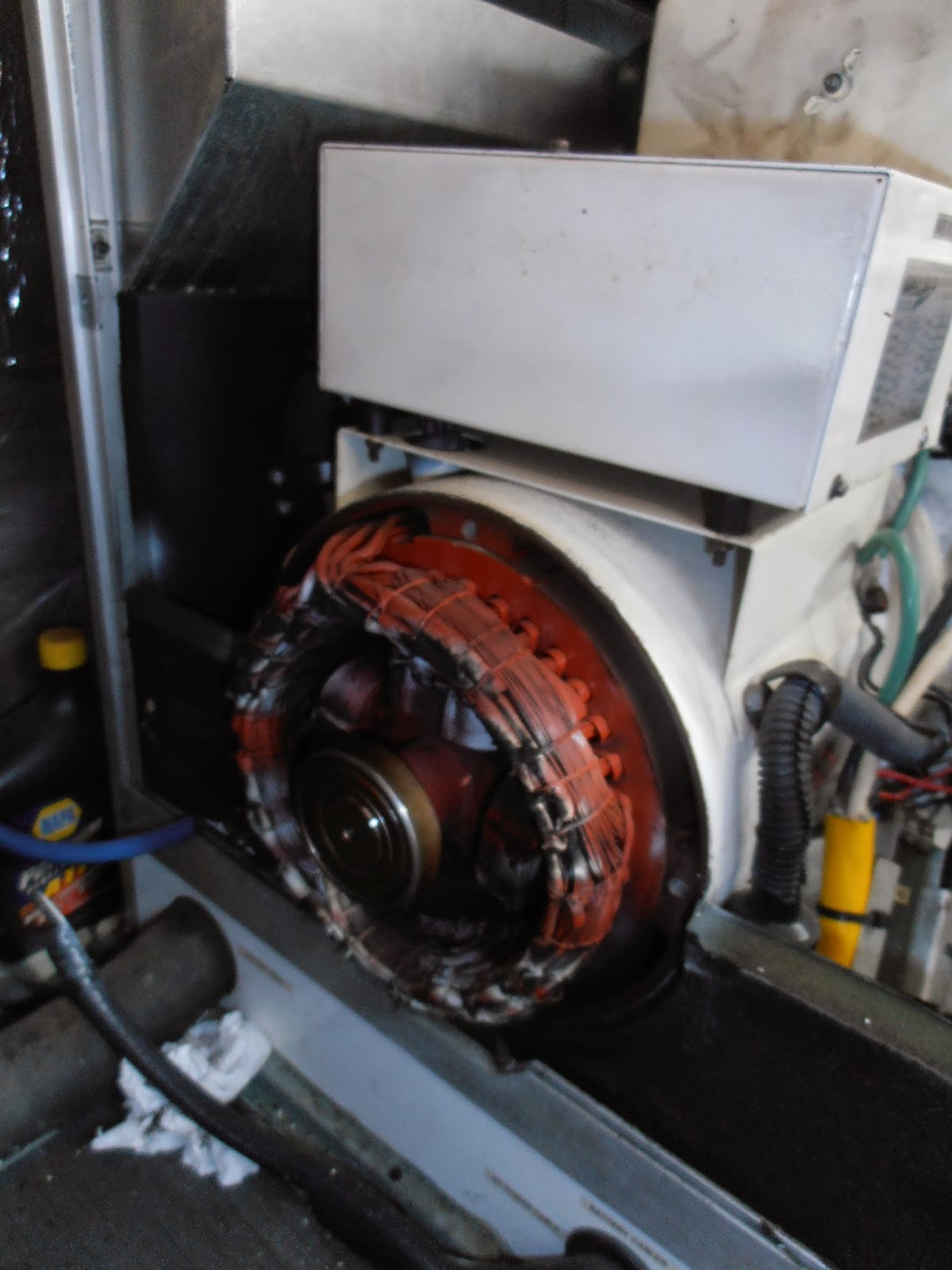
At Gouvia marina Leo and Theodore are very competent guys who’ve worked on Envoy before. They said it would be best to first address the issue of the failing bearing in the AC power unit. They explained the tolerances are very fine and maybe with the worn bearing the stator is getting too close to the rotor. The bearing was removed and found to be badly worn. Leo advised this is common and these bearings need to be checked and replaced every few thousand hours. The housing that seats the bearing had to be machined and shimmed to hold the new bearing dead-centre, and this was done within a couple of days.

View of the genset showing AC power unit

Close-up of AC power unit

This housing had to be modified to hold the new bearing dead-centre

Although the genset now sounded better without the rattly bearing, the basic problem wasn’t solved. So next was a full check of the exhaust system, and the exhaust elbow was found to be badly clogged with carbon. These elbows are prone to carbonizing as this is where hot exhaust gases meet up with cold seawater before going out of the exhaust. In fact the Manual advises checking this every 600 hours and it was 1,050hours since the last check – I’d been planing to check it this winter. As soon as the elbow was cleaned the genset ran fine once again.
Also had a minor issue with the Seapower generator powered by the Lugger. One day it didn’t power up until we were about an hour into our passage. I don’t know why, and there’s more on this issue to follow.

Thursday, October 31, 2013

OUR DAUGHTER AMY VISITS ENVOY

Envoy is currently at Sivota, Lefkas Island, Greece.
Amy arrived in Corfu 14 September, and at Gouvia Marina we added her passport details to our official Crew List, and had it stamped by the harbourmaster, as required in Greece.

Greek fishing families live in these rustic cottages just across from Envoy’s Gouvia Marina berth

What an anchorage - Laurie and Amy on Envoy’s foredeck with Corfu’s Castle in background
Corfu Old Town has stunning cobbled alleyways with quirky shops and cafes

Many cruise ships visit Corfu and we decided to give Norwegian Jade a wide berth as she crossed Envoy's bow

With Amy aboard we visited some of the delightful places we’d already been to, and we knew Amy would enjoy – Kalami, Mourtos and Lakka, where we enjoyed the sun, swam, walked, drank in tavernas and caught up on family news.

Envoy anchored in gorgeous Kalami

Near Agni, Laurie behind a probably hundreds of years old olive tree

We cruised further south to Lefkas trolling a lure and caught a small tuna, unfortunately too small to keep, but the first of three small fish we landed during Amy’s visit.

In Lakka Laurie gets free water from shore using Envoy's small RHIB. This is often easier than using the water maker all the time, and these two 30 litre containers provide about one day's usage

Lakka was a surprisingly busy anchorage, and Envoy was the only motor vessel

Amy took this photo of Laurie Di in the picturesque main street of Lefkas

In Lefkas we met Canadians Bill and Joanne Vanlenthe aboard their 44 ft Kady Krogen, Pescadou. This was great as we’ve been in email contact with them for some time. Bill told us they motored across the Atlantic, encountering waves up to 18 feet high. Then they navigated the inland waterways of the Rhine and Danube rivers to enter the Black Sea. Recently they had a bad experience though – like Nordhavns, Kadys need their stabilisers in any beam sea. During a recent trip heading north from Lefkas their Naiad stabilisers failed, and the boat rolled so much that their large RHIB broke its wire strops and fell off their boat deck into the sea. Conditions were too rough to recover it, although it eventually washed onto rocks ashore and was returned to them in a badly damaged condition. Bill said the waves they encountered on this trip knocked their boat around more than those in the Atlantic.
Having drinks aboard Envoy at one of our favourite bays, Ormos Dessimou, we heard some music playing. At first we thought it was a CD, but then noticed somebody playing the guitar on a small powerboat nearby. He was anchored close to cliffs which acted as a natural sound shell, and he sounded pretty good. We could see from the boat’s flag that the singer was German, and this was confirmed when he sang the Beatles’ song, Let it Be, as “visper vords of visdom, let it be” and Norwegian Wood as Norvegian Vood. Anyway he was a good act combining the guitar, singing and mouth organ. Later we had the chance to talk to our guitar-playing friend to discover he lives aboard his 5.9 metre outboard-powered trailer boat for five months of the year, while spending the winters busking in Germany. Incredibly, he motored his small craft from Germany down the Rhine and Danube rivers into the Black Sea, through the Dardanelles to cruise the coast of Turkey, then across the Aegean to the Ionian Sea. Some voyage in a 5.9 metre outboard cruiser!

Our German guitar-playing friend lives five months of each year aboard this boat

TECHNICAL Nothing to report
ENVOY LOG as at 28 September, 165 days spend aboard and 1,647 miles cruised for 320 engine hours.