Friday, February 19, 2016

TOP CRUISING SPOTS OF THE EASTERN MED (PART 1) – Turkey’s Kekova Roads

While Envoy is in Lefkas Marina, Greece, we are home in Auckland, New Zealand planning to return to Greece early April to commence cruising by late April.

Over the next several blog postings we’re going to describe ten of our favourite eastern Med destinations. This is based on the point of view of the cruiser rather than the tourist, for example Santorini is very special but not a great place for cruising having limited shelter and facilities.
The selection was a very tough choice – it’s easy to make a list of our favourite 20, but not so easy to narrow it down. So that you know what’s coming up, these places are, from east to west:
TURKEY – The Kekova Roads and Snake Island/English Harbour
GREECE - Simi, Astipalaia, north-west coast of Crete, Cephalonia and Corfu
CROATIA - Korcula
ITALY – Cefalu and Trapani/Egadi Islands

All of these places are not just isolated magical spots but parts of broader regions of considerable interest. Some areas aren’t featured as we haven’t cruised there – eg North Africa, France, Spain and Portugal and some not, including destinations in Albania and Montenegro, as we feel they just don’t have that magic combination of factors, and we haven’t attempted “political correctness” by including some from each visited country.
For interest some destinations that came close, but finally missed out were Kotor in Montenegro, and Lesvos, Monemvasia, Amorgos and Kavala/The Three Fingers in Greece.

Destination 1: The Kekova Roads
Where is it:
Part of the famed Turquoise Coast on Turkey’s south-east coast. To the east is Finike and to the west is Kas, Kalkan, Fethiye and the tiny Greek island of Katellorizon.
How long is required to enjoy here?: Several days.
Brief outline:
A strait protected by uninhabited four-mile-long Kekova Island with several islets offering anchorages sheltered from all wind directions. See Lycian tombs, sunken ancient ruins, a Byzantine hilltop fortress, a picturesque village, stunning natural scenery, rustic tavernas.
One must do:
Climb the summit behind Kalekoy to explore the Crusader castle ruins and enjoy panoramic views of the area.

This map of Kekova Roads shows why it's so special

It’s logical that we start this series with Turkey’s Kokova Roads as this is where we joined my brother in 2005 for a brief cruise aboard his yacht, Acrobat, and made our decision to buy our own Med-based boat.
Our first night we anchor in the pristine waters of a perfectly sheltered bay inside Asirli Island, close to a rustic, atmospheric bar called The Smugglers Inn, which in our part of the world would never get building consent or health and safety approvals. It doesn’t open until 2200 hours and we go there after dinner for what turns out to be a very late night. The always friendly and concerned Turks insist on escorting us safely back to Envoy and join us aboard for a nightcap.

Next morning we eventually appear and take the dinghy to Kalekoy to climb precarious steps to the summit of the 15th century castle built by the Knights of St John Crusaders on the foundations of an already existing ancient fort. Several unofficial lady guides offer their services in return for the purchase of cheap trinkets which we happily buy in return for some interesting local knowledge. The site was first occupied around 400 BC and there are many ruins and long since ransacked tombs dating from Lycian times, including some adjacent to Kekova Island submerged by earthquakes and able to be viewed from glass-bottomed boats.

Looking down on Kalekoy from the castle summit

Wild goats roam among Lycian tombs long ago robbed of valuables

On the northern shore lies the picturesque fishing village of Ucagiz where we go ashore to replenish some supplies, enjoy coffees in a taverna and wander through a traditional carpet shop. Most of the locals have made no concession to modern dress and appear unchanged from how their great grandparents probably looked.
Nearby is the village of Demre where apostle Saint Paul stopped over on his voyage to Rome and where in the 4th century the Bishop of the Church was Saint Nicholas who's alter ego was “Santa Claus”. His remains stayed there until 1043 when some Italian adventurers removed them to Italy where they still lie. Legend has it that Saint Nicholas threw bags of gold down a chimney to save three sisters from a life of prostitution and this is how the Santa Claus tradition started. Turks are of course Muslim, but they too have Santa complete with red costume and white beard as part of their New Year celebrations.

Looking to the castle summit from seaward

Looking up the large channel between Kekova Island and the mainland


FOR FOODIES Gozlemes are a traditional savory flatbread similar to a pancake, made from hand-rolled dough and cooked in a heavy frying pan or griddle. Traditionally they had numerous varieties of fillings ranging through meats, fish, vegetables, cheeses, herbs and spices, but nowadays sweet fillings including banana with honey are increasingly popular. Recipe to serve four: 2½ cups plain flour, 1 teaspoon salt, ⅓ cup olive oil, ¾ cup water. Make the dough by sifting the flour and salt in a large bowl. Add the water and oil and mix to combine. Lift out the dough and knead on your bench top for 10 minutes until silky smooth. Let the dough rest back in the bowl for 20 minutes. Divide the dough into four equal pieces and roll out thinly. Add the topping to two of the rolled-out pieces and place the other two pieces on top as covers. Brush olive oil into a frying pan at medium to high heat and cook for 5-6 minutes each side until golden brown and crisp. Serve sizzling hot with lemon. Warning: gozlemes are habit-forming!

Turkish couple row their ancient wooden dinghy around moored boats cooking gozlemes to order


Saturday, February 06, 2016

Envoy's 2016 Cruising Plans

Being unable to cruise during 2015 we sure had plenty of time to think about this subject and here’s what we’ve come up with.
We’ll get back to Lefkas Marina early April and hope to have Envoy back in the water mid April. ASAP after that we’ll leave the marina for a 3-4 day shakedown cruise and if all is well head towards Corfu.
We’ll clear out of Greece at Corfu and cross to Albania for about 2 weeks. Apart from wanting to spend some more time in this fascinating and by European standards very basic area this will give Envoy a spell out of EU waters avoiding any requirement to pay VAT.
We’ll clear back into Greece at Corfu and head south through the magnificent Ionian islands to the east coast and then south coast of Peloponnisos (mainland Greece). From there we’ll cruise east via the southern Cyclades Islands of Milos, Kimolos, Folefandros, Sikinos and Ios to Santorini.
Then we’ll cruise south to the central north coast of Crete and work our westwards before cruising back to the Peloponnisos coast by way of Antikithera and Kithera Islands.
Then we’ll be retracing our steps back up the Ionian Sea to Corfu before concluding our 2016 cruise at Lefkas Marina late October.

So now finally this doesn't seem like something way ahead in the future and our excitement is building!

Envoy Tech-talk
While we've been away from the boat things have still been happening recently on the technical front (apart from the various works completed up to mid last year and detailed in previous blogs):
-One of our bow thruster's 24V battery bank batteries was damaged due to a short circuit caused by loose connections. Batteries in a bank should always be replaced together so we've got two new Deka batteries en route from a dealer in Italy to replace these.
-The hydraulic rams on our Naiad stabilisers have been leaking a small amount of oil and the “knuckles” on these rams have been worn. Parts are coming in from USA to replace these and at the same time the fluid and filter will be replaced.
-The windlass's electric motor is being removed to be cleaned and checked. When you anchor hundreds of times in a year windlasses are subject to much more wear than normal - carbon dust collects in the back of the motor and can cause a short.
-Envoy's hull and running gear are being cleaned off and prepared for anti fouling so this can be done within days of our arrival and we can launch quickly.
-Envoy's large RHIB is having some maintenance done and the Yamaha 25hp outboard fully serviced so we can sea trial it on our arrival.

There's a very long list of technicalities to be performed before we can start cruising and we expect this to take about 2-3 weeks based on previous experience. We'll talk about this during April and hope there's no nasty surprises!

Thursday, January 21, 2016

WHAT MAKES A GREAT CRUISING DESTINATION?

While Envoy is in Lefkas Marina, Greece, we are home in Auckland, New Zealand planning to return to Greece early April to hopefully commence cruising by late April.

Travel not to escape life but so life doesn’t escape you 

Most years we cruise to dozens of different new bays, villages and towns and we enjoy most of them in their own way, but makes for a really special one?
Destinations fall into one of three categories – anchorages, town harbours and marinas. Wherever possible we opt for anchorages, even when there is a harbour wall to secure to or a marina nearby.
The reasons for this are:
Cost:
All marinas are fairly expensive at typically NZ$60-180 per night. While some harbours are free most charge something like half the lower end marina cost. When you’re cruising for months at a time you simply can’t afford to pay this cost more than you have to.

Mooring in a harbour is cheaper than a marina

Convenience:
It can take close to two hours to get into your berth, set up mooring lines, connect to shore power (if it works) and connect to water. In all marinas you then need to go to their office and show at least your passports, registration certificate and insurance policy and pay for your berth. In many cases you also need to go and visit the Port Police to show the same documents as well as the cruising log that most countries provide. This is less prevalent in harbours, but normally the authorities will come to find you. Leaving takes a lesser time, generally about an hour although longer if there is some complication such as another vessel’s anchor chain over yours (most harbours require you to anchor and then reverse in to the wall). In some destinations you need to visit the authorities on departure day as well, adding to the time. When at anchor there is rarely any obligation to visit authorities.
Coolness / Swimming:
There is more cooling breeze at anchor away from the shelter and concrete expanses of harbours and marinas. In the hot Med summers it’s great to be able to swim regularly and this is possible in most anchorages. Not so in marinas or harbours where it’s mostly not allowed and in any case dangerous due to the proximity of shore power and/or the water is too polluted.

When anchored it's cooler, more private, easier and cheaper

Privacy:
You enjoy good privacy at anchor while in marinas and harbours you generally have a boat on each side with attendant noise and lack of privacy. Another factor is that many of the boats alongside you are charter boats with their crews on short holidays wanting to party all night.
Having said all of the above we choose to go into marinas and on harbour walls from time to time in cases where there is no safe anchorage, if extremely adverse weather is forecast, when we are meeting visitors, when we are doing repairs or sometimes simply to enjoy the atmosphere of special harbours.

Sometimes it's nice to enjoy the atmosphere of quaint harbours - Envoy in Fiskhardo

What makes an anchorage special? A special anchorage must have a great “atmosphere” and this can be from stunning natural features, from a picturesque village or town or from a combination of the two. Also most important is good holding and security in all forecast winds while second best is an alternative bolt hole nearby. You want calm water with little wind chop or swell from the open sea making for a peaceful stay. Too may vessels spoil an otherwise good anchorage, particularly if there are water skiers, jet skis or ferries passing through the anchorage, often at dangerous speeds and in close proximity. It should also have unpolluted clear water for swimming.

What makes a marina or harbour special? Those really special spots are mostly adjacent to atmospheric historic villages or towns. Again, most important is security in all conditions – many small marinas and harbours are not suitable for all weather and can encounter waves breaking over sea walls and dangerous surges. Allied to this is having good quality lazy lines to secure your bow (your stern is secured using your own lines). You want access to good facilities such as shore power, fresh water, toilets, showers and provisions with friendly staff (marinaras) to assist.

Sunday, January 10, 2016

SCOTLAND’S LOSSIEMOUTH HARBOUR (PART 2)

While Envoy is in Lefkas Marina, Greece, we are home in Auckland, New Zealand planning to return to Greece early April to hopefully commence cruising by late April.
On a chilly October morning we stand on Lossiemouth harbour’s quayside, where all that remains to remind us this was once a bustling fishing port filled with trawlers is one lobster boat, a handful of small open fishing boats and a long outdated sign pointing to where a busy fish market operated decades ago.

Well-dressed against the cold I examine the sign which is all that remains of a once thriving fish market

The area around the harbour is hugely atmospheric including many historic stone buildings now used as cafes, shops and a museum. The harbour’s main source of income nowadays is a marina accommodating up to 120 boats in the water and 48 on the hardstand, where they are securely lashed down during winter to prevent them blowing over during severe gales.
Lossiemouth has a long waiting list for permanent berths but visitors are always accommodated and enjoy the friendly reception, excellent facilities and local marine infrastructure. It’s not by chance that we’re visiting Lossiemouth but due to a family connection – my brother, Charles, is the Harbourmaster and we can see his 36ft van der Staadt designed sloop, Acrobat, moored to one of the pontoons.
Charles and his now-wife Marie sailed Acrobat from Brisbane Australia through south-east Asia, across the Indian Ocean and up the Red Sea into the Mediterranean. It was here during our 2005 visit to Acrobat in Turkey that Charles and Marie became our inspiration for the Med cruising life we now enjoy. After spending several years living and working in Turkey, Italy and France Charles and Marie motored through France’s Midi Canal system eventually arriving in Lossiemouth, where they continued to live aboard while working as well as finding time to sail and explore Scotland’s rugged and remote offshore islands and some of Norway’s frigid coastline. Charles has a great sense of humour and gets on very well with most everyone - he’s also a practical and highly technically qualified guy, being a shipwright, builder and cabinetmaker. After Acrobat arrived in the marina the staff and other berth holders were soon tapping his skills until he eventually gained employment there, later becoming the marina’s manager, a position which is very much hands-on.

Harbour chairman George Reid (at left) with my brother Charles

One of the most interesting vessels in the marina at the time of our visit was Lady Kathryn, an 18 tonne, 54ft oak-framed timber motor yacht powered with two Perkins diesel engines which were more than 10 years old when they were installed in the new vessel in 1929 and still going strong. Her owner proudly gave us a tour of his vessel and explained that she had participated in WW2, loaded to the gunwales with allied troops during their evacuation from Dunkirk.

Lady Kathryn evacuated allied troops from Dunkirk


The ultimate “big boy’s toy” 
Most marinas move boats in and out of the water using a travel lift that straddles a boat and lifts it with high tensile strength strops. Lossiemouth uses a Swedish designed and built diesel-powered, remote-controlled submersible sub-lift with a 25tonne capacity. As the whole unit including the engine goes underwater the engine has a watertight hood using trapped air to keep the engine dry, and a snorkel for the exhaust to be used while the engine is under water.

Lossiemouth’s 25 tonne capacity sub-lift

Close-up of waterproof engine cover

Lady Kathryn being launched using the sub-lift

The sub-lift disappearing under water


Amanda provides super-efficient administration services for berth holders and visitors

If like us you enjoy wandering around marinas and fishing harbours, there’s plenty to see on Scotland’s wild north-east coast.
Our next posting will start to detail our favourite ten Eastern Med cruising destinations - most of them relatively unknown.

Sunday, December 27, 2015

SCOTLAND’S LOSSIEMOUTH HARBOUR (PART 1)

While Envoy is in Lefkas Marina, Greece, we are home in Auckland, New Zealand, planning to return to Greece late March.

THE FIRTH OF MORAY
The next best thing to boating is wandering around interesting marinas. I’m lucky to have seen plenty of them around the world, but few as interesting as fishing harbour-turned-marina Lossiemouth in Scotland’s largest Firth – the Moray on the north-east coast.

Fishing-harbour-turned-marina Lossiemouth

Bordering the Highlands this is wild territory, where temperatures can struggle to reach double figures (the days we spent there were around 7dC), vicious North Sea gales and huge waves often lash the coast and the har (fog) severely restricts visibility.

This scene looks peaceful but these massive harbour wall stone blocks were  knocked down by huge breaking waves

The Firth’s 500 miles of shoreline includes salt marshes, mudflats, rocky shores, windswept cliffs and surprisingly, many stunning sandy beaches. But even in summer the water is a very chilly 12dC, discouraging all but the most masochistic of swimmers. Nevertheless hardy types enjoy kayaking, surfing windsurfing and sailing.
The Firth holds abundant wildlife both within and outside its Special Area of Conservation, one of Europe’s largest marine protection areas hosting seals, whales, dolphins, lobsters, scallops, many varieties of fish and hundreds of bird species.

Unlike the Med Scotland is very tidal
Picturesque Cullen harbour

At its western end the Firth leads to the famous Loch Ness and the 60-mile-long Caledonian Canal completed in 1822 and providing access to western Scotland. At the outer eastern end is the closest of the North Sea fields – Beatrice, with drilling rigs towering out of the sea.
Numerous whisky distilleries surround the area, many of which are open for the public to tour, enjoy tastings and lunches.

This whisky shop near the distilleries has an unbelievable number of whisky brands

Whisky bar near distilleries

LOSSIEMOUTH
The quaint village of Lossiemouth’s harbour is found at the mouth of the Lossie River, blasted out of solid rock in the 1830s as a trading port for the nearby town of Elgin.

The narrow harbour entrance is parallel to the beach to reduce the surge from large waves

Access to this area is by train or air to Inverness 40 miles to the west of Elgin.
Between the two is the site of the historic Culloden battlefield where the last major battle on British soil took place in 1746. This battle still gets passions rising but contrary to the popular belief that this bloody battle was fought between Scots and English it was in fact between Protestant Loyalists led by the Duke of Cumberland and consisting of English, Scots, Irish and even some German and Austrian troops and Catholic Jacobites led by Charles Stuart consisting of mostly Highland Scots with some English and Irish troops. The Jacobites were largely non-professional volunteers and their early attack was quickly routed with severe casualties and further reprisals on the Jacobites to prevent any chance of the House of Stuart threatening the House of Hanover’s control of the monarchy.
The RAF has long maintained an airfield here nowadays home to Tornado fighters, Sea King Helicopters and the 617 Squadron – famously known as the Dambusters. It's common to see these Tornados thundering overhead at low altitude.
Fishing became the mainstay of the economy and the first modern seine-net boat was designed here. Lossiemouth was Scotland’s second largest whitefish port and a fascinating quayside maritime museum brings back to life the tough times the hardy fishermen endured. In its zenith Lossiemouth was home port to about 80 fishing boats and the present chairman of the Marina Board, George Reid once owned 18. He explained to us the industry not only provided employment for about 400 boat crew but also for an infrastructure of a further 600 associated workers including packers, drivers, chandlers, mechanics and riggers. Nowadays all we could see is a solitary lobster boat plus about six small open fishing boats.

The fishing fleet now consists of a solitary lobster boat plus the small boats in the foreground


Close-up of lobster boat (lobsters are plentiful)

Although we assumed fishing died out here in the 1980s due to over-fishing and depletion of stocks, George says this was only part of the story and the other part is the EU largely forced the UK to abandon fishing. Many of the displaced workers subsequently found employment in the oil industry centred around Aberdeen.

Trawlers still operate from some ports including MacDuff

This is exactly my idea of a traditional still-working Scottish trawler

Next posting read more on the marina itself plus a highly unusual submersible travel lift and the 54ft wooden motor yacht that went to Dunkirk.

FOR FOODIES Think of Scottish food and you first think of porridge and haggis, but a more popular “national dish” these days is a rich seafood soup called Cullen Skink. We’ve enjoyed delicious clam chowder in Massachusetts and traditional bisque in France, but Cullen Skink has a smokier flavour than the former and is heartier than the latter – just the thing to warm you up on a cold Scottish autumn day. Cullen Skink originated in the medieval seaside town of Cullen on Scotland’s east coast, now a popular summer holiday and surfing resort. It’s based on smoked haddock, which is a popular and heavily fished species found on both sides of the North Atlantic generally reaching a size of about 600mm in length and 1.5kg in weight. We haven’t tried, but guess Cullen Skink could work well with any smoked fish. The balance is potatoes and onions. First the onions are lightly fried in butter. Meanwhile the haddock is separately lightly poached. Add milk to the onions, then small chunks of potato. When the spuds are nearly cooked, add the haddock and simmer for about five minutes. Add salt, pepper and chopped parsley, then serve piping hot with fresh crusty bread and butter - it is absolutely delicious.

Tuesday, December 01, 2015

WORK DONE ON ENVOY IN OUR ABSENCE DURING 2015

While Envoy is in Lefkas Marina, Greece, we are home in New Zealand

APOLOGY - it's been too long since our last post - sorry about that and we'll now be more regular once again. Please look back on the last three posts which have now been "brought to life" with the addition of some great images.

Still having our rental car, by the way costing about 20 Euros (NZ$35) a day, we visited some of Lefkas’s west coast that we hadn’t explored aboard Envoy, in particular two stunning beaches.
Kalamitsi is accessed using an extremely narrow, steep winding road making us thankful it was now off-season with little traffic. The beach is secluded and gorgeous consisting of a series of small coves with crystal clear water set between large rocks affording each cove complete privacy from the others.

Great isolated beach at Kalamitsi

Enjoying a dip at Kalamitsi

Agios Nikitas is also very special – without the spectacular approach but has a stunning beach overlooked by several great tavernas. Just the place to swim before enjoying a cold beer as we watch the sunset.
This is an ideal time to visit Greece as the weather is warm without being sweltering, the sea is still warm and most of the tourists have gone.

Looking down on Agios Nikitas on Lefkas Island

The picturesque taverna-lined lane to Agios Nikitas beach

Agios Nikitas beach in late afternoon

My father and stepmother have friends of about our age living in Lefkas and while there we met with Gene (his wife Vicki was away). Gene and Vicki built a Herreshoff sailing yacht on which they lived and cruised the Australian coast for many years. Nowadays they’re “over owning boats” but occasionally enjoy boating with friends. Gene says they love having retired in Lefkas, mostly because of the acceptance and friendliness of the local people, the respect that people have for each other and the young have for the older, the less materialistic lifestyle, the great summers and mild winters and the low cost of housing and living. Of course this would probably not be feasible if they still needed to work. Lefkas is an ideal Greek island to live on as it’s connected to the mainland by a bridge over the Lefkas Canal. As we have mentioned previously there’s no refugee issue in this area of Greece and little sign of any economic problem. Recently they bought a donkey named Henry and have great fun walking him and attempting to train him. Donkeys are still widely used throughout the Greek countryside for transport over rough terrains.

TECHNICAL We’ve found the contractor we use in Lefkas, Sailand, to be very good technically and nice people to deal with. Just a few days before leaving Lefkas I mentioned to Sailand’s owner, Andreas, that we’d like to pay him some money (as we hadn’t asked us to pay him anything for the last 11 months). He replied casually, “don’t worry about small things like that”.
In our absence during this year Sailand did some maintenance for us:

Lugger main engine:
- Alternator rebuilt and sent to Athens for balancing
- Gearbox oil replaced and suction filter cleaned
- Primary Racor filters dismantled, cleaned and new drain seal kits fitted

Wing Engine (Yanmar):
- New engine mounts fitted
- Alternator reconditioned
- Leaking raw water pump reconditioned
- Heat exchanger reconditioned, including rebuilding and machining some corroded parts
- Coolant circulation pump replaced
- Injectors checked by specialist shop and replaced
- High pressure fuel pump reconditioned by specialist shop
- Gearbox oil replaced

Generator:
- Starter motor removed and checked (last checked more than 10 years ago but needed nothing more than greasing)
- Partially carbon-clogged cast iron exhaust elbow replaced with stainless steel unit
- Heat exchanger reconditioned
- Coolant circulation pump reconditioned
- Some coolant hoses replaced
- Injectors checked by specialist shop and replaced

Main head holding tank: - Breather pipe connection to tank replaced and new hose fitted due to blockage 

Still to be done is to remove and check the Maxwell windlass electric motor.

No Foodies section in this posting.

Friday, October 23, 2015

GREEK MOUNTAINS ROAD TRIP

Envoy is currently in Lefkas marina, Greece, and we are in England.
During our recent visit to Lefkas we hired a car to visit some of the mainland’s mountain villages just an easy half a day’s drive north-west towards the Albanian border.
The great thing about driving in Greece and Italy is that every couple of miles there are stunning things to see – the natural rugged scenery, interesting villages and historical ruins – not only Greek but from the Roman and Turkish occupations. The not-so-great thing is sharing the roads with local drivers for whom speed limits and no passing zones represent a challenge not a restriction. You need to keep a constant lookout for drivers approaching you on the wrong side of the road as they overtake, expecting you as oncoming traffic to pull well over to avoid them. However I must say that we’ve not seen any accidents or cases of road rage. Greece has some superb toll motorways, where the speed limit ranges up to 130 km/hr, with spectacular viaducts bridging valleys and long tunnels piercing mountains - we drove through some up to 3 km long putting to shame anything we have home in New Zealand.
On the other hand when you leave the motorways and climb into the mountains, the roads are winding, narrow, potholed, mostly one-way through the villages and frequently shared with flocks of sheep and herds of goats.

The sheer walls of one of Lefkas's medieval castles

First stop for us was Papingo, high on the slopes of Mt Astraka, looming 2,436m above sea level, where we stayed in a traditional inn (see a previous Foodies comment). This is within a national park featuring rugged mountains, forests and rivers, although high on the mountain slopes the trees give way to stubby shrubs, rocks and slopes of scree. The hewn-stone village buildings with slate roofs blend with the landscape as if they were always meant to be there. This is a noted skiing area during the winter months.
Next we make a lunch stop at Ioannina – a bustling town built from the 6th century around the western side of Lake Pamvotis. Here the notorious Ottoman-Albanian ruler Ali Pasha ruled the larger area from a formidable, largely still-intact castle.

We found this incredibly interesting and rustic antique shop

We moved on to the village of Metsovo, using it as a base to visit the area’s highlight – the monasteries of Meteora, a word meaning “suspended in the air”, as the monasteries are built on seemingly inaccessible towering rock pillars. There is evidence of cave habitation here 23,000 years ago, but the first monasteries were built around the 12th century. Eventually they numbered 20 but today only six remain, each inhabited with less than 10 monks or nuns. In former times the monasteries could only be accessed by long wooden or rope ladders, or using wicker baskets lowered by hand-powered winches. But these days roads have been built to accommodate the lucrative tourist trade – as Diane said, “these nuns have got a right little earner going” as you pay for the entrance fee and then extra to visit certain areas. As Lonely Planet says – visiting two or three is probably going to suffice, but they sure are spectacular.

The hilltop monasteries of Meteora


Our last night was spent at the delightful seaside town of Parga with its incomparable harbour overlooked by what remains of an 11th century castle. Nearby there’s yet another of Ali Pasha’s many castles, but this one has only ruins left. Ottoman rule of Greece lasted nearly 400 years until 1821.

Parga waterfront scene

Looking down on Parga from Ali Pasha's castle

FOR FOODIES
In the Med countries we’ve visited so far the dynamics of most restaurants are quite different to what we’re used to at home. Most of them are operated by families who between them do the cooking, maitre de duties, waiting and clearing. Hardly any of them seem to employ chefs, although the larger ones employ additional waiting staff.
In Greece there are very large numbers of restaurants (called tavernas), particularly in tourist areas where they only open from about May through October and then close for the winter. Although we’ve always found the fare to be good and well-priced there is little variety from one to another. Home in New Zealand we’re used to a huge ethnic diversity of eateries but apart from the occasional Italian restaurant and an even rarer Chinese one, it’s all very much Greek. We always get a very courteous and friendly reception and menus are available in English. A custom we really like is that they always offer you something a little extra for free – typically an appetiser, a plate of dessert fruits, a round of wines or ouzo.

Wednesday, October 14, 2015

MORE ABOUT ABOARD ENVOY IN LEFKAS MARINA

CORRECTION of last posting; Greeks can withdraw 60 Euros from the bank per day not 6 as mentioned.
I mentioned last posting there were no great technical surprises coming back aboard Envoy, but there’s a few things to mention:
- Normally when we return to Envoy the interior is exactly how we left her, but this time she was a bit dustier than usual as we’d had some fibre-glassing work done to repair a crack in the floor of the main shower, and a bit of grinding dust had spread through the boat – not bad though.
- We’d had a short circuit in our bow thruster 24V battery bank caused by cable connections working loose. This has resulted in one of the two Deka AGM batteries not holding charge and although these batteries are only a bit over three years old we’re needing to replace both of them as it’s not recommended to replace just one battery in a bank. Fortunately we can get these from the Deka dealer in Italy.
- For all of the time we’ve owned Envoy the aft stainless steel fresh water tank has leaked a little (less than 1 L/day) when filled above about half capacity. I removed an inspection hatch in the top of the tank and found its general condition to appear OK. Being empty, I gave the exposed surfaces of the tank a clean.
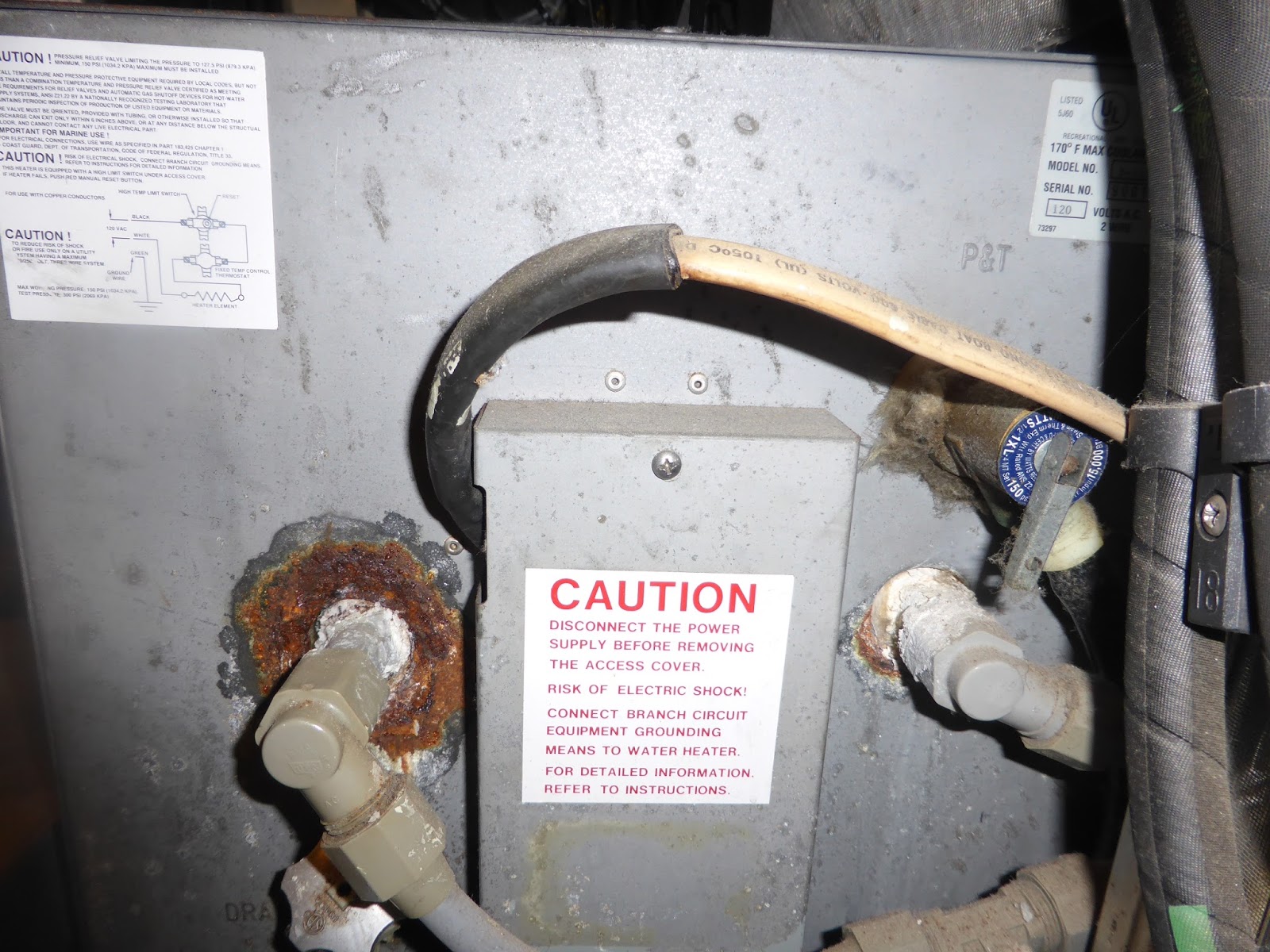
- Our domestic hot water tank has signs of corrosion on its outer galvanized steel protective cover (as opposed to the aluminium alloy water tank). This seems to have been caused by tiny leaks of fresh water from the input tap running onto the cover over a period of several years. The difficult to access exterior of the tap itself is coated with a thick layer of calcification resulting from the leak. The tank is working fine but Sailand are going to remove it for refurbishment.

Corrosion and calcification build-up on the cover of our water heater

Close up of corroded area - this has since been removed and reconditioned
t

- Last year we took our Toshiba laptop used for navigation back to New Zealand for repair as it kept shutting down. We got it repaired in Auckland and there it seemed to be OK, but now it’s doing the same again – it gets hot real quick and its two cooling fans aren’t working. So it’s back to NZ for repair once again!
- When leaving your boat for the winter the fuel tanks should ideally be over 80% full to reduce the chance of water ingress through condensation. Our four tanks are 25%, 46%, 70% and 90% full – so not ideal, especially considering our longer than expected absence. Envoy has a fuel “polishing” (ie filtration) system based on a 12V, 7L/min pump passing fuel through a magnetic DeBug device and a Racor filter. If any water or “bug” is present this should show up in the Racor’s clear bowl. I’ve polished a portion of the fuel from each tank, over 1,000L in total, being careful to avoid cross contamination and all seems to be OK.
While we were away from Envoy the local service company, Sailand did some work for us and I’ll detail that in another post, but next post we’ll skip the technicalities and talk about our road trip to the Greek mountains.

FOR FOODIES: Greek Salad – a salad sans greens.
Every single taverna and restaurant we’ve been to here offer a delicious Greek salad and they all seem to follow much the same formula. Normally the salad seems to be eaten before the main course.
A Greek salad is based on lots of coarsely chopped tomatoes. Greek and Italian tomatoes are big, sweet and juicy. Next in volume is medium thicknesses of sliced cucumber. Then add slices of red onions and green pepper. Fetta cheese is generally added as one large thick slice on top of the salad rather than as cubes mixed in. Lastly add some ground oregano, a generous quantity of olive oil and a little balsamic – there you have it.

A mouth-watering Greek salad

Thursday, October 08, 2015

BACK IN LEFKAS ABOARD ENVOY

Read our new Blog section below – FOR FOODIES.
Last November 2014 when we left our second home – our Nordhavn 46 “Envoy” in Greece’s Lefkas Marina, we expected to be back cruising by April this year. Unexpected circumstances prevented that and just last week we returned to Lefkas to check on Envoy, as part of a wider trip to visit our daughter in London and my brother and his wife in Scotland. We knew it was too late in the season to do any cruising – winter weather generally arrives by early November and it normally takes about two to three weeks to prepare Envoy and a week to winterize her after cruising. So this trip we’re using Envoy like a motel unit – to do some land-based exploration.
On arriving aboard Envoy up on the marina’s hardstand we found everything OK with no surprises - more on Envoy technically in next post.
Obviously Greece has featured a lot in the news recently with their financial crisis and the refugee issues. We arrived into Athens, spent one night there and then made the five hour bus trip to Lefkas.

This 16th century church is nestled in the basement of a new multi-story building in Athens

So far we haven’t seen any refugees or any visible signs of the crisis. We’ve no doubt that a lot of hardship does exist, but people are out and about, tavernas are bustling and several Lefkas shop owners told Di it has been one of their best seasons ever. But we have heard that Greeks can only withdraw six Euro per day from banks or ATMs. The areas where refugees are flooding into Greece are the islands adjacent to Turkey, such as Kos and Lesvos – a long way from here.
We hired a rental car for eight days to explore some inland areas we’ve not visited previously and will mention that in our next posting.

FOR FOODIES Yes “foodie” is a real word and refers to a person having an enthusiastic interest in the preparation and consumption of great food. During our unexpected sojourn home in New Zealand I took on three months consultancy work with some old friends. One of them, Vivienne, told me she regularly reads our blog, is not particularly interested in the technical stuff, but when we mention going into this or that “taverna” would like to hear more about what we eat. So this new section is dedicated to Viv, and we'll get it going properly when we come back to the Med next year.
While staying in the village of Papingo high on the slopes of Mt Astraka looming 2,436m above sea level we stayed in a traditional inn.

Papingo is set high in rugged mountains

We weren’t particularly hungry and opted for a simple three-course organic vegetarian dinner, which turned out to be stunning with all of the ingredients coming from the inn’s garden and surrounding fields:
- Zucchini salad: smallish light green zucchini sliced lengthways very thinly with a potato peeler, doused with finely-chopped phenyl, whole red pepper corns, olive oil mixed with lemon juice and garnished with sliced lemon
- Fried porchini mushrooms: porchini mushrooms are the ones with very ragged edges. Our host, Kostas, said they gather about 100kg of mushrooms every third day from the fields around the inn. These were served fried in olive oil and garlic, and garnished with rocket leaves and ground pepper.
- Green beans: coarsely sliced lengthways and lightly cooked in a tomato pasta sauce heavily diluted in olive oil. We’re definitely going to try and replicate this back home.
Of course this was complimented by obligatory glasses of passable local red and white wines at ridiculously low prices.

Our traditional taverna served organic vegetables fresh from their own garden

Trays of porchini mushrooms drying in the sun

Tuesday, September 22, 2015

LEAVING ENVOY DURING THE WINTER IN THE WATER VS HARDSTAND

Envoy is on the hard in Lefkas marina, Greece and we will be back there early next week.

Having owned Envoy since late 2006 we’ve now left her unattended for periods ranging from about 5 months to 27 months, mostly on the hardstand but sometimes in the water so what are the pros and cons of each for boats in general?
Next week when we rejoin Envoy she’ll have been out of the water for about 6 months so then we’ll report more on this subject.

Envoy on the Ostia marina hardstand, Italy

Firstly it’s much more pleasant in a marina living aboard while your boat is in the water. You still get gentle boat movement (sometimes not so gentle during gales) and it’s much easier and safer to get aboard your boat and load supplies using the passarelle from the dock compared to a ladder from the ground.
In most marinas we can use our own shower rather than the shore facilities and empty the galley sink, neither of which we can do on the hardstand.
Marina hardstand areas are generally rather litter-strewn and dusty so we always find it easier to keep Envoy clean while in the water. But of course below waterline areas are a different story and while your boat is sitting unused in the water your hull will suffer more marine growth than usual.
So far as safety of the vessel is concerned each option is probably neutral. While in the water there is the risk of damage to mooring lines, cleats and hulls during storms, as well as the risk of taking on water if a leak develops. This is very dependent on the location of the marina since many are subject to surges during adverse winter weather.
On the hardstand there is some risk of damage during travel lift operations or from the vessel falling or being knocked over during earthquakes or severe storms, both of which are prevalent in the Med.
Personal safety is better with your vessel in the water as many accidents occur with people falling from their vessel or ladder onto the hardstand below.
In most marinas security is better on marina piers than it is on the hardstand where there are more people coming and going and public access is less restricted.
Cost is another factor to take into account and this depends on the individual marina and their ratio of berths to hardstand area. Sometimes it’s cheaper in the water and sometimes not. Seasonality also affects this with considerable more hardstand area being available during summer months.
Envoy’s refrigeration system has the option of air or seawater cooling but the latter is more efficient so that’s another plus for being in the water.
There are some repairs and maintenance which can only be performed out of water (for example servicing seacocks and running gear) but on balance there is more that can be achieved in the water.
Another negative for staying in the water is the possibility of galvanic corrosion and/or stray current electrolysis.
Osmosis is another risk for GRP hulls and a spell of several months out of the water can only assist its prevention.

Monday, September 14, 2015

INTERESTING INFORMATION FROM TECHNICAL TRAINING SEMINAR ABOARD NORDHAVN 68 – PART TWO

Envoy is currently in Lefkas marina, Greece and we’re home in New Zealand. But we arrive back in Lefkas late next week and soon after that will give an update on how Envoy's faring having been left for 11 months.

Our last posting introduced the technical seminar held aboard Nordhavn 68, Karajas, in Akuna Bay Marina north of Sydney.

View of Karaja's engine room with single John Deere main plus Northern Lights wing engine

Steve d'Antonio talks to course attendees in engine room

So what are a few key points others can learn from? Here is a flavour of some specifics.
- Always install equipment according to the manufacturer’s guidelines and insist that contractors do so,
as well as supplying a schematic diagram where needed.
- No AC power connections should be exposed or able to be accidentally touched.
- When working on AC power systems always totally isolate the inverter and remove the shore power
cable.
- Stainless steel bolts, nuts and washers should not be used in demanding applications like prop shaft couplings, steering couplings or engine mounts. Nor should they be used in electrical situations due to
the low conductivity of stainless steel.
- Although two hose clamps are supposed to be used for all raw water plumbing applications it is better
to use one properly than two improperly. Ensure hose clamps are marine grade stainless steel and have
solid not perforated bands. To avoid cuts and injuries use “Clamp-Aid” silicone covers on the sharp
exposed tail of the clamp.
- Only use correctly rated and marked hose for raw water plumbing and exhaust systems.
- Operate seacocks regularly to avoid them seizing up.
- Hydraulic steering rams and tiller arms should be regularly checked both at rest and under way while steering lock-to-lock to check for significant leaks and movement in fastenings.
- Test your emergency steering tiller before you need to use it.
- To reduce corrosion on aluminium masts, paravanes, booms, door frames etc bed fittings and hardware
in a PU bedding compound. This can be done retrospectively.
- In the event of engine room fire stop all engines and blowers (to maximise the effect of the extinguishing agent) and isolate the batteries (in case the fire is caused by a short circuit or overload).
- The prop shaft stuffing box temperature should not exceed about 30dF above the ambient sea water temperature.
- There is no need to change primary fuel filter cartridges too often, but as dictated by your vacuum gauge
(at about 5 inches of vacuum). Use 10 or 30 micron cartridges – finer is not better in the primaries.
- Bleeding of the fuel system should not be necessary if the primary and secondary filters are bled
correctly when changed. To ensure any air remaining in the system is passed through run the engine for
about 5 mins at 1200-1440 rpm, not at idle. This rpm range will reduce the chance of the engine stalling while passing air.
- Dry exhaust thermal insulation should be regularly checked using the pyrometer and for potential fire
and safety reasons no section should exceed 200dF. Wet exhaust system hoses should not exceed about 160dF.
- To maximise AGM battery life normally discharge to about 50% of its capacity and don’t routinely start charging much above that level.

I would certainly recommend any serious cruiser to attend a course run by Steve or a similarly qualified industry expert both to learn specifics and to stimulate thought.