Tuesday, September 06, 2011

THE ISLANDS OF SKYROS AND LESVOS, AND OUR RETURN TO TURKEY

While doing this posting I’ve also added photos to the last one.
Skyros, the largest and eastern-most isle of the Northern Sporades, proved to be our favorite of the Group. It’s much quieter, and has much of the charm of the Cyclades with older style whitewashed stone houses with blue trim, and the Chora (hilltop village) of Skiro. Here were fewer tourists, and the pace more to our liking.

Skiro’s ancient monastery and castle


We try to avoid mooring in harbours, not only due to the cost and the formalities, but also because we like to swim several times a day, and you mostly can’t do this in harbours. Skyros had a superb bay for anchoring just a few hundred metres from the main harbour of Linaria, and at anchor we could hear bells ringing on the collars of the goats as they foraged for food. Their meat is a delicacy here, and one night ashore in a taverna Doug and I enjoyed a delicious goat casserole.

The picturesque Linaria harbour in Skyros


Another night we had local lobsters and met an English couple who have lived here for 40 years, and he was the lobster fisherman, telling us that in Skyros they catch lobsters using nets rather than pots. In appreciation of us buying his lobsters he bought us a jug of delicious local wine.

We enjoy a dinner of local lobsters - Laurie, Doug & Sharon in photo


There is also a very interesting handcraft shop run by an Austrian lady artist called Monika, and Sharon & Diane found plenty to interest them.

Monika’s quaint handcraft shop in Linaria


From Skyros we had a cruise of about 70NM eastwards to Sigri on Lesvos, taking about 12 hours. The Naiad stabilisers performed well with a 18 knot wind and 1m seas on our beam most of the way. This passage took us across the main shipping route to the Dardanelles, and several times we needed to keep a close radar watch on ships, and make course alterations to avoid them. About 57,000 ships pass through the Dardanelles annually (160 per day) mostly carrying petroleum products.

We had to alter course to allow this ship to pass safely half a mile ahead of us


There is also a current setting south, and at times we needed to steer 15 degrees to port of our required course to compensate.
We spent a couple of nights in Sigri, and while anchored there a large yacht of about 25m anchored with his chain across ours. When we wanted to leave I asked the yacht’s captain if he would mind moving so we could retrieve our anchor. He was very cooperative but preferred to don his scuba gear to free our anchor – easily done in only 8m of sparkling clear water.

We anchored in Port Sigri and a large yacht ran it’s anchor chain over ours


Diver being towed above our fouled anchor


The yacht’s skipper dived in the clear sparkling water to free our anchor


A great restaurant overlooking our anchorage had a huge selection of Ouzo


At this time the weather forecast was warning of another Meltemi gale of several days duration – very common in the Aegean during July and August, so we needed to find good shelter. As Amy was flying in from London to Lesvos’s capital of Mithilini we decided to moor in the harbour there for the duration of the gale, and spend some time touring Lesvos by car.
Mithilini is a great and sheltered harbour to stay in, except for one thing – the quay is adjacent to the main street and the noise of traffic, particularly motor scooters, car horns and car “boom boxes” drives you mad after a while. This noise continues without interruption all night long, and it seems that Greeks don’t drive more than a few metres without sounding their horns.

Envoy moored Med-style in Mithilini


We took a rental car and visited the coastal villages of Plomarion, to the south-west, one day, and Mantamados and Molyvos, to the north, the next day. All three destinations proved to be just great, with atmospheric narrow cobbled streets, elderly Greeks sitting around drinking coffee and ouzo, and just a smattering of tourists.

Two shots of the atmospheric streets of Plomarion


Laurie & Doug check out butcher’s shop in Plomarion


Although it was hot we were able to stop and have swims along the way to cool ourselves down.

Laurie & Amy cooling off in a rock pool


Two shots of the village of Mantamados on Lesvos, famous for yoghurt and cheese


Doug, Laurie, Sharon & Amy in this one


Quaint harbourside restaurants in Moyvos


Early on Sunday morning we heard the sound of a military band and jumped out of bed to see a parade of soldiers marching along our street with the traffic banked up behind them. They stopped at a nearby flagpole, hoisted the Greek flag, saluted and then marched off. In the late afternoon they marched back again, and lowered the flag. We had encountered this previously in Kavala on the mainland, and it’s interesting that there is a military presence on most of the Greek islands.

Parade of soldiers saluting the Greek flag


On the 24th we loaded 900 litres of diesel at Euro 1.42 per litre (about NZ$2.45) cleared-out of Greece, and headed over to Ayvalik, just 15NM away on the Turkish mainland coast.

TECHNICAL
Nothing much to report. The main Lugger engine had still been having occasional starting problems, twice needing six attempts to start. I was pretty sure it was the starter solenoid, so last time it didn’t start I tapped the solenoid sharply with a rubber hammer, and it’s been fine since. We have a spare solenoid on board, but in any case the solenoid terminals can be bridged to start the engine.
LOG (to 24/8/11): 113 days aboard since leaving Marmaris, 1,588NM cruised for 324 engine hours.

WE GET A SEAWATER SHOWER IN BED, AND RETURN TO THE NORTHERN SPORADES

The morning of Doug & Sharon’s arrival we got a rude awakening. We were anchored off a village called Ay Yeoryios, and fishing boats up to about 20m work from there. About 0600 we hear a boat pass close by and then a deluge of water came through our two cabin portholes and soaked us, our pillows, mattress, and books etc stored around the bed. Obviously the fishing boat either on purpose, or just not thinking, had passed far too close with too large a wake – our portholes are 0.7m above sea level. At the time we had our flopper-stoppers down, so maybe the fishing boat captain was just curious and came close to look.

View of Ay Yeoryios from where Envoy was anchored. A fishing boat came too close and we took water through the portholes above our bed


Doug & Sharon arrived having flown from Auckland to Dubai to Athens. Their plan was to get a taxi from the airport to the bus terminal, and catch a bus to Ay Konstandinos in the Gulf of Evia to meet us. Firstly they had the same problem as Ian & Patsy encountered – their NZ phone didn’t work in Greece, so they couldn’t contact us to confirm their arrival. Secondly all the taxis were on strike, so they got a bus into Athens but then couldn’t find the correct bus terminal for Ay Konstandinos. They found that people weren’t very helpful until a taxi driver on-strike heard their plight, and offered to drive them for Euro 200. As the distance was about 180km, Doug & Sharon thought this a fair price, and we finally all met as planned.

Doug buys beautiful fresh vegetables from a street vendor in Ay Konstandinos


The next day we started heading towards the Northern Sporades, and our replacement Lugger alternator stopped charging. I phoned A1 Yachting and they confirmed there was an electrician in Skiathos, so we decided to continue on our way using the genset for charging.
Skiathos is a major centre for charter boats, and was very busy with these, as well as many tourists shopping and patronizing the many waterfront tavernas. It’s also where the movie “Mamma Mia” was filmed. The N Sporades are very green, as they do get some rain all year round. They also have great beaches, even if mostly crowded, but they don’t have those classic Greek villages of white and blue stone buildings, or very much of historical interest.
There was no room for Envoy in the harbour, but we managed to find space in a crowded anchorage outside. Later we found out we were only about 200m from 15 discos competing with each other for maximum decibels until four in the morning.

Very sleek car ferry in the crowded Skiathos harbour


While Diane, Doug & had a walk around Skiathos the electrician arrived, tested the alternator, and confirmed there was no charging. He took it away, and attempted to repair it – without success. Next day we had breakfast in a taverna ashore and watched the All Blacks beat the Wallabies in rugby to retain the Bledisloe Cup. I suggested the electrician try to make one good alternator out of the two failed ones. This worked, and the electrician was confident the resulting alternator was a good one. Nevertheless we’re buying a new Balmar alternator from the US for a spare asap.

Diane & Doug enjoying lunch in Skiathos


Skiathos is interesting, but too busy to be a great cruising destination, and that afternoon we moved on to the much quieter Nissos Skopelos and had a great night ashore in a taverna.
Then another problem struck. During my daily checks I found the genset out of coolant, and on investigation found a rust hole in the body of the water circulating pump, from where all the coolant had leaked out. Although we can use our Yanmar wing engine as a genset, we need the higher capacity of the genset when running the watermaker. So back to Skiathos where A1 Yachting organised an engineer to repair the hole (with cold weld) – and all ok again. Must say by this time I was getting a bit tired of spending my days in the engine room, but as the saying goes, “Cruising is fixing your boat in exotic locations”. We have since received a new spare water pump from the US.
Back to N Skopelos again and found a wonderful bay called Limnonari. This was only large enough for a few boats, had good shelter, wonderful clear, clean water with small fish swimming around, and a taverna ashore owned by the same family for 400 years.

We stayed one night in this idyllic sheltered bay called Limnonari


We would have stayed there more than one night but had to find shelter for a gale due to arrive around midnight - we were warned by locals to expect winds up to 40 knots.
We cruised across to Nissos Alonnisos, and after checking various options decided on a bay called Ormos Milia as being our best option. This was a large bay about 800 m across, with good depths of 8-13m, no rocks or reefs, and no other boats. So we dug our anchor in, put out 100m of chain, and waited. Sure enough the forecast wind arrived about 2100 and did blow up to high 30s for several hours, but Envoy held position and we had no problems.
As I wrote this we were doing a 45NM cruise SE to Skyros, the largest of the N Sporades.
TECHNICAL
See above re Lugger alternator and genset water pump.
LOG (to /8/11): 89 days aboard since leaving Marmaris, 1,196NM cruised for 255 engine hours.

COMMENTS
Frank said: Hi Laurie, seems like you are having a plethora of running repairs at present. I'd fit the new water pump and keep the old one as a spare. The locations sound wonderful. Can't believe there are places like you describe with no other boats. Cheers

Chris said: Now I kow why you needed that belt tightener - and I am not referring to eating less in the restaurants. See you soon.

Namik said: What can I say after reading all. Seeing what you have been experiencing with the kindness of the sea I am envious but proud of you both. Enjoy!!

Sunday, August 21, 2011

EVIA ISLAND, THE GULF OF VOLOS AND SMOKE IN THE ENGINE ROOM

The island of Evia at about 90NM long and 10NM wide is Greece’s second largest island after Crete. Unlike Crete it’s very close to the mainland coast, being mostly about 5NM away, but at the town of Chalkis separated by a bridge only 39 metres wide.
Considering the area’s proximity to populous areas (Athens is only 1-2 hours drive away), it is surprisingly quiet and unspoiled, and most of the anchorages we’ve been in have been shared with only one or two others.
This area doesn’t get the notorious Aegean “Meltemi” NW wind, but in late July a wind was forecast of 20 knots S, turning 20kn NW, so we found a bay with good all-round shelter and “dug in” for the night with 80m of anchor chain out in a depth of 10m.

Photo: We don’t always get a great view but this bay offered ideal shelter for a big blow


When the wind arrived it peaked at 34kn within half an hour, putting up a half a metre chop even with the limited fetch in our bay. Because the wind was from the S it was very warm, and the temperature reached 39d, despite its strength. About 5 hours later it completely died away and the bay was flat calm again within half an hour.
We’ve spent the next 10 days or so looking around various bays in the Gulf of Volos, north of Evia Island, and doing various routine maintenance jobs as we await the arrival of Doug & Sharon.

Photo: This taverna caught my attention for some reason


We stayed a couple of nights in a very sheltered circular bay, about half a mile across with a narrow entrance called Ormos Vathikelon. It reminded us very much of Auckland’s Port Fitzroy area, with a dead flat sea, and high green hills. We were anchored in 17m, and all was good with a mirror-like sea, and no wind. At 2300 we were about to go to bed, when we saw lightning. Within 10 minutes we had a wind up to 30 knots that turned Envoy around, pushing us towards shore. Then it started to rain too – the first rain we’ve seen since late April. Don’t feel too sorry for us as it was welcomed to give the topsides a good freshwater wash. The anchor held, but we were now in a much shallower 7m, and only 30m from shore. We started the engine, and kept it running in case we had to power away from the shore and re-anchor. After half an hour the storm abated as suddenly as it started, Envoy returned to its original position, and all was well.
As we were anchoring late one afternoon we heard a loud beeping noise which we soon tracked down to the smoke detector in the engine room – not what you want to hear! Carefully going into the engine room I could smell something like burning rubber, although there was little smoke. Leaving the engine running I grabbed my infra-red thermometer to see what was too hot and it was the main engine alternator – at 88dC it was about 25dC above normal. As I looked at it closely I could also see the occasional spark being thrown out through its front. For the non-technical, an alternator is what charges your batteries.
We were safely anchored so I shut the engine down.
Envoy can run without a main engine alternator – in that case we need to run the Genset or Wing. However we carry a spare alternator so the next morning I fitted that. I was a bit nervous as this was the first time I’d ever done this, and there are 11 wires connected to it. However all went well and now we’ll send the failed unit in to be reconditioned. Unfortunately this was not the end of this issue, as you’ll read in our next posting.

Photo: This is the failed alternator we replaced with our spare


TECHNICAL
Apart from alternator issue above, nothing to report.
LOG (to 31/7/11): 89 days aboard since leaving Marmaris, 1,196NM cruised for 255 engine hours.

Monday, July 25, 2011

WE ASSIST A YACHT AGROUND ON A REEF IN THE NORTHERN SPORADES AND ENVOY GETS HER NAIAD STABILISERS REPAIRED

We’re well into our 2011 cruise now with over 1,100NM covered. Summer has set in with daytime temperatures of about 36d, and the seawater at 27d. Fortunately the humidity is not high here, which makes the heat manageable.
The Northern Sporades group consists of about eight main islands, with numerous other islets. We spent just four nights there as we needed to keep moving to Chalkis on Evia Is about 85NM away, where we would meet the Naiad technician. This short visit gave us the chance to scope out the N Sporades for our longer visit next month with Sharon & Doug.
One late afternoon we anchored off a fantastic sandy beach on the small uninhabited nature reserve islet of Nissos Tsoungria. Lush green forest came right down to the beach, and the islet was deserted except for a great little rustic taverna on the shore with home-built tables and chairs, and fern leaves over a makeshift frame to provide shelter from the sun. The staff don’t live there, but when the last patron leaves they go home to Skiathos each night on their fishing boat. They just lock everything up, and leave it all unattended. Can you imagine doing that in New Zealand?

Envoy anchored off Nisos Tsoungria


The great taverna on Nisos Tsoungria


We watched the sunset, and spent the night sharing the bay with three sailing yachts and a high-powered six metre RIB, the occupants of which were camping ashore. We had a tranquil night, with just enough motion to remind us we were anchored off an exposed beach.
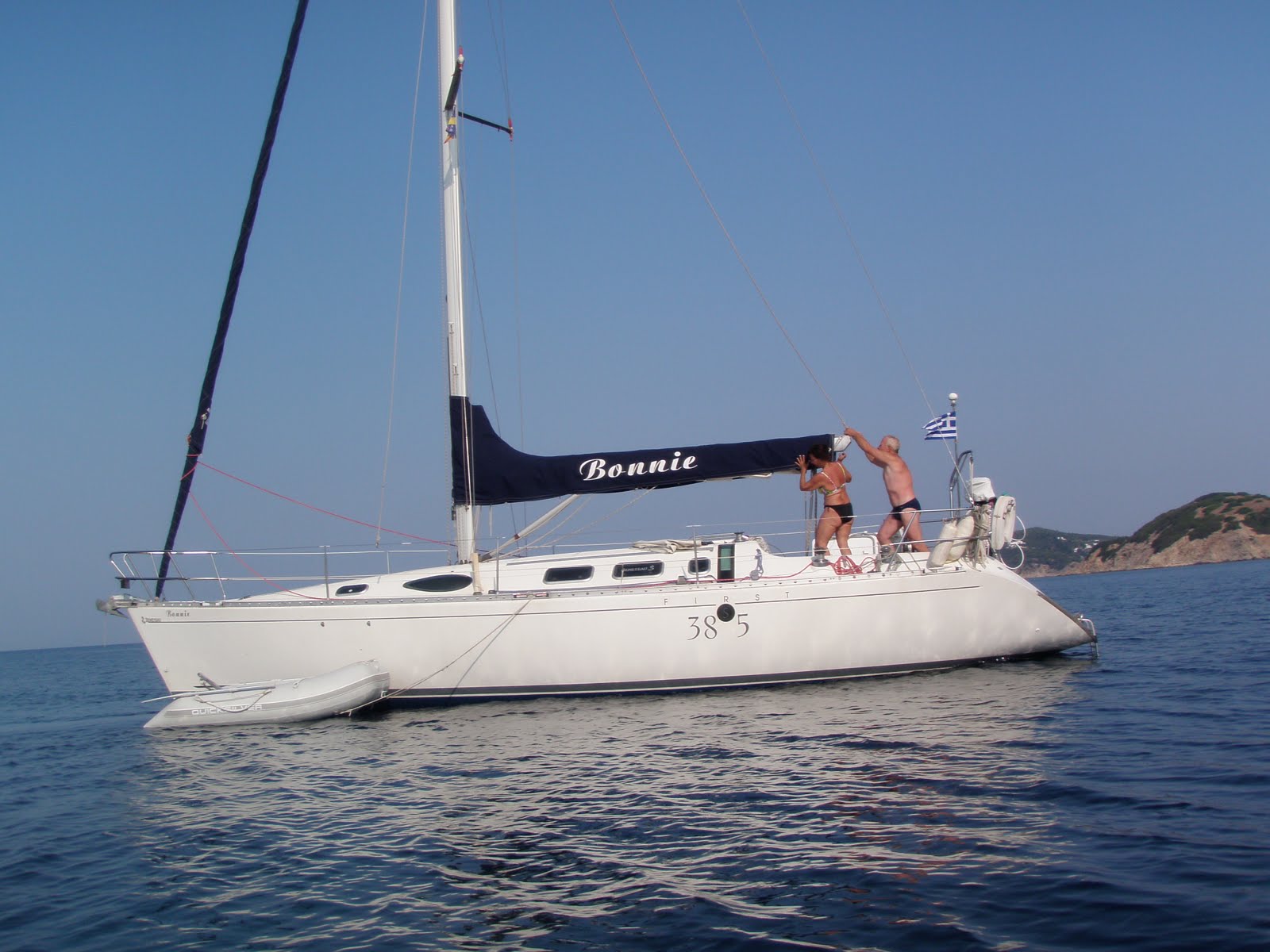
In the morning I went up to the pilothouse, and noticed that one of the yachts had departed – but not very far, as 200m away she was stuck fast on an underwater reef that protruded out from the end of the bay. The yacht was a Beneteau 385 sloop, flying the Greek flag, and with 3 people aboard. I watched for a few minutes, and nothing was happening except one of the occupants was in the water checking the depths around the hull.

The yacht Bonnie aground on a reef


There was no swell, and there is virtually no tide here. My Coastguard training kicked-in, and I jumped in our small dinghy, and went over to see if I could help.
The skipper’s wife spoke some English, and it was apparent they had little idea what to do, although he was able to tell me that only the keel was aground, they were not taking water, and the deepest water was astern. I suggested that I take the skipper ashore to ask the owner of the six metre RIB for assistance to tow him off, and to ask the skipper of a nearby Greek yacht to lend a hand with his large dinghy by tilting the Beneteau over using a halyard attached to the top of the mast. This would lessen the yacht’s draught, and make it easier to free from the reef. The owner of the RIB was only too happy to help (after we’d woken him up), but the other skipper didn’t want to know. Consequently we used our own small RIB with the 2.3HP Honda to tilt the yacht over, and were surprised how little power was needed with the amount of leverage provided by the line to the halyard. On the second attempt the RIB slowly pulled the Beneteau off the reef and was able to tow her to deeper, safe water.

The RIB takes the strain - you can see the reef under the water in foreground


After the skipper checked that there was little damage apart from scrapes to the keel, and to his pride, he gave us a bottle of Greek chardonnay for our help. In NZ & Australia we’re so lucky to have Coastguard to assist us out of boating mishaps, and at negligible cost. The Coastguard here is much more concerned about enforcement, people/arms/drug smuggling, and anti-terrorism than in providing assistance, although they are responsible for SAR at sea.

TECHNICAL
On 18 July Wim Verkoelen, a Naiad engineer based in Holland, visited us in Chalkis, about an hour’s drive north of Athens airport. With him were two engineers from Naiad’s Greek agents. Wim brought with him a new Control Unit (cost Euro 1,881 or about NZ$3,400), and a Display Panel – both of which had been tested and were working well.
It’s great to see a talented and knowledgeable guy like Wim at work, and within about two hours he had checked the whole system over and installed the new Control Unit. We did a sea trial, and everything seemed to be working OK I only say “seems” because where we are currently the sea state is very flat, and there was no chance to test the system in waves. Wim found there were some errors made by the Turkish agent’s staff during re-assembly of the system after they changed the seals for the fins, one wrong polarity possibly causing the failure of our own Control Unit. Since then we’ve used the Naiads for about 20 hours and all is well so far. We’ve yet to encounter any waves above about half a metre to really test them, but inevitably will.

Wim from Naiad Holland (3rd from left)fixed our stabilisers - I'm smiling


I forgot to mention that a couple of weeks ago we had a fresh water leak into the bilges. I was talking with Kevin in the pilothouse, and noticed the amp meter was running a bit high, there were no lights on, and there were no faucets open, but when I switched off the fresh water pump breaker the amps dropped. It turned out that the outlet hose from the fresh water pump had come off the inlet to the water filter. If this had happened at anchor we would have heard the water pump running, but under way we can’t hear the fresh water pump. It was a simple matter to re-connect, and shows the importance of keeping an eye on the instruments. On Envoy we do a full check hourly, but also watch things in between.
LOG (to 19/7/11): 77 days aboard since leaving Marmaris, 1,132NM cruised for 229 engine hours.

Wednesday, July 20, 2011

Photos taken during Kevin & Diane's visit

Part of the fish market in Kavala


Envoy in Kavala with castle in background


Porto Koufos was a narrow sheltered anchorage that reminded us on NZ's Whangaroa


There are 20 major monastaries on the Akti Peninsula


One of the many monastaries near Mt Athos - women are not allowed within 500m of the shore


Beautiful fresh cherries in the weekly market


The fascinating weekly market in Kavala - where local people shop


Laurie with Kostas, who was very friendly and a great help to us in Kavala


Kevin makes the traditional pikelets


Kevin, who was a senior fire officer explains a hydrant to Laurie


Kevin & Diane in relax mode aboard Envoy
Envoy moored among the busy fishing boats in Kavala Harbour coming and going all hours


Aqueduct in Kavala built by the Turkish Suleyman the Magnificent in 16th century

Wednesday, July 13, 2011

THE THREE FINGERS AND THE INCREDIBLE MONASTERIES NEAR MT ATHOS

On 27 June with Kevin & Diane we left Kavala after a very enjoyable stay there. It’s great to see destinations where normal local people live and work, without hordes of tourists. Those tourists who do visit this area mostly drive down from eastern Europe. Our Greek friends from Blue Cruises wished us “kales thalases”, meaning “have favourable weather and a safe voyage”, and left us their contact details in case of any problems – they are professional skippers and engineers.
We cruised over to the area of Chalkidiki or “The Thee Fingers”, so-called because there are three peninsulas, each about 25NM long, forming two gulfs between them, and another gulf with mainland Greece. The easternmost peninsula is Akti, and at its southern end is the spectacular “holy mountain” of Mt Athos, rising to 2,033m, with ice flows still visible near the cloud-shrouded summit. The Virgin Mary is said to have visited here after the death of Jesus. The Akti Peninsula is a semi-autonomous region of Greece ruled by the monks who inhabit 20 large monasteries, some dating back to the 9th century. Some of these are the size of large villages, and of course over the centuries have been attacked and ransacked numerous times by various pirates and invaders. Access to the peninsula is sealed off, and only 110 visitors (who must be Christian) are allowed each day, after gaining permission which can take up to six months. No females are allowed to visit, and any boat containing a female is not allowed to approach closer than 500m to the shore. Because of this limitation we had to make the 61NM voyage around the peninsula in one day, and several times we were joined by schools of dolphins frolicking around Envoy’s bow. It was really spectacular to see not only the monasteries, but also numerous other monks’ huts and retreats perched on the sides of cliffs, some in the most inaccessible of positions – they sure like their isolation.
Here for the first time we’ve seen a few other cruisers – one night nine other boats in the same perfectly protected bay of Ormos Kriftos, about half the size of Auckland’s Islington Bay. Four of them were rafted together so there was ample space.
In retrospect we should have stayed another night or two there, as the area has several beautiful and secure anchorages.
It’s a tradition when we go boating with Kevin & Diane that Kevin makes pikelets, and this time he made a lunch of them which we enjoyed at anchor off Ormos Sikias.
We finished our time with Kevin & Diane in Porto Koufo, a very protected bay that reminded us of Northland’s Whangaroa Harbour, with its narrow entrance, high rugged cliffs and perfect shelter.
We took on fuel for the second time this year, buying 750 litres at Porto Carras marina at Euro 1.57/L (about NZ$2.86). Here was a large resort with plenty of facilities including a doctor I visited to get an ear infection looked at. She gave me some antibiotic ear drops and asked me to come back 2 days later to have my ears cleaned out. She did an excellent job, and the two visits cost a total of Euro 80 (about NZ$146), which was excellent considering the time she spent.
Nearby we met some British cruisers aboard a yacht called Rosa di Venti, and it turned out they know our friends Alan & Anne from Sula-Mac. Once again a small world.
We did a 49NM cruise south to the Northern Sporades, where we are now en route for Chalkis, on Evia Is near Athens. There we’ll meet the Naiad serviceman coming from Holland to try and fix our stabilisers. He says it will be a 2-3 hour job so here’s hoping he’s right!
There are more boats around now as the holiday season kicks in, but nowhere has it been crowded. The temperature is now in the low 30s with the sea a very warm 26. Although the Aegean is notorious for it strong NW wind – the Meltemi – it doesn’t often reach this NW section, and we’ve had light winds up to about 15 knots.
There is little observance of boating regulations, or common sense here by small boat users, and speedboats, RIBs and jet skis roar around at high speed, very close (5 metres distant) to anchored vessels. This is annoying and of course highly dangerous, especially as there are often people swimming from anchored vessels.
TECHNICAL
Kevin is very knowledgeable about rigging, and he inspected ours, and took some measurements of the mast and boom so that he can calculate if it’s safe to lift our large RIB, weighing about 250kg, up out of the water behind Envoy’s transom using the boom winch The purpose of this would be to avoid barnacles growing on the RIB, which is not anti fouled. Our initial conclusion is this would not be a good idea, at it would place too much strain on the lifting tackle. It would be possible to design and build an A-frame support for the boom so this lift could be done, but I think we’ll just continue to lift out our RIB for a day or two once a week. In any case when Diane and I don’t have visitors we use our smaller RIB, weighing only about 50kg, which we do lift out at the transom without any problems.
LOG (to 10/7/11): 68 days aboard since leaving Marmaris, 929NM cruised for 190 engine hours.

Photos relating to last blog posting

These days wild deer roam the Myrina Castle grounds


View of Envoy anchored in Myrina harbour from the castle above it


View of Myrina's hilltop castle from Envoy's anchored position in the harbour


Ian wheeling the shopping trolley full of supplies


Ian & Patsy enjoy some time ashore


Envoy anchored at Skala Marion, Thassos Is
Greek oil rig between Thassos Island and Kavala


Di, Ian, Patsy & Laurie enjoy a traditional dinner ashore in Myrina

Friday, July 01, 2011

ENVOY VISITS LIMNOS, THASSOS & KAVALA

We arrived at the island of Limnos a day before Ian & Patsy, who were arriving from Malta late at night and staying in a hotel, and sent them a text from our Greek phone with our location, so they could meet us the next day. On the next day, mid-morning turned to early afternoon, and we still hadn’t heard back from them, so I sent further texts using both our Greek & NZ phones. They only got the text from our NZ phone, and it turned out that our original text hadn’t been received at all (it did arrive a day later), so Ian & Patsy had no idea where we were, or how to get to us. Ian & Patsy did finally join us after some consternation - panic over, and we enjoyed a great six days together.
Limnos is a very fertile island, with many farms, but rather devoid of interesting features compared with islands further south. The first night we spent in Moudros Bay - very large and sheltered, but unappealing. This bay was the base for the Allied fleet during the First World War’s disastrous Gallipoli campaign. We met Ian & Patsy at the much nicer, totally unspoiled Ormos Kondio.
Limnos has a strong Greek military presence due to its proximity to the Dardanelles, and we frequently saw fighter jets soaring loudly overhead during their training runs. One night we saw large light flashes on the horizon, and heard distant rumbles as the navy practiced gunnery.
The highlight at Limnos was spending a couple of days anchored in the port of Myrina. In ancient times Limnos was ruled by Amazon warriors, and Myrina is named after one of their Queens. It’s reputed that the beach we anchored off is where the Amazons cut the throats of husbands they had tired of. Although Ian and I were sure Patsy & Di weren’t tired of us, we took the precaution of making sure all Envoy’s sharp knives were well out of sight. Jason and the Argonauts called at Limnos about 1300BC on their way to the Black Sea in search of the Golden Fleece. They spent two years dallying with the Amazons, who by that time had killed all the men on the island, and continued on their quest with their throats intact, though probably somewhat underweight and exhausted - a man’s gotta do what a man’s gotta do!
Myrina is overlooked by the inevitable hilltop castle – this one dates from very early times, was rebuilt by the Byzantines in 1186, and then by the Venetians in 1214. Now it is home to about 200 tame deer who freely roam the interior grassy hillsides.
We had to keep moving as Ian & Patsy were spending only five nights with us, and we had over 100NM to cruise to their departure point. Further north is the island of Nissos Thassos, and finding very little shelter, we anchored off ocean beaches for two nights, using our flopper-stoppers to reduce rolling. We enjoyed one very picturesque fishing village called Skala Marion, and went ashore there, but it wasn’t sheltered enough to stay overnight. Overall we couldn’t recommend N Thassos as a cruising destination, although we believe it’s great for land-based touring.
Between N Thassos and the mainland Greek coast of Macedonia are several active oil rigs, looking rather incongruous against a Med backdrop.
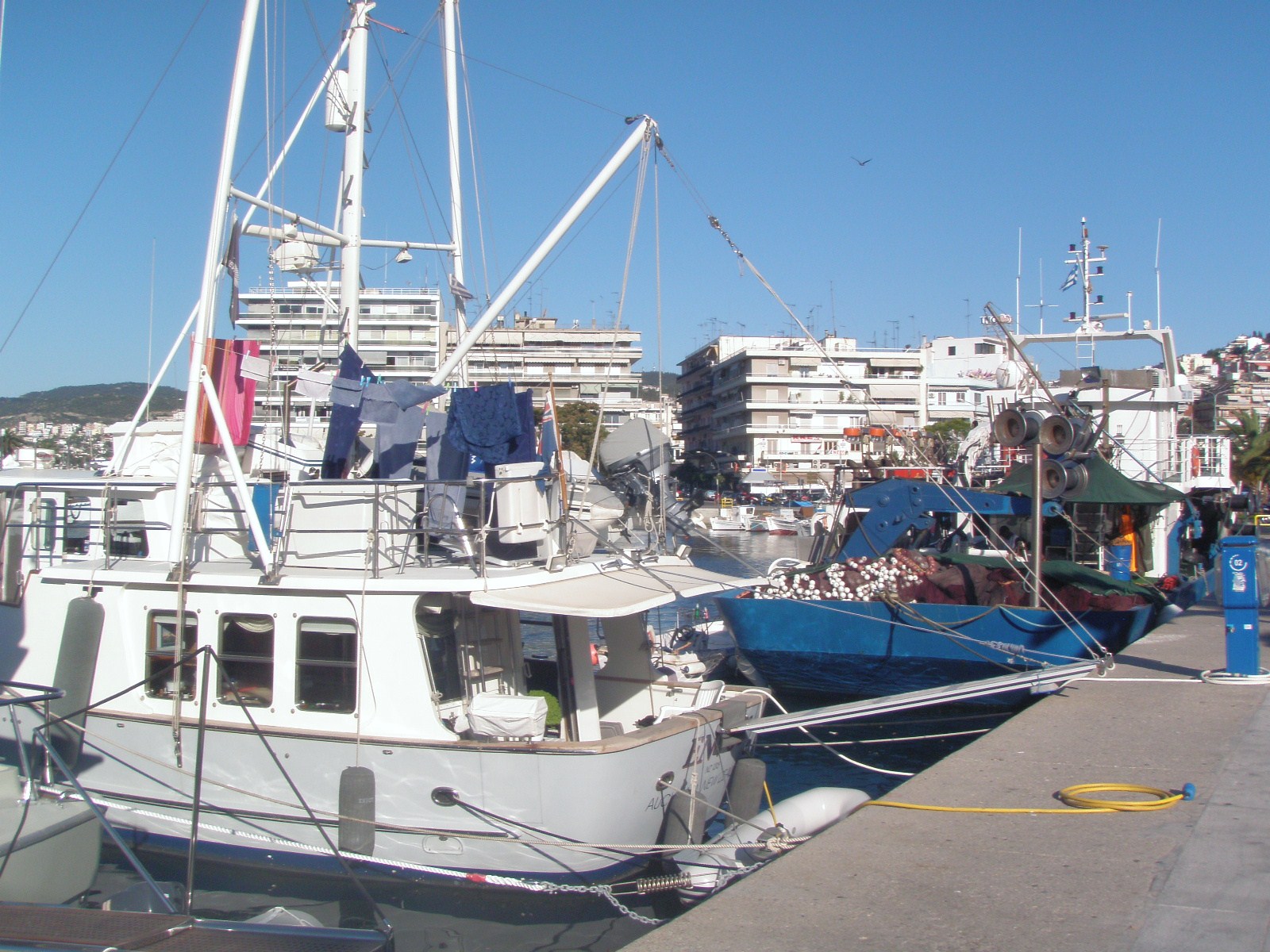
It’s always a bit stressful arriving in a strange harbour for the first time, not knowing if berths are available, where to berth, whether bow lines are provided or we need to use our anchor, if water and power is available, where the authorities are located etc. Some harbours have signs at the entrance advising VHF radio channels to use. Others send a guide boat out immediately a visitor arrives. At Kavala Harbour on the mainland coast there was none of this, and we glided in trying unsuccessfully to call Harbour Control on the radio. We saw a guy standing on the foredeck of a motor yacht. We headed over to him, and I asked Di to go out and ask him where we could berth, figuring he’d be more helpful to Di than to me. Sure enough, he told us it was OK to berth right next to him, and he helped us with our lines.
We berthed stern-to a busy quay which backs on to Kavala’s main street.
Apparently very few foreign boats visit Kavala, and we were the only cruising boat among a harbour filled with fishing boats, and local pleasure boats, so we attracted quite a lot of attention (in fact we’d not seen another cruising boat since leaving Limnos.)
An elderly lady came to see us, having noticed our NZ registration. She was born in Kavala, lived for 50 years in Wellington, and recently returned here to live, preferring the Greek weather to that of Wellington (can’t say I blame her – why wait 50 years!). She still gets a weekly copy of “The New Zealander” delivered. This newspaper is published in Australia for expat Kiwis, and the next day she brought a copy for us. She used to work for Mobil Oil, and knew one of our close friends – Don – who also used to work for Mobil – a small world!
Kavala is an interesting city with quite a history, having been inhabited since Neolithic times – that is the period from 10,000 to 3,000BC. Even St Paul came to visit here, so we were in good company. A prominent feature is a large aqueduct built by the Turks in the 16th century, and still in good repair. The castle here was originally built in the 5th century BC, and modified by subsequent invaders.
The guy who helped us with the lines is called Kostas, and he was really friendly and helpful with advice. Power and water is always an issue in these harbours because of poor maintenance, and Kostas let us connect into his power and water supply. He also gave us a large basil plant, telling us it’s excellent for keeping away mosquitoes. Time will tell on that.
Having spent some time in Greece waters again we’re reminded how cheap the restaurants are here – we’re getting excellent meals for about NZ$30 per head. That includes wine, all you can eat, great atmosphere and service, and even food for the numerous cats who invariably congregate around us. Very often wandering musicians come through the restaurants to serenade the patrons, but this is not for free, and when the tambourine is passed around some contribution is expected.
Ian & Patsy left us here, and the next post will cover Kevin & Diane’s visit.
We’ll be spending the next few weeks heading west along the mainland coast, until we head south to The Sporades.
TECHNICAL
Our fresh water system problem was resolved. It turned out to be that a seal on one of the replaceable filters had moved enough to block about half of the water flow. Now all OK.
We had some further starting issues with the Genset. A local (and seemingly very competent) engineer checked the connections to the relays again, left us with a spare and made up a wiring loom to bypass the state relay if we can’t start the engine. I also learned from him never to touch a capacitor, even with the engine off, as they store enough voltage to give a nasty shock. No other issues right now.
LOG (to 26/6/11): 54 days aboard since leaving Marmaris, 689NM cruised for 143 engine hours.