Tuesday, April 23, 2013

ENVOY LAUNCHED WITHOUT A HITCH

Envoy is currently berthed at Lefkas Marina, Ionian Sea, Greece.
Envoy went into the water without a hitch on a beautiful still and sunny spring day last Thursday.
Launching is quite a procedure. The travelift arrives (always at a different time to that booked), and we have to get off the boat and remove the ladder while the marinaras position the heavy-duty synthetic lifting straps. Although we are nervous, these guys have done this hundreds of times before, and have no qualms about walking under boats while they are suspended from the straps. With its diesel engine roaring and belching exhaust smoke the travelift slowly trundles to the dock and gently lowers Envoy into the water. We need about ten minutes to check for any seawater leaks before the straps are removed. Aboard Envoy this involves checking eleven different internal areas, but the marinaras are relaxed (“don’t worry, take your time my friend”) and enjoy a smoke in the sun while they wait.
We give the all-clear and turn the engine’s start key. Last shut down six months, ago the trusty Lugger roars into life within a second. We back out of the launching dock as the marinaras fend us away from its rough concrete sides, and head to our berth.
So far everything is working well, the only issue was a leaking seawater strainer downstream from the generator’s seacock. While we were home in New Zealand the engineers from Sailand replaced the very heavy-duty Edson manual bilge pump hose, as it was cracking. This hose runs very close to the clear plastic section of the strainer, and the strainer probably got damaged as they wrestled the old hose out. A replacement from Athens and been installed.
With the generator running we were able to re-commission the water maker (the high electrical power requirement of the water maker means that we can only run it using the generator). Today I flushed out the winter “pickling” chemicals from the water maker, changed the two fresh water filters, cleaned the heavy-duty seawater filter, and the water maker started producing quality water within a few minutes.
Somebody up there does love me after all!
In a country where bulk potable water is not available, and you can only drink bottled water, you can’t imagine how great it feels to be able to produce your own drinking water.
Because the leaking diesel tank has not been fixed we needed to put ballast into it to maintain Envoy’s lateral trim. Previously we used ten litre bottles of water, but we can’t really get enough weight into the tank with water, so we’re now using old anchor chain. We needed about 500kg in total, which is obviously difficult to handle and load in one length, so we cut it up into approx 20 kg sections packed into plastic bags to avoid rust from the old chain spreading to our tank. Anchor chain makes great ballast because it settles into the available space within a tank.
Now we’ve only got a few jobs to complete before we can start cruising, and plan to leave Thursday.

During the weekend we had a huge surprise to see a Nordhavn 47 come into Lefkas Marina and moor just a few metres from us. This superb vessel, called C’mon Girl, is owned by Canadians Guy and Lou Goodwin. We had a great night out with Guy and Lou, who have cruised from Italy heading to Marmaris, Turkey, and we shared a rental car on Sunday to explore the interior of Lefkas Island.

For all you non-technical readers of the blog – hopefully our work stops, fun starts and the next posting will be more interesting with plenty of pics.


Wednesday, April 17, 2013

ENVOY'S LAUNCHING IMMINENT

Envoy is currently on the hardstand at Lefkas Marina, Ionian Sea, Greece.

During the three weeks we’ve so far been here the weather has improved dramatically and most days are now sunny with temperatures in the low 20s. Activity around the marina has significantly increased, with many more owners arriving and preparing their boats for cruising; the silence now broken by grinders, hammers, motor scooters and the travelift moving boats on the hardstand.
In Lefkas town, shutters are coming off shops and tavernas closed during winter, and colourful umbrellas are now appearing on the waterfront (although it’s still too chilly to eat outside at night).

I am not an engineer or mechanic, just someone trying to learn and do as much as I can myself for reasons of safe cruising, independence, cost saving and having the full live-aboard cruising experience. Inconsistent and conflicting advice from “experts” is always a problem; here is an example. The main seawater filter for our water maker costs Euro 124 (about NZ$191). The previous owner said they don’t need to be changed annually, just removed and washed either annually or when the pressure on the gauge on the filter housing rises above an indicated level. But last year in Turkey the water maker technician told us this was incorrect and the filters must be changed annually regardless. Being out of these filters we bought two from a water maker mechanic we met in Piraeus in 2007, and he re-affirmed they can be washed (even though he’s in the business of selling filters). This kind of situation happens a lot and you need to be very careful whose advice you follow or you can waste money or make mistakes.

Our Yanmar propeller shaft modification is now complete, and all the parts re-installed. This was the critical job for launching Envoy and we’re going into the water tomorrow.
The leaking diesel tank issue has been complicated. After exposing as much of the tank as possible so that we could best see the source of the leak, we progressively filled it with fresh water, but nothing leaked out. The theory is that very light surface rust gathered and filled the small pinhole where diesel was leaking. We considered applying a small amount (e.g. under 1 psi) of air pressure internally, but this was considered to be too risky. This outcome is not what we expected; several hours of wasted labour costs, and now time has run out to investigate this further so we’ll spend another cruising season with the tank in ballast (to maintain Envoy’s trim). Coastal cruising in the Med we don’t need the lost fuel capacity, as the other three tanks can contain up to about 2,900 litres of diesel, which is about 480 hours of cruising (typically about 3 months). I now think the best solution to this may be to make the tank’s access port larger, remove the internal steel baffles, and install a heavy duty off-the-shelf flexible tank inside.
We’ve also delayed some other non-critical jobs in order to get cruising as our friend Chris arrives from New Zealand on 24 April and we want to get moving shortly after that.
I doubt there’s ever been a ship “set sail” with no outstanding jobs on their list!

Here’s hoping that all goes well with launching - that there are no leaking seacocks, that our three engines all fire up, and that the water maker and other equipment not yet tested all works. Read about it in a few days.


Friday, April 12, 2013

SLOWER THAN EXPECTED PROGRESS

We’ve now completed all of the out-of-water jobs we can do ourselves and are waiting for the leaking diesel tank and Yanmar prop shaft to be repaired.
Work started on the tank today – removing all of the plumbing attached to the exterior of the tank, then the stainless steel mesh, then a plywood facing which had to be destroyed to remove it, so a new plywood facing will be needed. Now the tank is much more exposed, and it’s been filled with water so that tomorrow they’ll use a miniature camera again to confirm the area of the leak. The final repair plan depends on just where the leak is.
The Yanmar prop shaft has been modified and is ready to be installed. We definitely needed to do this job because for example, if we have any future problems with the Yanmar gearbox we’d have to pull Envoy out of the water and remove the gearbox and prop shaft as one piece – and that makes no sense at all.
Our best guess for launching Envoy is now mid next week. Then there’s only a few jobs left to be done – most importantly starting the water maker.

Greece obviously has many economic problems impacting on the populace, particularly high unemployment (especially under age 30) and reducing benefits. A 61 year old shopkeeper told us he formerly received a pension of Euro 2,800 per month (about NZ$4,300) and has so far suffered five cuts, so that it is now Euro 1,200 (about NZ$1,846) per month. He also mentioned that at one point the government had no money, so the pension was not paid for three months. As a matter of interest, in NZ you don’t qualify for the pension until age 65 and for a couple the pension is about $2,548 per month (before tax). Medical care used to be almost free, but now, although accident treatment is free patients have to pay 25% of the cost of any medications.

I’m always surprised by the cost of dry-cell batteries, particularly “D” type at Euro 3.44 (about NZ$5.30) each. Some of our flashlights require four or six of these, whereas you can buy LED torches with “AA” batteries included for about Euro 5 (NZ$7.70). When replacing the “AA” batteries they are Euro 0.40 (NZ$0.63) each, and nowadays the small high quality LED torches are as bright as a large conventional flashlights. Sure you can buy Chinese D batteries for half the price, but they last next to no time, and when you need a flashlight on a boat you need it to work. We’ll be gradually moving over to LED flashlights.


Monday, April 08, 2013

ENVOY TAKING SHAPE

Daily we progress and tick more items off a very long list without adding too many more.
An unexpected issue has arisen with the Yanmar wing engine. Each year its prop shaft seal (which stops seawater coming into the boat) has to be checked after removing the prop shaft. Last year the shaft was stuck solid to a collar which holds the shaft to the gearbox. This year we got the shaft and gearbox removed as one piece (drawn forward internally) and taken to a machine shop where the shaft was removed. The problem is that the prop shaft has too tight a fit to the gearbox, not allowing sufficient movement for correct alignment of the shaft. Sailand are modifying the shaft, and machining the gearbox bearing to overcome this, which will take several days, and of course we can’t launch Envoy until this is done. The shaft seal is also worn and needs replacing. While access allowed, the clutch plate was also found to be in good condition, but cleaned up and treated for light surface corrosion.
So this job together with the repair to our leaking diesel fuel tank is holding us up - the last blog predicted we’d be cruising by 11 April, and our best guess now is a week later.

For a 23 year-old vessel Envoy is in excellent condition and her gelcoat and stainless steel gleams. Every year we invest in a machine cut-and-polish of the whole topsides and hull, and believe this has paid dividends. Of course we could do it ourselves, but this is seriously hard physical work taking two much younger guys than us about three days, plus another day to apply two coats of antifouling with a third coat around the waterline, as well as a different formulation for the three propellers (main, wing and thruster).
I’ve replaced most of the zinc anodes, but done them slightly differently this year. Previously they’ve been mounted snug up against Envoy’s hull, but I read that anodes should be mounted with a gap between the hull allowing the seawater to access the whole anode – so that’s what we’ve done.
So far we haven’t needed to buy too much, but we do shop around. Chandlers provide a valuable service of convenience, mostly being situated within marinas, but their prices are often very high. Needing some spray-on electrical contact cleaner a chandler’s price was Euro 12, whereas a hardware shop in town charged only Euro 5. In Turkey we had examples where chandlery shops charged several times the price we paid elsewhere. The moral of the story is that everything to do with “marine” seems to cost exorbitantly so wherever possible just buy your needs in a normal shop.
We met with the marina manager regarding booking Envoy into Lefkas marina for the coming winter. He says it’s no problem to leave Envoy in the water, but the hardstand is already full, and although he thinks there’s a 90% chance they can squeeze us in, there’s a 10% chance they can’t. We’ve decided to take this chance, and in the worst case winter Envoy in the water for the first time. There’s no problem about the safety of the boat from weather, as the wintering-berths are sheltered by buildings. In many marinas surge coming from large swells during winter gales is the major problem, but not so in Lefkas which is accessed from a canal. Of course the vast majority of boats here and at home are wintered in the water with no problems, and we can take precautions like closing all seacocks, and leaving the automatic bilge pumps on. Wooden boats are generally left in the water because their seams can open-up if they’re out of the water for too long. Overall we prefer to winter Envoy on the hardstand, but we’ll have to wait and see if that’s going to be possible. With Envoy in the water we won’t be able to use our storage cover, designed for use on land.
During winter we removed our anchor chain from its locker and stored it flaked over a stand at ground level, a practice which most boats on the hardstand follow. Although we always wash the anchor chain with fresh water at the end of season to remove salt deposits, storage in this way helps the winter rains to wash it further, and prevent rust spots forming where chain links touch. Up to now the bitter end of the anchor chain has been shackled to a ring in the anchor locker, but we wanted to change this arrangement to make it easier to discard the anchor chain in an emergency. What kind of emergency? Well for example we could be anchored in some bay during a gale, need to move and find the anchor is snagged and not able to be retrieved. Now we have shackled five metres of 12mm line to the last link of the anchor chain and secured the other end of the line to the ring in the anchor locker. This would allow us to let out the whole length of chain until the last link came through the hawse pipe onto the deck, and then we can secure the end of a long buoyed line back through the pulpit anchor roller to the last link of the chain, let go the other line, leave the anchor and chain buoyed for later retrieval, and move away. Of course Envoy has other combination chain/warp anchors for use in the meantime.

Tuesday, April 02, 2013

PROGRESS WITH ENVOY

It’s been showery and chilly here with daytime temps under 20dC, but we’re snug aboard Envoy on the hardstand. With Envoy’s cover on it’s a bit like living in a cave, but yesterday we removed the cover, so we now have natural light and can see the surrounding area.
This early in the season, many facilities and shops aren’t open yet and it’s not until early May that everything is in “summer mode”.
Early Monday morning we heard and felt a sharp “crack”, as though something heavy had fallen against Envoy. Inspection revealed that all was OK, and we concluded this must have been a minor earthquake. Minor quakes are common here, and even major ones are not uncommon in this region. Nearby Cephalonia had a giant quake in 1953, that levelled most buildings and tragically killed 476 people – a large percentage of their population.
Lefkas last had a serious quake in 2006, which badly damaged houses and caused widespread panic and minor injuries.
During this week most of the out-of-water jobs should be completed, and we hope to launch Envoy some time next week. From a technical viewpoint all seems to mostly OK so far.
Envoy’s storage cover was made in 2007 to protect Envoy through two or three summers while we returned to NZ to complete our work commitments. In fact we were away for 27 months and the cover lasted well. Since then it’s been repaired twice, but now again the fabric has small tears, and is wearing thin in several places. A rough estimate for the price of a new cover is Euro 4,000 (over NZ$6,000), so we’re planning to get the cover repaired yet again.
Last season we extended the length of our stainless steel swim ladder to make it easier to climb out of the water (us older folks have to think of such things!). This extension resulted in more leverage on the stainless steel tube, and subsequent bending. During winter the ladder has been repaired and reinforced with some additional stainless steel tube, so we hope this will be OK for the coming year.
The Lugger alternator has been reconditioned, and its noisy bearings replaced – very essential for battery charging.
Both RHIBs have had minor repairs completed and their engines serviced. The 25hp Yamaha needed a new tachometer, a new remote control lever, and replacement of a corroded hydraulic tilt pump.
A split on the main radar’s radome housing has been repaired, and our 23ft-long SSB radio aerial has been re-glassed as it was de-laminating.
Our Robertson autopilot’s hydraulic pump motor was repaired, but there seems to be some problem with its control – we won’t know more until we can do a sea-trial. In any case this we have two auto pilots, so we won’t do further work on this before our departure.
In our guest cabin two very sun-damaged and cracked acrylic hatches have been replaced, and their teak surrounds re-varnished.
A canvas repair shop has repaired or replaced a variety of squab covers, awnings and storage bags.
So the work continues, and in about a week from now we’ll have a clear idea of our departure date. Our target is to start cruising on Thurs 11 April. Our friend Chris O’Brien joins us for three weeks from 24 April for our cruise north to Montenegro.


Friday, March 29, 2013

TRAVELLING TO GREECE TO RETURN TO ENVOY

Tonight we’ll sleep aboard Envoy for the first time in 2013, on the hardstand at Lefkas marina. Our first impressions are that Envoy is much how we left her last October. The only damage noticed so far is to Envoy’s aging storage cover, which is wearing thin and has split in two places, apparently during a recent hail-storm.
Here in coastal Greece it’s early spring, and the locals say it’s been an exceptionally mild but wet winter and has rained constantly from December until just a few days ago.
Quite a lot of the work planned for Envoy during winter has been done, and importantly the source of the leak in one of the fuel tanks has been found. We meet with engineers today to find out how they plan to weld a repair in this difficult-to-access tank. I’ll post more on Envoy in a few days.

Emirates offered the best airfares, and also have a generous luggage allowance at 30 kg each. Only problem is the Auckland to Dubai flight is over 19 hours (including a brief stop in Sydney) making the first leg a very long haul, so we stopped in Dubai overnight to break the journey before our flight to Athens.
Coming back to Envoy we always have quite a bit of luggage as we procure things in NZ we can’t easily get where Envoy is located. When checking in at Emirates we were 7 kg over weight and were told it would cost us NZ$455 in excess baggage charges. After I explained we were away for eight months the check-in clerk took pity and reduced the charge to NZ$325. Fortunately our cabin baggage was not checked as that was over-weight by several kg too (you are allowed 7kg plus a laptop, plus a ladies handbag).
In Dubai we moved some weight into our already-bulging cabin bags and avoided any further charges for our nearly six hour flight to Athens.

From Athens we needed to catch a bus for the 5.5 hour trip to Lefkas, and during our taxi ride to the bus station near downtown Athens we noticed how little traffic there was. The driver told us that with the economic crisis, around 30% unemployment and increased taxes on petrol many people can no longer afford to use their cars, and there’s been a big shift to public transport. He added that crime has also increased and he’s been robbed twice while driving his taxi at night.
Waiting for about two hours at the very run-down Kiffisus bus station we were approached by numerous street vendors trying to sell goods including perfume, paper towels, cheap toys, cigarette lighters, sunglasses and pictures. They ranged from young children to the elderly and included a pregnant mother – the only person we bought something off - for one Euro. Since arriving in Lefkas several people have told us how bad things are for many Greeks, and that the general situation is expected to be worse for this year compared to last. Really there is no ray of hope for an improvement in Greece any time soon.
Greece has a close affinity to southern Cyprus, and there is much feeling here for the Cypriots who are losing something like 40% of any bank deposits over Euro 100,000. Of course there are also super-wealthy money-launderers from various countries (notably Russia) with large deposits in Cyprus, but the sorrow is for older people who’ve worked all their lives to save money for retirement only to lose a large part of their nest-egg in this way.

Saturday, March 23, 2013

THE THINGS YOU REGRET ARE THE THINGS YOU DIDN’T DO

“THE THINGS YOU REGRET ARE THE THINGS YOU DIDN’T DO” are the banner words of Kadey-Krogen Yachts’ advert in Passagemaker magazine, along with “Working hard is one thing, living your life to the full is another. You get only so many spins around the sun – what will you do with yours?”
I was pretty impressed with these words, nicely summing up why Diane and I are cruising at this stage of our lives. Of course it doesn’t have to be living on a boat, just living your dream, whatever that is.

Diane and I get back to Lefkas marina next Weds 27 March, and regular Envoy blogging starts again. For the blog last year we mostly worked on more and better quality photos integrated into the text. This year we’re going to work on including some video clips too. Interesting subjects coming up are visiting Montenegro and Croatia and reports on using marine iPad apps.

Meanwhile here is the completion of our cruise to Auckland’s Great Barrier Island aboard Consort.
Returning to Consort after a great late afternoon ashore smoking freshly caught snapper we found a pod of dolphins leaping playfully from the surrounding waters. We donned our wetsuits to join the dolphins, who seemed to enjoy our presence and approached us almost close enough to touch, providing a magical and memorable experience.
Like much of NZ the Barrier has some thermal activity, and we met some shore-based friends and walked about 90 minutes to the Kaitoke Hot Springs to soak ourselves in a hot water stream surrounded by dense forest.

Diane relaxing in the Kaitoke natural hot water springs surrounded by forest

To visit the springs you anchor in idyllic Whangapapara

The minerals contained in the natural spring are said to have healing qualities and we certainly felt calmed and relaxed in a scene that was totally tranquil except for the calls of native birds. Here in the wilderness we were thankful that NZ has no snakes or poisonous insects.
One day we visited artist and potter Sarah Harrison’s rustic studio in Tryphena Harbour, and had plenty of time to admire her work, chat and meet her family. Sarah makes unique pottery mugs with wide bases providing ideal stability for use on boats, and we ordered some to take back to our own boat in Greece.

Local artist Sarah Harrison with her children in their fascinating studio

Laurie outside Sarah's rustic studio set in the bush by Tryphena's waters-edge

After four years cruising the eastern Med we found it interesting to compare that experience with this. The Med is a very large area with quite diverse areas but here are some observations:
- Summer weather – Auckland’s climate is based on constant ridges and fronts moving in from the sea. Med summers are longer, warmer, generally more stable and less windy. NZ’s air is cleaner and therefore clearer, providing a more distant visible horizon and more beautiful sunsets
- Cleanliness – although we find the Med’s seas largely litter-free, sadly this is not the case ashore, whereas it’s very unusual to find much litter in NZ either on beaches or generally. The waters of the Med though are considerably clearer than we found around the Barrier.
- Points of interest – although the Barrier has fantastic natural scenery, so do many parts of the Med, while at the Barrier and generally in NZ there is little of real historical interest to see (the oldest building in NZ dates from 1840). In the Med we are fascinated by still-standing buildings centuries old and ruins dating thousands of years.
- Sea life – here there is no comparison and the Barrier wins hands-down with its variety and quantity of life. Snorkeling in the Med you rarely see any but the tiniest of fish whereas at the Barrier you see many species of good size and quantity. The NZ fishing is excellent whereas it’s poor in the Med (most fish being caught with nets).
- Anchorages – are excellent at the Barrier and also in most parts of the eastern Med. We find it more “atmospheric” anchoring in the Med, and surprisingly anchorages there are generally less crowded (although this would not be the case in the western Med)
- Support and safety – is much better in NZ with weather now-casting, VHF marine radio trip reports and the availability of Coastguard to assist in the event of problems. In the Med there is little observance of collision regulations or much use of common-sense with regard to dangerously high speeds in proximity to other vessels. The typical NZ cruiser is far more aware of these issues.

,,, and you can surf at one of the Barrier's several famed beaches, here Medlands

Consort is an outstanding example of a 12 metre planing cruiser, and kept us safe and comfortable for six superb weeks. Now though, we’re accustomed to the more sedate cruising style of our passagemaker and have not been converted away from that.
All too soon our sojourn enjoying Consort and the unique character of the Barrier came to a close, but at least we had April to November cruising aboard Envoy back in the Med to look forward to.
GETTING THERE
The Barrier can be reached by scheduled flights or ferry from Auckland, but by far the best option to fully indulge in what the Barrier has to offer is to visit by boat.


Sunday, March 17, 2013

CRUISING ABOARD CONSORT PART 2

A CRUISER’S DELIGHT
We spent the first few days relaxing, fishing, swimming and exploring some of Barrier’s magnificent sheltered anchorages, and soon found that a couple of hours fishing still got our adrenalin rushing and provided a delicious dinner. Our bodies had become used to the warm waters of the Med, and although we found the Barrier’s 18 degree (65 dF) sea temperature a little chilly we enjoyed swims in the clean water most days.
The mid-summer weather was dry, fine and sunny, but unusually windy conditions prevailed, and most days we encountered over 20 knots. One night exceptionally strong winds were forecast, but the Barrier has many sheltered bays with good holding, and even though we experienced winds well above 40 knots none of the many visiting anchored boats reported major problems.
The Barrier doesn’t exactly have a busy social calendar, but one not-to-be-missed event is Port Fitzroy’s Annual Mussel Festival. Dotted around the Barrier are several commercial mussel-growing farms and the Festival promotes mussels as a delicacy able to be prepared in a wide variety of mouth-watering ways, much like Forrest Gump’s shrimps. Most visitors to the Barrier are easily identified by designer t-shirts, shorts and caps, while many of the locals look like they got lost after Woodstock and just turned up there. We enjoyed wandering around some of the market stalls, listening to local musical talent, and washing down sumptuous mussel fritters with cold beers.

A great armosphere among the stalls at the Barrier Mussel Festival

Much as we enjoy spending time aboard boats it’s great to go ashore for a change, and we often had late afternoon drinks on different beaches while listening to music from our ghetto-blaster and smoking fish using a portable smoker; the taste of freshly smoked fish on bread and butter with a glass of chilled sauvignon blanc is hard to surpass. The unique smoky flavour is provided by heating up sawdust from native manuka shrubs, which abound on the Barrier.
An excellent place to meet fellow-boaters ashore is Smokehouse Bay, where land has generously been made available by the Webster family to build a communal bathhouse, fish smokehouse and open-air laundry. The facility stems from times when cruising boats were much smaller than today, and few had such luxuries such as hot water or showers. Swings are provided for the kids, and boats can replenish their fresh water here and use a sturdy grid during low tide for hull cleaning or below waterline repairs.

Smokehouse Bay has a grid for cleaning hulls at low tide and a bathhouse

The rustic bathhouse
 
 
Diane uses the primitive but effective laundry facility


Enjoying some time ashore with Consort in the background

A BBQ ashore on a gorgeous sandy beach

Several years ago heavy rain caused a landslide that destroyed most of this facility, and thankfully a small band of enthusiastic volunteers quickly re-built it using donated materials and services.
One day as we loaded gear back into our tender from an excursion ashore a curious stingray glided towards us with wings flapping gracefully. These generally shy creatures are not aggressive, but their spiny tail can cause injury so we gently prodded our visitor away with a stick … more to follow.

Tuesday, March 12, 2013

Marine Traffic ("AIS") iPad app

An excellent iPad app is Marine Traffic at $3.99, and if you don’t have AIS this could be useful to have. The app is a community service project hosted by the University of the Aegean, Greece. Volunteer base stations around the world equipped with AIS receivers use PCs to load the AIS info to the app via the internet. The app displays the data on a very good quality map (not a marine chart), for most worldwide coastal regions, e.g. all of coastal USA (the limitation being VHF radio range). The map can be zoomed in or out and has excellent zoomed-in detail. An option is to display the information on a satellite map, which then includes features in the sea. Any vessel using AIS is displayed on the map as an icon with the vessel’s name, and by clicking on the icon a pop-up appears showing considerable detail about the vessel, and in most cases one or more photos. You can display the vessel’s track on-screen, but not the current course and speed (although the pop-up displays the vessel’s max and cruising speed).

You can activate another pop-up which will list all vessels using AIS within about 10 miles from your position, showing their actual distance and bearing. Then you can display more details about those vessels if you choose to.
There is also the option to filter out different classes of vessels.
The map also displays many (but not all) navigational aids, and by clicking on their icon a pop-up appears with their details, and in many cases photos.
Wind direction and strength can also be overlaid on the map both for the present and for the forecast next 24 hours in 3 hour increments.
You can also track vessels out of range of your own AIS, in fact anywhere in the world that is covered by the app.
Your constantly updated position is displayed on the map, but your position is not being advised to AIS equipped vessels.
Now here are the disadvantages. The app is not displaying the information from the AIS transponder in real time, as an AIS receiver does. It is being relayed through the internet, and is several minutes behind real time (the app says up to maximum 1 hour behind real time but I’ve not found this to be so, and typically just a few minutes). Also you must be able to go on-line.
This is not a substitute for AIS, nor is it supposed to be used for navigation, but if like me you don’t have AIS this is an excellent second best, a useful back-up or portable system, and a means of tracking out-of-range vessels. See marinetraffic.com for more details.
I don’t have any connection with this app other than being a user.


Monday, March 11, 2013

CRUISING ABOARD CONSORT PART 1

This blog is specific to cruising aboard our Nordhavn 46 passagemaker, Envoy, and we have so far chosen not to deviate from that format or include coverage of our activities while away from Envoy.
During the northern hemisphere’s winter we’ve been back in New Zealand (NZ) for their summer (yes we’re fortunate to get the best of both worlds), and spent six weeks coastal cruising around Auckland’s stunning Hauraki Gulf, mostly at Great Barrier Island aboard a 12 metre (40ft), twin sterndrive-powered, planing cruiser called Consort. As the bulk of our Blog readership being North American and European may enjoy reading about Great Barrier, we’ve decided to post details and images of this cruise onto our Blog in three parts.

This Salthouse Corsair - Consort, was our home for 6 weeks

GREAT BARRIER ISLAND – A CHARACTER-FILLED SUB-TROPICAL PARADISE
Firstly imagine a sub-tropical island paradise, described by Sir Peter Blake as his favourite island in the world, with a population of only 500, no electrical power, no traffic lights, abundant sheltered anchorages, some of the world’s finest surfing beaches, pristine waters for swimming and diving, and where every day you’re virtually guaranteed to catch your own dinner from the sea. This is Great Barrier Island (locally known as “the Barrier”), about 50 miles north-east of Auckland, and so-named by Captain James Cook in 1769 because the island protects the mainland coastline from the rollers of the mighty Pacific Ocean.
Then imagine you have a long-standing friend who rarely uses his magnificent boat, and happily loans her to you for six sunny mid-summer weeks exploring this paradise.
Well that’s exactly what happened to us, and I was thinking this was too good to be true as we cruised to the Barrier aboard Consort, a 12 metre Salthouse Corsair motor vessel capable of well over 20 knots, and quite different to our passagemaker we live on most of the year. Consort is owned by Auckland Coastguard-legend Graham Reiher, who spent several days with us last year aboard Consort around some of the Greek Ionian Islands. Although we’ve spent many happy times at the Barrier previously, it had been several years since our last visit, and we looked forward with great anticipation to visiting some of our favourite spots.

Consort anchored at the Barrier's stunning Broken Islands

FROM ANCIENT MAORI WARRIORS TO THE PRESENT
The Barrier has a rich history ranging from original Maori occupation over 700 years ago, to the arrival of Europeans in the 1840s who commenced whaling, kauri timber milling, gold mining and shipbuilding. World War 11 fortifications abound, and there have been numerous shipwrecks including that of the Wairarapa claiming 121 lives in 1894. The world’s first regular airmail service started here in 1897 using pigeons to carry messages to the mainland until a telephone service commenced.
Nowadays the Barrier is home to many alternative lifestylers, artists and potters, and even has its own “Barrier time” system, meaning nothing happens on-time or in a hurry.

THE BARRIER’S ATTRACTIONS
Sea life around the Barrier is prolific and we regularly see whales, orcas, small sharks, dolphins, stingrays and penguins as well as being able to fish for several delicious edible species, and dive for lobsters and shellfish such as mussels and scallops.

Sharron and Doug with a large John Dory

Carol holding a kahawai caught trolling

Diane with two good-sized NZ rock lobsters caught scuba diving

Alice and John enjoy delicious mussels fresh from the sea
 
Diane holding two snapper - the most common species caught and delicious eating

With spectacular beaches, native forests, and a rugged interior ranging up to Mt Hobson’s 621 metres, the Barrier is a mecca for outdoors enthusiasts enjoying hiking, mountain biking, sailing, fishing, diving, surfing, kayaking, camping, and horse-riding, while less adventurous folks can spoil themselves in boutique lodges, enjoy spectacular scenic drives by rental car and visit some of the island’s few but rustic and quirky restaurants, bars and cafes ... more about the Barrier to follow.


Tuesday, February 26, 2013

SUMMARY OF ENVOY’S 2012 CRUISE AND CRUISING PLANS FOR 2013

We returned to Envoy in Marmaris last April and spent longer than expected (five weeks) getting Envoy into cruising trim. Normally we’d expect to be ready to cruise in two to three weeks, and the main issues we had were awaiting the arrival of new batteries, repairs to the water maker and removing a failed generator from the wing engine after finding it not repairable.
Leaving Turkey we cruised to the Greek island of Symi, then west across the Aegean Sea stopping at the islands of Tilos, Astypalea, Anifi, Santorini, Ios, Amorgos, Skhinousa, Naxos, Paros, Folegandros, Kimolos and Serifos. Then we cruised around the Greek mainland area known as Peloponnisos, including Kithera Island, to the Ioian Islands of Kefalonia, Ithica, Lefkada, Meganisi, Corfu, Paxos and some adjacent Greek mainland areas. We left Envoy at Lefkas marina in mid October having cruised 1,743nm. This was our fourth year cruising the Med totaling 9,326nm.
PLANS FOR 2013
We arrive back in Lefkas on 28 March and expect to spend about three weeks preparing Envoy. Quite a lot of maintenance was to be done while we’ve been away, and we hope to repair the leaking starboard forward diesel tank before we depart, although this is not critical.
This year we plan to spend the first few weeks in the Ionian Islands then in May cruise north to Albania, Montenegro and Croatia before returning to the Greek Ionian Islands around September as the weather gets cooler in the north. Once again we’ll leave Envoy at Lefkas marina for the winter, and return to New Zealand 20 November giving us a cruising season of over eight months. There’s a huge amount to see in Croatia with something like 1,000 islands dotted along the coastline, and many cruisers tell us that Croatia offers by far the best cruising territory in the Med. Consequently we expect to spend much of next year, 2014, also around Croatia.

Wednesday, February 13, 2013

FINISHING SEACOCKS

Next post will focus on Envoy's cruising plans for 2013.
Well-known and respected marine technical author Steve D’Antonio reviewed the last two posts re seacocks and added the following additional information.
Ideally, any seacocks obtained in the US should comply with ABYC H-27, which in turn requires compliance with ANSI/UL 1121. Be careful, however, just because a valve says "UL" on it, does not mean that it is UL 1121, the latter being the designation for "SEA VALVES" and not simply any ordinary valve.
In Europe, because of a spate of corrosion related valve failures, a standard has been established that calls for valves made of the appropriate alloy to be embossed with the letters DZR, which stands for 'dezincification resistant'. Look for this on any metallic valve or seacock used with raw water and offered in the EU.
Among the most common defects related to seacock installation is the use of non-compatible threads. Common through hull or skin fittings rely on straight, parallel or NPS threads, while most common in-line valves utilise tapered, cone-shaped or NPT threads. While the two can be forced together, they typically seize after just two revolutions, offering very little engagement. While it seems obvious that one would not make such a union between to clearly incompatible threads, it's done on a regular basis by boat builders, boat yards and do-it-yourselfers. I encounter it constantly, and the practice is often vehemently defended by those who practice it; rest assured, it violates the most basic principles of engineering as well as ABYC guidelines and those of many manufacturers. True seacocks on the other hand, utilize NPS or straight threads that are designed to properly engage those of through hull fittings.


Thursday, January 31, 2013

ALL ABOUT SEACOCKS – PART 2

Continued from last Blog posting.
Polymer composite seacocks
Polymer composite is another reliable material for the manufacture of seacocks, such as those produced by New Zealand-owned Tru-Design Plastics (TDP). These are sometimes referred to as “Maralon”, which is just a brand name of one polymer composite.
TDP’s glass-fibre reinforced polymer ball valves are fully compliant with all standards including the demanding ISO 9093-2 standard requiring that the ball valve and skin fitting continue to operate while a 1,500N (155kg) weight is suspended from the end of the fitting. TDP are also believed to be the world’s only producer of polymer composite fittings to gain the prestigious Bureau Veritas approval for through hull fittings and ball valves (Certificate Nbr 27801/ AO BV).
Polymer composite seacocks are about one sixth the weight of bronze (which can be particularly important in some sailing yachts and planing power vessels), corrosion free without the need for bonding wires, and price-competitive.
But just as there are seacocks produced from inappropriate metals there are low quality seacocks produced from polymer composites offered by some manufacturers, so in all cases be sure to select seacocks with parallel threads, the necessary approvals for marine use, and never use standard domestic water supply plumbing fittings in below-the-waterline seawater applications.
What should the boat owner do?
Firstly locate and document the internal and external location and function of every seacock and through-hull on the vessel. Check they are supplied from reputable manufacturers whose products meet the necessary marine standards and not subject to corrosion in sea water.
All seacocks should be accessible and operable, and if they are not able to be closed they should be serviced at the earliest opportunity, particularly if they are below the waterline. Don’t be concerned if bronze seacocks have a greenish tinge, this is normally only non-harmful verdigris, formed when copper alloys are exposed to air or seawater.
The owner should also check that the correct quality of hoses for below waterline use are installed, that two marine grade 316 stainless steel hose clamps have been used on all fittings, that these clamps are tight and in good condition, that there are no water leaks, and that the electrical bonding wires are connected and not corroded. Some stainless steel hose clamps have worm screws produced from inferior grades of stainless steel, and these need to be checked and treated with anti-corrosion grease. Seacocks should also be operated occasionally, for example monthly, to ensure they are working correctly, and this also keeps the owner familiar with their location and operation.
A selection of tapered soft wooden plugs should be kept in a handy location to stop the flow of water through any seacocks which do fail.
Should I close my seacocks when leaving the vessel?
This depends on how long the vessel is being left unattended, and on the personal choice of the skipper. Most skippers would not close their seacocks if leaving their vessel unattended for a day, while many would close their below waterline seacocks if leaving the vessel for more than a day. In my opinion it would be foolhardy not to close all below waterline seacocks when leaving the vessel unattended for more than a few days. Regularly closing and opening the seacocks is good for them, as well as constantly reminding the skipper of their location. However there is a danger of inadvertently leaving one or more seacocks closed when next using the vessel, leading to possible damage of the equipment they supply water to. To easily reduce this risk the skipper can place a sign on the ignition key as a reminder of closed seacocks.
Another solution is to install seacocks which are able to be remotely monitored, such as the polymer composite seacocks produced by TDP. These can be wired directly to equipment, for example an engine, to prevent it from being started if the seacock is in the closed position.
Selection of seacocks produced only by reputable manufacturers to recognised standards using correct materials such as bronze or polymer composites, together with their regular inspection, operation and maintenance will greatly reduce the risk of problems in this vital area.

Tuesday, January 22, 2013

ALL ABOUT SEACOCKS – PART 1

This posting and the next one are definitely intended for the technos and are a précis of an article I wrote recently for a New Zealand boating magazine.
Seawater constantly tries to find weaknesses in your hull integrity to gain entry. If a leak occurs, flooding can take place at extremely high rates with possible catastrophic consequences; for example a 25.4mm (one inch) hole, 610cm (two feet) below the water line will allow 106 litres (28 gal) per minute, or 6.4 tonnes per hour of water to enter the hull. Leaks and flooding often occur as a result of faulty seacocks or the hoses and fittings connected to them.
What is a seacock?
Seacocks are used where liquids are required to pass out through the hull, for example toilet waste from heads, as well as in through the hull, for example seawater used for cooling engines or flushing heads. A seacock usually consists of a skin fitting that passes through the hull and a ball valve. It performs a vital function because it can be closed when necessary, for example to clean internal seawater strainers, or to stop the flow of water during routine maintenance of below waterline components, or if a problem occurs with a downstream item of equipment, a hose or a fitting.
It is common for boats to have something like 20 seacocks, for example Envoy has 23, and sinking can easily occur if only one seacock should fail.
Highly respected boating author, Nigel Calder, writes that despite the critical importance of seacocks to a boat’s safety, marine surveyors undertaking boat inspections find that 40% to 50% of seacocks are unable to operate (mostly stuck in the open position), 25% can be reached only with difficulty, and 5% to 10% are totally inaccessible from inside the boat, making their installation a virtual waste of money.
What is the problem?
Even relatively new boats have been known to sink because of defective seacocks, and recently in Europe there has been a series of sinkings and near-sinkings caused by seacock failure, particularly with boats built by some of the mass-producers.
Largely these problems have resulted from using seacocks made from inappropriate materials, and have been in two areas. Firstly, there has been corrosion of the ball in the seacock’s ball valve, resulting in the ball being unable to rotate against the synthetic seal in the valve to stop the flow of water. Secondly, ball valve bodies have been corroding where standard brass has been used in their manufacture. Brass is an alloy of copper and zinc, and corrodes in sea water just as a sacrificial zinc anode does, leaving a porous copper residue that will fail under the slightest pressure.
While the most highly recommended materials for producing seacocks are bronze or polymer composites, some recent research has found that many European boat builders using metal seacocks don’t even know what type of metal they are produced from - most surprising considering the vital function that seacocks serve.
Traditionally seacocks have been produced in US and Europe using bronze, which offers a trusted and reliable solution, its only disadvantages being weight (although this is not an issue for all vessels) and the potential for galvanic corrosion.
Nowadays more boats are kept in marinas and connected to shorepower, increasing the incidence of galvanic corrosion, caused when two different metals are in electrical contact with each other while immersed in seawater, which acts as an electrolyte. Electrolysis can even occur if the metals are on different boats, both using shorepower and therefore connected electrically, or it can occur if there is a problem on a boat with stray-current from faulty electrical equipment or wiring.
The risks of galvanic corrosion can be minimised by using a galvanic isolator or an isolation transformer, and by connecting together all of the seacocks and other metal components of the boat with a “bonding wire” (an electrical cable that picks up stray current and sends it to the boat’s ground before it can damage metal components).
Groco produce highly respected and reliable seacocks and accessories using bronze, with a range to suit all applications. These all meet the stringent Underwriters’ Laboratory (UL) standard and have excellent features including (depending on model) a large flanged base for rugged mounting, in-situ serviceability, terminals for attaching bonding wires, drain plugs for winterising and to spray in anti-seizing lubricants, ptfe seats and seals, a patented ability to change the opening and closing handle’s position, and an additional side port for connecting a bilge pump.
In recent years some seacocks have been produced in Asia using lower quality bronze, and these have caused problems, so it is prudent to stay with proven brands such as Groco.
Some manufacturers have also produced seacocks from chrome-plated brass, and these need to be treated with caution, as standard brass is not corrosion resistant in salt water, and when the chrome plating wears off there can be considerable corrosion problems with the unprotected brass, resulting in the eventual failure of the seacock.
To be continued …


Sunday, January 13, 2013

COSTS OF THE CRUISING LIFE

As many readers are interested in what it costs to live aboard I like to re-visit and update this important aspect of the cruising life periodically.
Firstly I’ll re-state a few pertinent facts (see Blogs 16 April 2011, 10 June 2011 and 22 January 2012 for more details), then I’ll comment on our costs during 2012.
How much different is the cost of living on a boat in the Med, compared to living at home and keeping a similar boat on the marina?
As a general statement actual living costs such as food, beverages, “household” supplies and personal spending are about the same for us cruising as when home in New Zealand. Maintenance is dearer due to the higher cost of parts and greater distances traveled. What also bumps up costs is travel to and from your boat (very few cruisers don’t visit “home” once each year), additional fuel for the longer distances cruised, and sightseeing ashore – particularly rental cars and accommodation (occasional travel inland away from the boat is well worth the experience in the many interesting, new areas). Casual marina prices are also high, e.g. for our 14 metre Nordhavn 46 typically about NZ$130 (US$108) per night plus power and water. You pay considerably less (or sometimes even nothing) in town harbours, particularly in Greek waters, but the best option is to anchor wherever possible, which is always free.
Some costs are fixed and are for the whole year, such as insurance, winter marina, travel, most regulatory costs and some maintenance, while most other costs including living costs and fuel are variable depending on the time spent aboard and the distance traveled.
Maintenance and fuel will vary greatly depending on the size, type (displacement or planing) and the age of the boat as well as the distance cruised.
During 2012 we spent 200 days aboard, and cruised 1,736 miles for 336 engine hours.
Excluding living costs maintenance was the largest cost at NZ$26,200 (US$21,700). Although this sounds quite a lot, it’s about what we expected at 5.4% of Envoy’s estimated value, and has been consistent on average over four years cruising.
Major portions of the maintenance cost were new house and bow thruster batteries at NZ$5,700 (US$4,700), maintenance of Lugger exhaust system NZ$4,500 (US$3,700), repairs to water maker NZ$3,700 (US$3,100), cosmetic maintenance and antifouling NZ$3,000 (US$2,500), repairs to Yanmar wing engine NZ$1,700 (US$1,400), repairs to windlass NZ$1,400 (US$1,200).
Second largest was fuel at NZ$9,700 (US$8,100) including 3,440 litres (908 gal) of diesel, petrol for the RHIBs, engine oil and lpg for cooking.
Third was marina and regulatory costs at NZ$7,500 (US$6,200), while fourth was boat and travel insurance at NZ$6,100 (US$5,000).
Communication costs including internet and phone is significant at about NZ$4,000 (US$3,300), and although this could be reduced by using only WiFi, we prefer to stay connected all the time so use pre-pay USBs for internet access.
Diane and I look at this not as “cost” but as our “investment in fun”.

Saturday, December 15, 2012

ENVOY’S END OF SEASON TECHNICAL ISSUES – PART 2

Lefkas Marina is well situated, being accessed from a canal so not subject to surge or swell, close to Lefkas town and well organised.

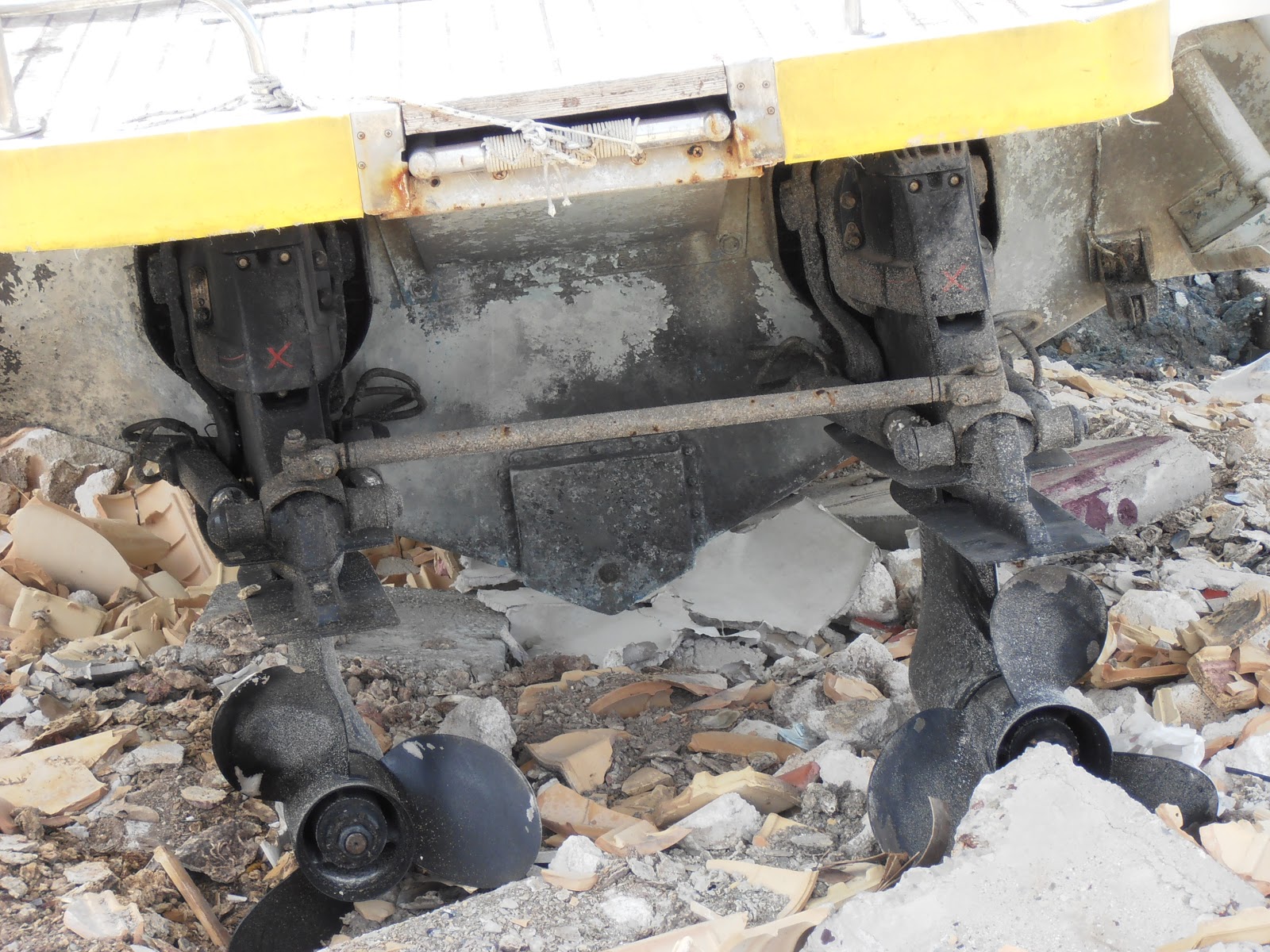
At the marina we saw the sad sight of this sterndrive-powered cruiser lying on the hard with its propellers half buried in rubble - probably not going to sea again any time soon.


This reproduction of an old sailing ship was very interesting though

Normally we complete our Med cruising early November, but this year wanted to return home in time for our son’s wedding. We allowed 2 weeks to prepare Envoy to leave for the winter, but could have completed all tasks within 10 days, or even less if we’d started some jobs while still cruising.
Lifting Envoy onto the hardstand for winter storage, we found the hull was in excellent shape as would be expected after only six months in the water.

Envoy being lifted onto the hardstand

Below the waterline including the propellers, was all in good condition with minimal marine growth

I already mentioned some of the end of season technical work in our last posting. and the list continues ...

- Our life jackets had not been tested and certified for at least the time we’ve owned Envoy (six years), so they have all been taken away for checking during winter
- Our Raytheon radar’s protective radome has a crack, temporarily repaired with duct tape. Sailand are going to remove this for inspection and repair or replace it.
- Our painted aluminium mast has a few spots where paint has come off, allowing some minor surface corrosion. These spots were inspected and found to be non-structural, but will be masked off, sanded back and re-painted when we return.
- Before we left Marmaris our Yanmar wing engine’s variable speed generator that provides 120 volt AC current failed, and was removed from the engine. This was made by VST Corporation, Seattle, who is no longer in business. There is severe mechanical damage to the aluminium generator housing, which has “blown apart,” as well as the stator needing to be completely re-wired. This generator was nice to have rather than essential, because we get 120 volt AC current anytime the Lugger engine is running or when using the generator. It can’t replace the generator, as only the generator has sufficient Kw to run the water maker. However using the wing engine at anchor to power the refrigerator and charge the battery banks did give us a reason to regularly run the wing engine. Sailand are looking into this and coming up with a price, but frankly we hadn’t missed it too much. There’s also an argument that the wing engine should be just that; an emergency get-you-home engine, not complicated by having an add-on generator.
- Since we lengthened our stainless steel boarding ladder earlier in the year to make access out of the water easier, there has been more leverage on the ladder causing bending and fracture of the stainless. This will be repaired again, and some extra stainless steel rails welded on to provide more stiffness and rigidity.
- The Lugger’s alternator with noisy bearings has been given to Sailand to recondition.
- One of our two Shurflo domestic fresh water supply pumps failed on the last day of our cruise. This has been removed for repair during the winter.
- Our domestic water heater has some exterior calcification around discharge taps and plumbing. This is difficult to access due to the heater’s cover. Sailand will remove the cover, clean up the calcification, check for leaks and reassemble the unit.
- On Envoy’s foredeck are three hatches. Two acrylic hatches are cracked and need replacement, and all varnished teak surrounds going through the deck need to be stripped back to bare teak and re-varnished.
- Our Whale emergency hand bilge pump’s hose was damaged when it accidentally came into contact with the propeller shaft. This was inspected and can be repaired in-situ during the winter.
- The Salon’s port side windows will have new seals fitted.
- Our smaller RHIB – a Valiant 2.7 metre – needs a repair to the wooden transom which is coming away from the port pontoon. The RHIB was removed to be done during winter, and its Honda 2.3hp outboard also removed for servicing.
- Various vinyl squabs, awnings and covers were removed for repair during winter.
-We had to get a crane in to lift our larger RHIB from Envoy’s boat deck. The Yamaha outboard has some corroding hydraulic pump parts that we’re going to get replaced, as well as getting the engine serviced and a faulty tachometer repaired. The crane was enormous and could probably have lifted Envoy off the ground.

A crane lifts Envoy’s RHIB off the boat deck for servicing during winter


One of our last jobs was to fit and secure Envoy’s full storage cover to provide protection from the winter rain.

Envoy snug for the Greek winter under her full cover

But wait ... there's more - yes the Blog will continue at regular intervals with a roundup of 2012, plans for 2013, and a new subject.


Friday, November 30, 2012

ENVOY’S END OF SEASON TECHNICAL ISSUES – PART 1


We are home in Auckland, New Zealand, for the northern hemisphere winter, while Envoy is in Greece's Lefkas marina.
There is so much technical activity at the end of a season’s cruising that I’m only going to mention specific problems or items of interest, and not the myriad of routine jobs such as oil and filter changes. Even this is going to require a couple of postings.
The contractor we selected to assist us, Sailand, have a great team and we met four of them – the owner/manager, a diesel mechanic, an electrician, and a general mechanic.

At a meeting aboard Envoy with the manager to discuss the whole work program, and what needed to be done before Envoy was lifted from the water, he made some excellent suggestions including running the two seawater cooled engines (wing and generator) plus all seawater pumps with fresh water and then glycol, when Envoy was on the hard. We’ve not done this before, but we thought removing all the salt from the systems was definitely a good idea. When we did this later, it took about four hours.

Firstly the diesel engineer checked out Envoy’s issue of the main Lugger engine running too hot at high (above 1,800) rpm. After the engineer inspected the whole system we started up the engine and went for a sea trial. The engineer made some adjustments to a bypass valve on the keel cooler, and the engine ran much cooler; in fact I was able to take the rpm up to 2,000 without over-heating, which only started at 2,200 rpm. I’m not sure at this stage how he achieved this, and will check this out further on our return.
To put this issue in perspective, Envoy generally cruises at 1,450 – 1,650 rpm, and has no over-heating issues at those revs, but now we will have a much wider operating rpm window. The engineer wants to make some further adjustments and check the thermostat and adjacent areas. The objective is to be able to run at wide open throttle (WOT) of 2,400 rpm without over-heating, but Envoy has never done that, even with the previous owners, and provided we can run up to 2,000 rpm without over-heating I’ll be happy.

He also checked our starboard forward 860 litre capacity diesel tank that has been ballasted with bottled water since a leak developed early last year. The problem here is lack of accessibility, although there is an inspection hatch on the top of the tank. The engineer plans to use a small remote video camera to inspect the seams. The camera’s image is expanded using a laptop to find any cracks and holes. This sounds very clever, and we hope it works. We don’t need the additional fuel capacity (with 2,900 litres of capacity in the other three tanks) but I do want to get it repaired and back in use to avoid corrosion, and to better control Envoy’s trim.

The electrician checked our non-working Robertson auto pilot. Envoy has two independent autopilots so this failure had not been a problem for us. I had assumed (never assume!) this failure to be an electronics problem, but the engineer quickly found it was a 12 volt motor problem – it’s only running intermittently. So this will be removed and serviced or replaced.

He also removed our 27 foot long SSB whip aerial, which is getting badly frayed, and this will be repaired during winter.
A damaged Garmin GPS antenna was also removed for repair (this was damaged by our boat cover resting on it during last winter).

Next post will cover other technical issues to be dealt with during winter, and “guardianage”.

Tuesday, November 20, 2012

LEFKAS MARINA AND GREEK REGULATORY ISSUES

Back home in New Zealand, this posting takes us up to second week October.

We’re very impressed with Lefkas marina. It’s very sheltered because it’s accessed from the Lefkas canal, so immune from any waves or surge caused by gales and storms.
It has capacity for 620 boats, including up to 45 metres long, but we’ve seen very few boats here above 20 metres, and mostly much less. The hardstand has capacity for 280 boats.
It’s much smaller than Turkey’s Marmaris Yacht Marine marina, and has a great relaxed “feel” about it. For example there are two travel lifts here, but we’ve hardly seen them move; whereas at Marmaris they’re going all day and well into the night. It’s also decidedly cleaner here with less general litter and junk lying around.
The technical facilities seem to be good, and we’re using Sailand, a firm recommended by a local professional British yachtsman and surveyor – so far, so good.
The marina has several bar/cafes and the interesting town of Lefkas, with many shops and restaurants, is only ten minutes walk. There’s also an excellent bus service from Lefkas to Athens and other destinations, as well as an airport at Preveza with flights to many parts of Europe.
Lefkas Marina is slightly dearer than Marmaris, and the cost for us is Euro 480 (about NZ$762) per month including time in the water, time on the hardstand (same cost), lift out, lift in, high pressure wash, propping charge, hire of steel supports, electricity and water and 23% VAT.
We found one other Nordhavn here – a 47, but they have now set off for Gibraltar and an Atlantic crossing.
We met up with A1Yachting’s local representative, Yvonne, who has been a great help. We’ve used A1 in Greece a lot for both regulatory and technical issues, and found them to be excellent. To re-cap the regulations and our situation, under the Schengen Treaty cruising visitors from outside the EU can only stay in Greece for 90 days in any 180 day period. However we were able to circumvent this by clearing into Greece as a professional captain and crew – which gave us a 180 day visa. Nevertheless, because we’ve been in Greece for longer than 90 days we still have to pay a cruising tax calculated on the vessel length – in our case 13.95 metres x Euro 14.67 per metre, plus 23% VAT. For us this comes to Euro 251.72 (about NZ$400) for three months. Although this sounds quite a bit, it’s not bad when you consider that it’s Euro 2.77 (about NZ$4.40) per day to stay in this beautiful area. We think it’s a little unfair that this tax still has to be paid while boats are on the hardstand, but that’s how it is, so no point in fretting about it – Greece needs the money!
Next posting will start to deal with end of season and winter lay-up technical issues.

Wednesday, November 14, 2012

ENVOY’S FINAL CRUISING DAYS FOR 2012

This posting takes the Blog up to 7 October.
We spent a wonderful two weeks cruising with Bruce and Lesley, the longest time period we’ve spent cruising in company with others.
All boats have maintenance issues, and Midi’s windlass motor failed due to salt water corrosion. They were able get a new one down from Athens within three days for a total cost of Euro 790 (about NZ$1,250).
Bruce and Lesley were due to carry on back to Marmaris, Turkey, but sadly Bruce’s 92 year-old Mum passed away, and they had to change their plans – leaving Midi in Levkas Marina for a couple of weeks while they made a quick return trip to New Zealand for the funeral.
At this time, early October, there were still large numbers of charter yachts cruising, together with cruising yachts, but all of the large power boats and super yachts had disappeared. Cruising from Ay Eufimia, on Kefalonia, to Lefkas Island, I counted over 50 sails up to the horizon around us.

During this day we saw a large tanker approaching from starboard across Envoy’s course.
We generally alter course to avoid commercial shipping even if we have right of way, but on this occasion the tanker was clearly the stand-on vessel, and we were the give-way vessel. The usual procedure is to activate the radar, and position the electronic bearing line (EBL) on the target, i.e. the tanker. If the target moves well ahead of the radar’s EBL, then it should pass safely in front of us. If the target falls well behind the EBL we should pass in front of it. If the EBL stays on the target there is a potential collision situation, and that was the case here. We reduced speed from six to three knots, and made a clear course alteration of 45 deg to starboard allowing the tanker to pass safely about 200 metres ahead of us. If this had been a night-time situation we would have allowed at least half-a-mile clearance.

Tanker with right-of-way passes about 200 metres ahead of Envoy
 
We spent our final two nights at anchor for 2012 back in Ormos Dessimou, one of our favorite bays, where we again swam in the beautiful grotto we’d enjoyed with Doug and Mary just several weeks before.
 
Ormos Dessimou showing beach and Taverna where we enjoyed a few cold beers (taken from Envoy at anchor)
 
Snorkelling in the clear water just outside the grotto
 
Shrine inside grotto
 
A great little beach we swam and sunbathed at
 
On Sunday 7 October we cruised into Lefkas marina, where Envoy will be wintered. Once again it  was a great feeling to complete a season’s cruise of 1,743 miles without any damage, major
technical problems, accidents or injuries, and to share that time with wonderful family and friends
aboard - Amy, Brooke, Brian and Carol, Doug and Mary, and Graham.
 
Lefkas marina is sheltered, safe, clean and well-organised
 
TECHNICAL: There will be a lot more technical comment in the next few blog posts as Envoy receives end-of-season maintenance and is prepared for winter storage.
Envoy has two identical 12 volt ShurFlo diaphragm pumps to circulate domestic fresh water to the taps, showers, and heads, and in the event of failure of one pump we can simply switch to the other. On the very last day of our cruise the in-use pump failed and we switched over to the spare. We’ll get this failed pump serviced during the winter.
LOG (FINAL): Up to 7 October had spent 191 days aboard, and cruised 1,743 miles for 336 engine hours.


Saturday, November 03, 2012

KEFALONIA’S FANTASTIC FOKI BAY, AND CAPTAIN CORELLI’S MANDOLIN

While we are back home in Auckland, New Zealand, this posting takes the Blog up to 3 October.

Captain Corelli’s Mandolin
From Vasiliki on Lefkas Island we returned to one of our favorite places – Kefalonia, the largest of the Ionian Islands, and where the tragic events took place featured in the great must-see movie, Captain Corelli’s Mandolin.
The movie is based on WW11 when 12,000 Italian troops were occupying Kefalonia. After the Italians deposed their fascist dictator, Mussolini, and signed an armistice with the Allies in late 1943, the 2,000 Germans also based on Kefalonia demanded that the Italians surrender their weapons to the Germans. This was to prevent these weapons being used against them. The Germans also brought in Stuka dive bombers, tanks, and landed large numbers of battle-hardened reinforcements. The Italians’ pride didn’t allow them to hand over their weapons, so they resisted the Germans. The Italians were brave but inexperienced in battle, and suffered heavy casualties in subsequent fighting lasting seven days. After the surviving Italians finally surrendered to the Germans about 5,000 of them were shot dead on Hitler’s direct orders. Some German troops strongly objected to carrying out this order, but were themselves threatened with execution if they disobeyed.

Foki BayWe first cruised to Foki Bay – one of the greatest places we’ve ever anchored in, and stayed there for three glorious days. This beautiful cove is surrounded by forest, has clear and clean, water with lots of small fish swimming around (when we swam they seemed to follow us), a beach at the head of the cove and a taverna just a short walk away with views over the bay. But wait there’s more – the bay has an interesting cave that you can go right into using the dinghy or snorkel around, and the atmospheric village of Fiskardo is only 20 minutes walk away. Here we just relaxed, swam, snorkeled, and enjoyed the sun for a few days.

Envoy anchored in Foki Bay

Fish beside Envoy in Foki Bay feeding on bread

Envoy and Bruce and Lesley’s catamaran, Midi, in Foki Bay
 
Envoy is anchored just outside the line of buoys marking the beach's swimming area

Another view of Envoy and Midi - two NZ boats in paradise!
 
This shot of Midi shows the great little beach with taverna behind
 
 Great view as we walked from Foki Bay to Fiskardo

Laurie enjoying a coffee with Lesley and Bruce in Fiskardo, Kefalonia

Fiskardo is a popular destination with quaint shops and tavernas

Leaving Foki Bay we cruised a little south to Ay Eufimia, one of our favorite harbours. Here we anchored in clear water, swam and saw turtles swimming nearby, had an evening drink ashore in one of the many tavernas, and watched the anchoring antics of charter yachts as they arrived and departed.

TECHNICAL:
On our 2.7 metre Valiant RHIB, bought mid-2010, the wooden transom is starting to separate from the starboard pontoon, and will need fixing over the winter. At the same time we’ll get a slow air leak fixed, and covers (known as “chaps”) made for the inflatable pontoons to protect them from U/V and abrasion.
I’ve mentioned bio-diesel on the blog previously as not being ideal for marine use, and now found out that all diesel sold in the EU contains some bio-diesel. So far I’ve not been able to find out the “bio” content in the fuel, but there’s not much we can do about it except to be aware of bio-diesel’s reduced storage time, and increased tendency to collect moisture.

LOG: Up to 3 October had spent 187 days aboard, and cruised 1,702 miles for 329 engine hours.