Thursday, July 05, 2012

ON THE WESTERN SIDE OF THE AEGEAN

Laurie getting into the spirit wearing colorful local hat

We really enjoyed the Cycladic island of Nisos Folegandros where we anchored in the idyllic bay of Karavostasi. On the beach beside the small port was a great little taverna where we enjoyed ice-cold beers at the end of hot days, and from the port there was a regular bus service to the hilltop chora (village).

This little taverna on the beach really appealed to us

Great cafe in chora’s village square at Folegandros

This rustic gate was made entirely from pieces of driftwood – nothing wasted

The weather forecast for the Aegean Sea showed a protracted (five day) NW blow up to 35 knots approaching. We didn’t really want to be stuck in one place for five days, particularly with friends arriving in about 10 days, so decided to head for the eastern Greek mainland, where the weather appeared much more settled. We had a great 63 mile open sea trip from the Aegean island of Serifos to Ermioni on the Greek mainland, in a 20 knot NW, with 1.5 to 2m seas breaking on our starboard bow, showering Envoy in spray (which is quite rare). The stabilisers “did their thing” and only once did my cup of tea spill a little! This is one of the longest journeys we’ll do in one day this year, as mostly we’re hopping between anchorages, typically 20 mile cruises.
We found an excellent sheltered bay near Ermioni, well sheltered from the north, and the blow here reached only 30 knots and lasted a couple of days. Here for the first time this year we saw some turtles in the water. Ermioni was also excellent for re-stocking supplies, and we found a great bakery where the lady serving us insisted that we taste her delicious treats.
Moving on to anchor off a small village called Vivari we met a fleet of 11 charter yachts. Many of the skippers had limited anchoring skills, and one of the yachts dragged and banged into Envoy, but no damage was caused. Shortly after that we could smell smoke, and a large bush fire erupted near the village. The smoke got thicker and then warm ash started to fall around us and aboard Envoy - so time to move. As we motored to a nearby bay two sea planes arrived to fight the fire – they took on water from the sea and dropped it on the fire.

Bushfire behind the village of Vivari

The next day the smoke cleared and we were able to return to our preferred bay of Vivari. Here we noticed a house near the water with a large vegetable garden, and beautiful organic fruit and vegetables for sale. They were remarkably cheap and we bought a good quantity of potatoes, tomatoes, eggplant, beans, peppers, cucumbers, and corgettes for a total of nine Euros (about NZ$15). The place was run by Dimitri and Marie, who invited us to come for a coffee the next day.

Organic vegetable garden in Vivari

Marie had painted this odd-shaped organic potato to look like a lady’s face

Our friend Brooke Archbold joined us here for three nights – our first visitor from New Zealand this year.
With Brooke we anchored in a nearby bay called Krathona, and climbed a steep winding track to visit a tiny old chapel built into a cave.

Envoy anchored in Karathona

Stairs to the small chapel in cleft of rocks

Laurie in a small section of the chapel

Diane Laurie in chapel’s main room


We were the only visitors, but there is one resident – in a corner of the chapel we found a small wooden box with a glass top containing a human skull and bones, with no explanation on the person’s identity.

Box containing human skull and bones

Laurie and Brooke outside chapel

Brooke is very knowledgeable about recent developments in all sorts of boating equipment, and as a result of discussions we’ve decided to buy a tablet to use as a GPS/Plotter, as we really want the back-up of a system which is not hard-wired to Envoy.
At the time of posting Brooke had moved on, and we are heading to nearby Nafplio to berth in the harbour and meet some more friends arriving from New Zealand.
Then we’re going to cruise around the southern area of mainland Greece known as the Peloponnisos into the Ionian Sea.
TECHNICAL
All mostly going well. Our smaller RHIB seems to have a minor air leak, as we need to pump in more air every few days. We’ll get this checked in Corfu early August.
Our Maxwell windlass has a minor oil leak from the gearbox. We have a spare gearbox so will swap that over in Corfu too, and get the leaking one fixed.
Envoy has two interchangeable autopilots. The Robertson unit (which are no longer produced) powers up OK, but will not hold a course, so we’re having to use the Simrad most of the time.
LOG
Up to 30 June have spent 92 days aboard, and cruised 640 miles for 118 engine hours.


Saturday, June 30, 2012

LOVE ME TENDER

Nordhavn 40 owner, Colin Rae, has posted the question on the blog “when you anchor out and go ashore, are there dinghy docks, or do you just tie the dinghy (tender) up somewhere convenient, or drag it ashore?” Well this has prompted a short dissertation about dinghies! Within a few days I’ll update the blog on our progress etc.
A suitable and robust tender is essential equipment for a live-aboard vessel. It greatly enhances safety and enjoyment, and serves varied uses including:
- Transport to and from shore for up to four people, not always in perfect conditions, often quite a distance from shore, and sometimes with visitors’ luggage.
- Carrying heavy loads, such as supplies, from shore typically with two people aboard.
- Recreational use – the boating life is all about fun, and a suitable tender adds immensely to your ability to safely explore places of interest nearby to the anchored mother-ship, to undertake diving or fishing trips etc.
- Taking lines ashore when mooring stern-to the shore, as is typical in many offshore destinations.
- Deploying and retrieving extra anchors or stern anchors.
- Helping to moor in tight spaces – if you have sufficient crew, one experienced can use the tender to help hold your vessel against the wind or push her into position.
- As an aid to safety, for example assisting in a man overboard situation, or as an additional life raft if weather and sea conditions allow its use.
- Acting as a platform for cleaning and doing maintenance work on the hull when at anchor.
What type of tender is best?
It wasn’t too many years ago that most tenders were traditional wooden dinghies, mostly rowed, but some also powered by small outboards.
Nowadays the tender market is totally dominated by Rigid Hull Inflatable Boats (RHIBs or RIBs. There is however some argument in favour of aluminium tenders where owners do a lot of fishing (fish dorsal spines can puncture inflatable pontoons), or pull their tenders up on very rocky beaches.
RHIBs have the huge benefits of excellent stability and load-carrying ability, robustness, light weight for size, being virtually unsinkable, being able to come alongside a vessel without causing damage, and ease of repair - there is no better testimonial to RHIB’s than their widespread adoption for police, military, search and rescue, and commercial work.
Their few disadvantages would be poor rowing performance compared with wooden or aluminium dinghies (particularly with passengers aboard), the danger of damage to inflatable pontoons in situations like contact with rocks or sharp protrusions from jetties, and long-term deterioration of the pontoons from the sun’s ultraviolet rays. The latter two issues can be mostly overcome by fitting “chaps” over the pontoons to protect them, and we have these on our larger RHIB.
Another disadvantage applicable only to small RHIBs compared with conventional dinghies, is they can be rather wet when powering into or across small, but choppy wind-driven seas. This does not apply to medium-sized, higher powered RHIBs which plane over the chop.
Envoy has two RHIBs - the larger one 3.7m long with a 25HP 4-stroke outboard, weighing all-up about 260kg, and a smaller one 2.7m long with a 2.3HP 4-stroke outboard, weighing about 35kg without the motor.
If we were to carry only one tender it would be our larger one as this has met all of our usage requirements, including planing with four people aboard, and being towed in winds up to 50 knots and seas to two metres without problems. But the weight of this RHIB represents its disadvantage, as it can only be launched and retrieved with our electric boom winch, and then only in calm conditions with light winds. For that reason we considered there was a safety risk in case of power failure, winch failure, cable breakage or bad weather, as well as an inconvenience, so we bought the second smaller RHIB.
Most of the time there are only two of us aboard Envoy, and then we normally use our 2.7m RHIB, which without the motor fitted, can easily be manually launched from Envoy’s foredeck by one person, and retrieved by two. This one is ideal for going ashore, and lifting out of the water onto a beach. There are no dinghy docks, except in the fanciest of marinas, so we are normally faced with beaching our RHIB or mooring to a rough concrete wall, or an equally rough wooden jetty with all kinds of sharp protrusions. For this reason fenders (buffers) are essential. Another option we sometimes use is to anchor the RHIB a short distance off the beach with a stern line ashore.
We’ve not had any security issues when leaving our tender, but do normally remove the ignition key (large RIB) or kill switch lanyard (small RIB).


Wednesday, June 20, 2012

AMY’S VISIT

Santorini has very poor anchoring options in strong winds, especially from the south, and our daughter Amy was due to arrive from London one morning at 0615, meaning we needed to be anchored the night before somewhere safe. Fortunately the weather gods were smiling, and we had only a light westerly breeze and no swell, enabling us to anchor off Kamari Beach on the eastern side of the island. As often happens, this is not mentioned in the cruising guides, which are just that – a “guide”, and not the gospel.

Kamari Beach at Santorini was perfect for anchoring in the light winds


We had all been to Santorini before so didn’t stay there, but headed north to Manganari on the island of Ios. The next day Di and I took a walk ashore on a beautiful, clean sandy beach, and were questioned by two Port Police – they had noticed Envoy, and thought she was a foreign fishing boat.

Amy and I enjoying a beer in very crude Taverna on Manganari beach at Ios

Amy and Laurie swimming at Manganari Beach, Ios

Ios has one of the best Choras we’ve seen with fascinating, narrow cobble-stone alleyways to explore, filled with interesting shops, and tavernas. Here we noticed quite a few “Staff Wanted” signs on shops and tavernas, so despite overall 22% unemployment in Greece, there are jobs around. We were told that until recently Greek Government workers were able to retire at age 52 on a pension of 90% of their previous wage – what country can afford that? Now pensions have been cut by 50% to about Euro 700 (NZ$1,167) per month, and retirement age increased to (still a very young) 62
I wanted to buy a guitar string, and asked a shopkeeper if there was a music shop on Ios. The answer was no, but he directed me to an art shop run by a musician, and there we met Thomas, who teaches guitar, writes his own music and has released 40 albums. He played us a selection of his music, gave me the guitar string I needed, and we bought two of his albums. I have said before, that we never go ashore without something interesting happening, and here it is again.

Laurie with musician, Thomas

Laurie back in action with guitar

The Aegean is notorious for the “Meltemi” wind – a NW that kicks in at 25-35 knots and creates a vicious short, sharp one to two metre chop, with the odd larger wave. This doesn’t sound much, but the waves are steep and close together. Some friends of ours who sailed their yacht across the Atlantic said they’d rather have a 30 knot wind in the Atlantic than in the Med. Anyway this time a SW was forecast at about 30 knots so we decided to shelter at the island of Amorgos – somewhere we’d been before in 2007. Here the jetty backs into the SW so whatever was coming our way didn’t matter. The cost was a very reasonable Euro 10 (NZ$16) per day including power. Boating back in New Zealand, when we get a strong wind warning (a regular event), or even a gale warning, we don’t think much of it. But it’s very different over here, where we’re not familiar with the anchorages, and we always “play it safe”.
One day we hired a car for a tour of Amorgos Island. The most famous attractions here are the Chora and the Panayia Monastery - built into the side of a grim, craggy, towering cliff high above the Aegean Sea, and accessible only by a steep, stepped pathway. It’s not clear when the monastery was built, but it’s known to have been renovated in the 11th century – so that makes it pretty old. The monks are very traditional, so men are only allowed to visit wearing long trousers and proper shirts, while women must wear a modest skirt and blouse.

Enjoying a drink at the Chora at Amorgos

The steep pathway to the Panayia Monastery

The Monastery is accessed through a small door, now reached by steps but in former times by ladder

Near the Monastery is a tiny cove where one small fishing boat is hauled into a cave, while another is suspended above the sea

Later we found the wreck of the 1,000 ton coaster, Olympia, driven ashore by a gale in 1979. It was quite eerie as we snorkelled around the wreck expecting a conger eel to emerge from within at any moment. Many scenes from the movie “The Big Blue” were filmed around here.

The wreck of the Olympia at Amorgos

That evening, we found an absolutely great, inexpensive restaurant, only 30 metres along the wharf from Envoy and enjoyed a fabulous meal. The owner / chef, Vangelis, said “I am really an electronics engineer, and I only run this restaurant for fun”. Judging by his build, he has plenty of fun!

Diane and Amy with jovial chef, Vangelis

There was only one problem with the harbour at Amorgos. Here in the Med it’s very common that you drop your anchor, then back into your berth. But at Amorgos they have two jetties at right angles to each other, so the anchor chains end up like macramé, and I had to spend some time in the dinghy untangling other boats’ anchor chains from ours.
Fortunately the wind had dropped, as this can be a serious issue in strong winds.

Envoy anchored in Katapola Bay, Amorgos

Next stop was the island of Nisos Skinhousa. We had been here previously in 2007, and although the bay was “crowded” with five yachts, we dropped our anchor and reversed back to tie to the shore in a depth of 1.7m. Here was magic – the water clean, crystal clear and warm, a great sandy beach ashore, and we did lots of swimming.

Amy swimming in Skinhousa - Envoy's stern lines in water


Later in the afternoon we visited the hill-top Chora, and had evening drinks in a taverna with superb views across the bays, then had a great dinner of shrimps and pasta.

View from the taverna at Shinhousa’s hilltop Chora

Dining out in Skinhousa


We planned to finish our trip with Amy in Naxos, from where she could take a ferry back to Santorini for her return flight to London. Naxos is great, and we anchored under the breakwater to shelter from a 20 knot NW and 1.5m choppy swell.
Naxos is hugely historical, and we explored first the old town, and then the Venetian Kastro.

Envoy anchored behind breakwater at Naxos

View of Naxos from Envoy

Soon it was time for sad goodbyes – where did eight days go to? Anyway our family is used to this, and we always focus on the next getting-together and adventures to come.
After Amy left, we moved on to Aliki, on Paros Island
TECHNICAL
Nothing to report.
LOG
Up to 15 June have spent 77 days aboard, and cruised 543NM for 98 engine hours


Wednesday, June 13, 2012

TURKISH GOVERNMENT MAKES IT A LITTLE EASIER FOR CRUISERS AS ENVOY CRUISES THE AEGEAN

We’ve heard that the Turkish Ministry of Interior has eased its position regarding residency permits for cruisers. In a document published 14/5/12 they openly state that cruisers are beneficial to their economy, and that’s the reason for the change. Cruisers will no longer need to provide a Turkish address or have a long term marina contract in order to obtain residency. The accepted address will now be that of the boat specified in the Transit Log. The process still involves some additional cost and inconvenience compared to the previous 90 day renewable visa system, but is a welcome move. Astypalea is one of the most sheltered island groups in the Aegean, and we spent a few days in a bay called Maltezana, mentioned in the last post as so-named because it was a lair for Maltese pirates preying on shipping plying across the Aegean. Here there is a memorial to a French Naval Officer, Captain Bisson, who was sailing an under-crewed captured prize-ship, Panayoti, back to France with some pirate prisoners aboard in 1862. He was forced by bad weather to shelter in a small cove near Maltezana, and here some pirates escaped and met the Maltese pirates ashore. That night two boats containing about 140 pirates attacked the ship, and knowing that he had no chance, and not wanting the ship to fall into the hands of pirates, Captain Bisson, blew the ship up, killing himself and a good many of the boarding pirates.
Memorial to Captain Bisson who blew up his ship killing many pirates

While anchored here a Dutch-built 18m trawler, Sarah Jane, similar to a Nordhavn joined us. She is crewed by a Croatian couple, Captain Raoul, and his wife, Ditsi, who were taking the vessel to Rhodos to meet the owners. One of the owners is the Irish-born author, Caroline Faver, who recently wrote an excellent cookbook. We all got on great and Raoul gave us some useful advice about cruising in Croatia.
Sarah Jane was built from steel in 1962, powered by a 1930 Gardner 180hp engine. This engine is nearly three times the size of our 143hp engine, and cruises at a very low 900 rpm for 7.5 knots at 14 litres/hour. Her extra 4m in length compared with Envoy gives her a much more spacious cockpit, as well as accommodation for 12, including the two crew, in five cabins, and an engine room you can walk around in. Unusually for a motor vessel she has a wind-driven power generator, and Raoul said this supplies about 75% of their power needs at anchor.

Dutch steel trawler, Sarah Jane

Sarah Jane and Envoy anchored in Maltezana

No this is not one of the Maltese pirates, but Captain Raoul of Sarah Jane, Laurie and Ditsi

Colorful local fishing boat

Astypalea has a hill-top chora, with the remains of a Genoese 15th century castle, inhabited until the 1950s, when an earthquake severely damaged it.
Historically the inhabitants of the castle had an understanding with the local pirates, and all co-existed on the island.

15th century Genoese castle and Chora in Astypalea

We met a butcher here with a distinct Australian accent, and it turned out he was born in Sydney to Greek parents who returned to the family home in Astypalea when he was 14, and he’s stayed there since.
En-route to Santorini we anchored off the island of Anafi for a night, and had dinner ashore at a quaint taverna. Like many small Tavernas, they have no menu but just tell you what food selection is available.

The small port on Anafi Island

Above - Envoy anchored off Anafi Island with flopper stoppers out to reduce rolling in the swell
Popy’s Taverna on Anafi Island.

TECHNICAL
Nothing to report – great! New house-bank batteries have been ordered from Deka agent in Italy to be delivered to us in Corfu (Greece) early August. By sheer coincidence that’s the arrival time of Doug & Mary. Doug is an electrician and battery expert.
LOG
To 2 June 64 days aboard, cruised 291NM for 54 engine hours


Friday, June 01, 2012

GREEK ISLANDS OF TILOS AND NISIROS

All is going well – summer is now starting to settle with temps around 25d, although the sea is still a slightly breath-taking 21d. We’ve had a week of unsettled, windy weather causing us to pay close attention to the forecasts, as out here in the islands of the Aegean Sea you have to pick your shelter carefully. There are a few cruising yachts around – mostly local, plus French, German and Dutch - although it’s anything but crowded.
Obviously Greece is having its financial problems – but there’s no sign of this at all in the Greek islands where life seems normal. However work is mostly related to tourism, and we’re told that tourist numbers are down because potential visitors are discouraged by what they see in the media about events on the mainland. Island residents make their money in the six months from May to October - after that many of them are involved in harvesting olives. One lady told us that in Athens the average wage is only about Euros 600 (NZ$1,000) per month, and that typical rent is about Euro 400 (NZ$667) leaving very little to live on. In the islands they are better off because most of them plant vegetables, have fruit and olive trees, keep goats and chickens, and in many cases go fishing.
We spent five days at the sleepy island of Tilos - moving to different anchorages as the wind shifted from W to a strong SE, and then back to W again. The wind itself isn’t the problem so much as the seas that get whipped up - at the main harbour of Livadhiou waves were breaking over the top of the breakwater.
For the first time this year we used our flopper-stoppers to effectively reduce Envoy’s roll in a residual swell entering the anchorage.
Di & I both like Rugby League, and we had a great lunch ashore watching the 1st Australian State of Origin match on laptop via WiFi. Brian take note as you’ll be here for the 3rd and final game.
We’ve said before that every island seems to have a military base and police station, and Tilos’s police station seemed quite large for the population of 533.


It’s only 14NM from Tilos to Nisiros, where we spent three days. Nisiros doesn’t have a safe anchorage, so we berthed in the small, all-weather harbour of Palon, for a reasonable cost of Euro 19 (NZ$32) per day including power.
Envoy berthed in Palon harbour

Looking down on Palon harbour


Nisiros is also quiet, and has a population of only 1,000 but is more interesting than Tilos – it is the only Greek island with a volcano, which last erupted in 1422. Here we hired a car and spent a day touring the island, including the volcano’s crater, the quaint choras (hilltop villages) of Emborios and Nikia, and the main village of Mandraki with its two castles – one ancient, and one medieval.

In the chora of Emborious

Lonely Planet describes Emborios as “empty, with the silence broken only by the braying of a donkey or the grunting of pigs”, but we found the mixture of ruins and reconstructed dwellings in the narrow, winding, cobblestone streets interesting. There’s always something special to discover, and we found it in a one-room taverna, where there was a photo on the wall of a Greek Army Captain, Evaugelos Hatzievangelou, executed by Germans in that same room in February 1945. An adjacent mirror was left in the same condition as on that terrible day, much of its glass shattered by bullets.

Photo of Greek Captain killed by Germans, and shattered mirror.

A view from inside the volcano’s crater

A noticeable feature of Nisiros is the hugely extensive terracing of the hillsides, and you can only wonder in awe at the man-hours of labour that were required to do this. Their purpose was to make flat sections of ground for the planting of crops, to hold the rain water (there being no natural water supply), and prevent soil erosion. Although the crops are gone today, the legacy is little erosion and green, fertile slopes.

Nisiros is extensively terraced to hold water and prevent soil erosion

Normal cars are too large to negotiate the narrow streets of the older parts of villages, and these three-wheel cars powered by 2-stroke motorcycle engines are very popular.

After visiting Simi, Tilos and Nisiros, we were reminded of three things about Greece.
Firstly it is noticeably cleaner than Turkey – where there is a huge litter problem, despite numerous rubbish bins being available. Secondly the small towns and villages have more “atmosphere” with numerous historical buildings, and narrow, winding cobblestone streets. Thirdly the taverna food is just as good, but lower-priced. Typically we start with fresh bread with olive oil, garlic and oregano for Euro 0.50 (NZ$0.85) each, have a wide selection of appetizers for about Euro 3 (NZ$5) each, and main courses at about Euro 5-7 (NZ$8-12) each. Main courses are wide in variety including the traditional Greek dishes souvlaki, stifado, moussaka, pastas and local specialties like roasted goat, rabbit in oregano, rooster in red sauce, grilled octopus, fried calamari. Beer is typically sold for Euro 2.50 (NZ$4) and house wines for Euro 3 (NZ$5) per half-litre. If you order wine by the glass you pay about Euro 1.50 (NZ$2.50) and get a full glass, not like the “standard drink” ie third of a glass you now mostly get served in New Zealand (if you think I’ve “got a thing about this” – you’re right!)
We’re now at the island of Astipalaia in a great, sheltered bay called Maltezana, so-named as it used to be a lair for Maltese pirates preying on shipping plying across the Aegean.
TECHNICAL
A few days ago for the first time since last August, the main Lugger engine would not start first time. Previously when this happened it was caused by a stuck starter relay, and after I tapped the relay with a hammer the Lugger started fine. Same thing happened this time.
The Lugger’s digital tachometer has stopped showing rpm, although it powers up with ignition ON. Not a problem as we have the analogue tachometer. Probably a loose wire from the alternator feed although I’ve not been able to find one.
LOG
59 days aboard, cruised 209NM for 39 engine hours


Wednesday, May 23, 2012

FIRST SQUALLY THUNDERSTORM OF THE YEAR

I forgot to mention in the last update that here in the Med we get a lot of quite violent thunderstorms (far more than we are accustomed to in New Zealand), especially during Spring and Autumn. These are nearly always accompanied by strong winds, significant shifts of wind direction and rain squalls, so we take them pretty seriously - in fact the only time Envoy has dragged her anchor was during a thunderstorm with 55 knot gusts in 2010.
Before leaving Turkey’s Bozburun we encounter our first of this season. It was soon after sunset, and Envoy is one of about 15 boats anchored off Bozburun village. The boats are reasonably well spread-out, and none very close to us. As we hear the last Muslim call-to-prayer of the day from the Mosque’s loudspeakers, we also hear the first thunderclaps echoing through the rugged hills behind Bozburun. At this stage the wind is less than 10 knots, but we wonder if it will dramatically increase as we’ve sometimes experienced before. The thunderclaps are getting louder as the spire of Bozburun’s Mosque is illuminated by lightning. We put on one of our favorite CDs – Rod Stewart’s Great American Songbook as we watch the spectacular display.
We see a heavy rain squall approaching across the bay, and the wind ramps up to 25 knots. Our GPS position alarm starts an urgent beeping, warning that Envoy has moved a little. I had only set it for a distance of 0.02NM (120 ft), and I’m confident it only sounded because our anchor chain is fully stretching-out with the increase in wind, so I re-set the alarm. I check how much anchor chain we have out – 60 metres (197 ft) for a depth of 16 metres (53 ft), and realise this won’t be enough if the wind picks up dramatically. Suddenly we hear one yacht urgently calling another, “Stargazer ….your anchor is dragging … you’re going to hit us”. Di and I watch as the two yachts collide and they appear locked together. They are well clear of Envoy, and there is nothing we can do to help. We see figures on both decks, illuminated by lightning, working to resolve their problem. Eventually they separate, and we watch Stargazer motor away to re-anchor, and breathe a sigh of relief when she anchors nowhere near us. We drink tea as the wind continues up to 30 knots for another half-hour, fortunately without any change in direction, and then quickly abates. Normality returns as the sea returns to glassy calm once again, and another mini-adventure in the cruising life is completed.
At Symi Island’s Pedhi Bay we met some American friends, Patrick & Chrissy, aboard their Nordhavn 46, “Frog Kiss”. This is a famous vessel as it’s the first Nordhavn passagemaker ever built. She’s in great condition with several innovations, and Patrick & I spent an interesting time comparing our vessels. Frog Kiss is now for sale. Apparently there are six N46s for sale worldwide, but Frog Kiss is the only one located in the Med.

Frog Kiss and Envoy in Pedhi Bay, Symi


Nordhavns age well, and of course as time passes equipment gets progressively updated, for example Envoy’s hull and main engine are 22 years old, but there is very little else aboard pre-2000, and Envoy looks in better condition than many five year-old vessels.
Moving from one country to another generally involves communication hassles. Our Greek phone and my internet was no problem, but Di had to buy a new USB plug-in and SIM card with the Greek company Cosmote, as that was the only one in stock in Symi. They won’t sell the SIM cards separately, and claim that in any case they won’t work unless bought as “a package”. All is working OK now.
While in Symi we also took on 1,340 litres of diesel for Euro 1.60 (NZ$2.69) per litre (US$7.80 per gal), which will last us several months.
We’re now at the island of Tilos, the first time this year we’re in new territory.
TECHNICAL
Nothing to report
LOG
52 days aboard, cruised 132NM for 25 engine hours


Wednesday, May 16, 2012

MED MONSTERS OF THE DEEP

Several days ago another Nordhavn came into the bay we were anchored in – the first time in over three years of cruising. This was a Russian-owned, three year-old, 85-footer, with five full-time crew, and powered by twin Detroit diesels. Cruising at 11 knots she only uses 35 litres/hour of fuel, but we can only imagine the costs of running a vessel of that size, and paying five salaries.
Nordhavns were originally conceived as Passagemakers, but now Nordhavn seem to be also diversifying into the category of super-yachts or expedition yachts. There is no finite definition of “Passagemakers”, but they are generally considered to be ocean-capable vessels in the range of 40-70ft, able to be operated by a cruising couple. In most cases vessels above about 60-70ft are beyond the typical cruising couple to manage and maintain without crew. Here in Turkey we even see boats of about 50ft with professional crew.
We arrived in one of the beautiful anchorages near Bozburun, with only two other boats there, and a boatman rowed up to us in a small dinghy offering fresh produce and home-made clothing for sale. We bought some honey, nuts and apricots but passed on the Turkish-style clothes. This is always a process rather than a transaction, and we spent half an hour talking with the boatman about the qualities of his produce, his life and family, and our life and family. I can’t imagine doing this ashore, when things always seem to be hurried, but it comes naturally in the cruising life when there is plenty of time to talk, and to really listen. We always try to buy something to help the local people support their families.

This Turkish boatman sells produce and clothing to visiting cruisers


We’ve now cleared-out of Turkey and anchored at Pedhi, on the Greek island of Simi.
With the help of the Greek yachting agency – A1 (who’ve always been very helpful on a whole variety of issues) we managed to clear-in as Captain & Crew in transit, which means we have up to six months in Greece, rather than three, and the Schengen Treaty does not apply. From here we’ll leisurely cruise through various Greek islands towards Santorini, where we meet our daughter, Amy, on 2 June.
Di has been reading the autobiography of an Australian who fought at Gallipoli in WW1.
Sometimes the off-duty soldiers were allowed to have a swim, and mysteriously the occasional soldier didn’t come back out of the water. One day the author was enjoying a swim, when he suddenly heard another soldier shout a warning to him. He turned around and saw a very large eye looking up at him from under the water. He was a strong swimmer and quickly managed to reach the safety of a nearby jetty, then seeing that the eye belonged to a huge squid, with a body about a metre wide and long tentacles trailing behind. That was the last time they went swimming at Gallipoli. Checking this out on Google, there have been two findings of giant squid in the Med, but many more than that in New Zealand, so we feel quite safe in the water.

Laurie hard at work testing out the BBQ


TECHNICAL
We’ve installed our two new Deka AGM batteries for the 24 volt bow thruster bank, although it was quite a mission to maneuver batteries weighing 59kg each into the confines of the anchor chain locker.
With Envoy’s large fuel tanks and low consumption, we only refuel about three times a year, but we need to do so shortly so we’ve been thinking where to do this. Sometimes Turkey is dearer than Greece, but currently they’re similar in price. Here in Turkey it’s Lira 4.20 (NZ$3.00) per litre which is US$9.12 per gallon. It’s not only the price to consider though, but the quality. Nowadays most of the diesel sold for on-road use contains bio-diesel, and this is definitely not recommended for marine engines (although an exception is commercial vessels using high fuel volumes and modified for use with bio-diesel.) Bio-diesel has a far shorter storage life, and has high solvent properties, which reduces the life of seals and hoses. We’ve been advised that marine diesel sold on the Greek island of Simi is bio-diesel free, so we’ll refuel here.
LOG
Will update in next posting.


Tuesday, May 08, 2012

THE SPY CONNECTION AND ENVOY WINE

We left the marina last Thursday for a four day cruise around the very picturesque Marmaris Bay local area in great weather, and plenty of swimming.On our first day out we launched our large RIB, weighing 350kg, from the boat deck using the boom winch. We’d no sooner got the RIB into position over the side, level with the boat deck just over two metres from the sea, when a stray line caught on the winch’s clutch release and pulled it out. To our horror the RIB then plummeted two metres in free-fall, hitting the water with a great splash. It landed so perfectly that any observer might have thought this was normal! Fortunately no damage was done but it could have been nasty if the dinghy had been in a different position, like half-way over the stainless steel rails, when the clutch released. We’ll certainly make sure that doesn’t happen again.
While ashore at a beautiful village called Turunk we met Orchun, the manager of a family-owned taverna. He goes snorkelling at night-time to catch crayfish and octopus, and to spear fish. He says there are plenty around in 3-4m of water.

Laurie with Orchun and the crayfish he caught while snorkelling. Background is Turunk village


The next day we did our first ancient ruins exploration of the year, checking out the 3rd century BC Rhodian fortress of Amos. It sure wasn’t crowded – we were the only boat anchored in a large bay, and there were only four other people exploring Amos.
We got our money back for the non-delivered house batteries, and the bow thruster batteries are due to be installed in two or three days.
While back in New Zealand and touring the South Island’s Blenheim area, we visited the mysterious Waihopai Valley, otherwise known as Spy Valley, and so-called because there is a large satellite communications tracking station nearby, run in conjunction with the US. This facility made the news about three years ago when a trio of misguided “pacifists” broke into it, caused over NZ$1 million (US$0.8m) of equipment damage, and then somehow escaped conviction, despite admitting doing the damage.
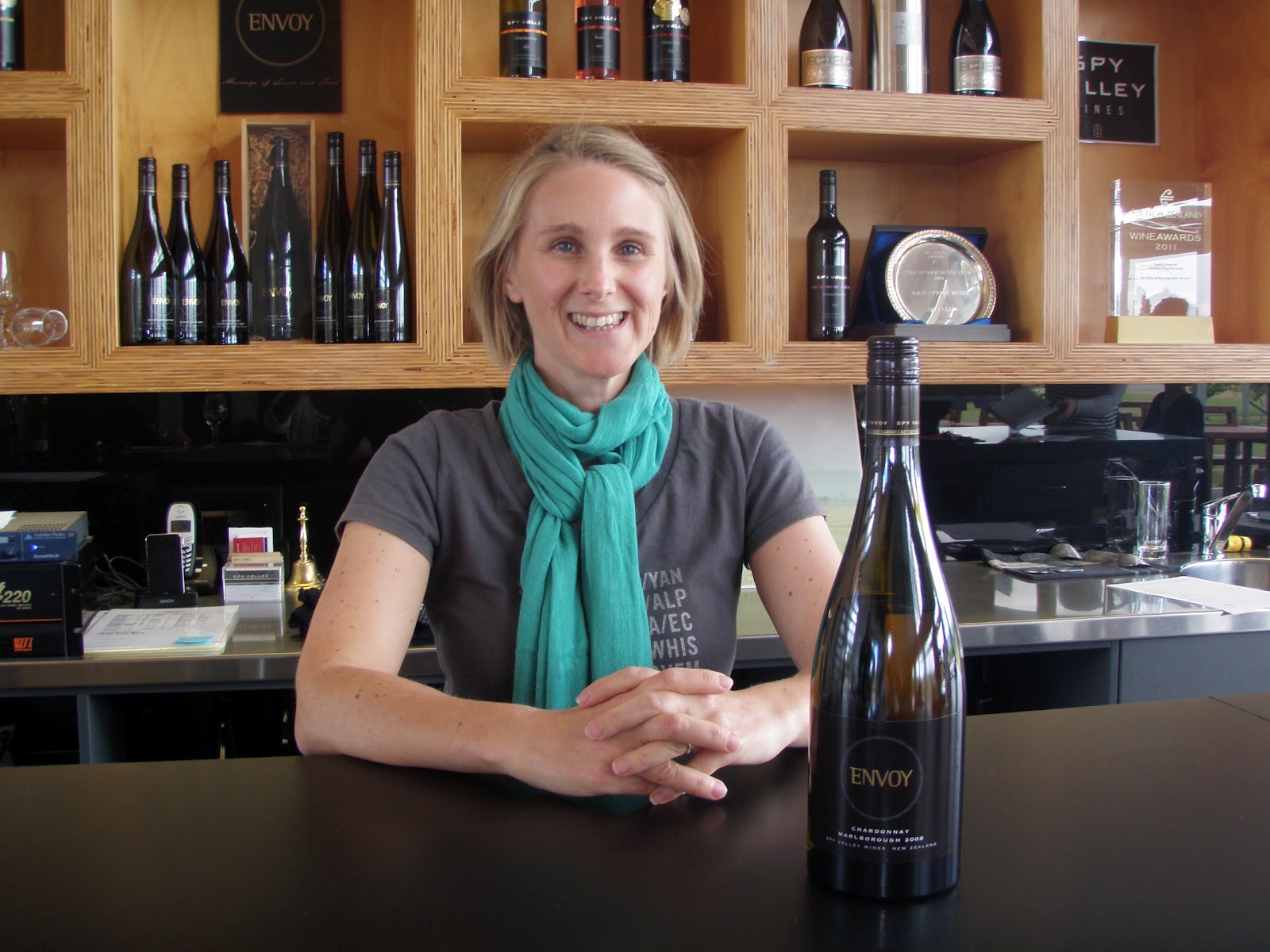
Here is the home of family-owned Spy Valley Wines, who craft a great range of premium wines marketed under the “Envoy” label. Envoy means messenger, representative, or chosen messenger, and Spy Valley Wines chose the Envoy brand to mean Message of Land and Time. They explained that to express the true character of the site and variety, a key component is time, and they never rush Envoy. That’s very much like ourselves, as we’re never in a hurry with Envoy’s 6.5 knot cruising speed.
Spy Valley produce most of the classic wines of this famous wine-making region; sauvignon blanc, riesling, pinot gris, gewürztraminer, chardonnay and pinot noir.

Here we discuss Envoy wines with Spy Valley’s Tracy McKean.


This spy connection also reminded us of when the Turkish Coastguard boarded Envoy last year because they were curious why she has so many aerials (11 plus two radomes). Envoy often attracts Coastguard’s attention because of her unusual, and slightly military-look.
Spy Valley Wines widely export their Envoy wines, and their niche market is restaurants. If you ever see this wine we suggest you try it – we certainly think it’s great.
Coming back into the marina we noticed this large motor vessel - whoever designed this obviously has no taste at all! Different boats for different folks.


TECHNICAL
The Water Maker has been modified as described in last blog, and all working well.
LOG
Spent 39 nights aboard since arrival, and cruised a mere 42 miles for 9 engine hours.