Wednesday, July 20, 2011

Photos taken during Kevin & Diane's visit

Part of the fish market in Kavala


Envoy in Kavala with castle in background


Porto Koufos was a narrow sheltered anchorage that reminded us on NZ's Whangaroa


There are 20 major monastaries on the Akti Peninsula


One of the many monastaries near Mt Athos - women are not allowed within 500m of the shore


Beautiful fresh cherries in the weekly market


The fascinating weekly market in Kavala - where local people shop


Laurie with Kostas, who was very friendly and a great help to us in Kavala


Kevin makes the traditional pikelets


Kevin, who was a senior fire officer explains a hydrant to Laurie


Kevin & Diane in relax mode aboard Envoy
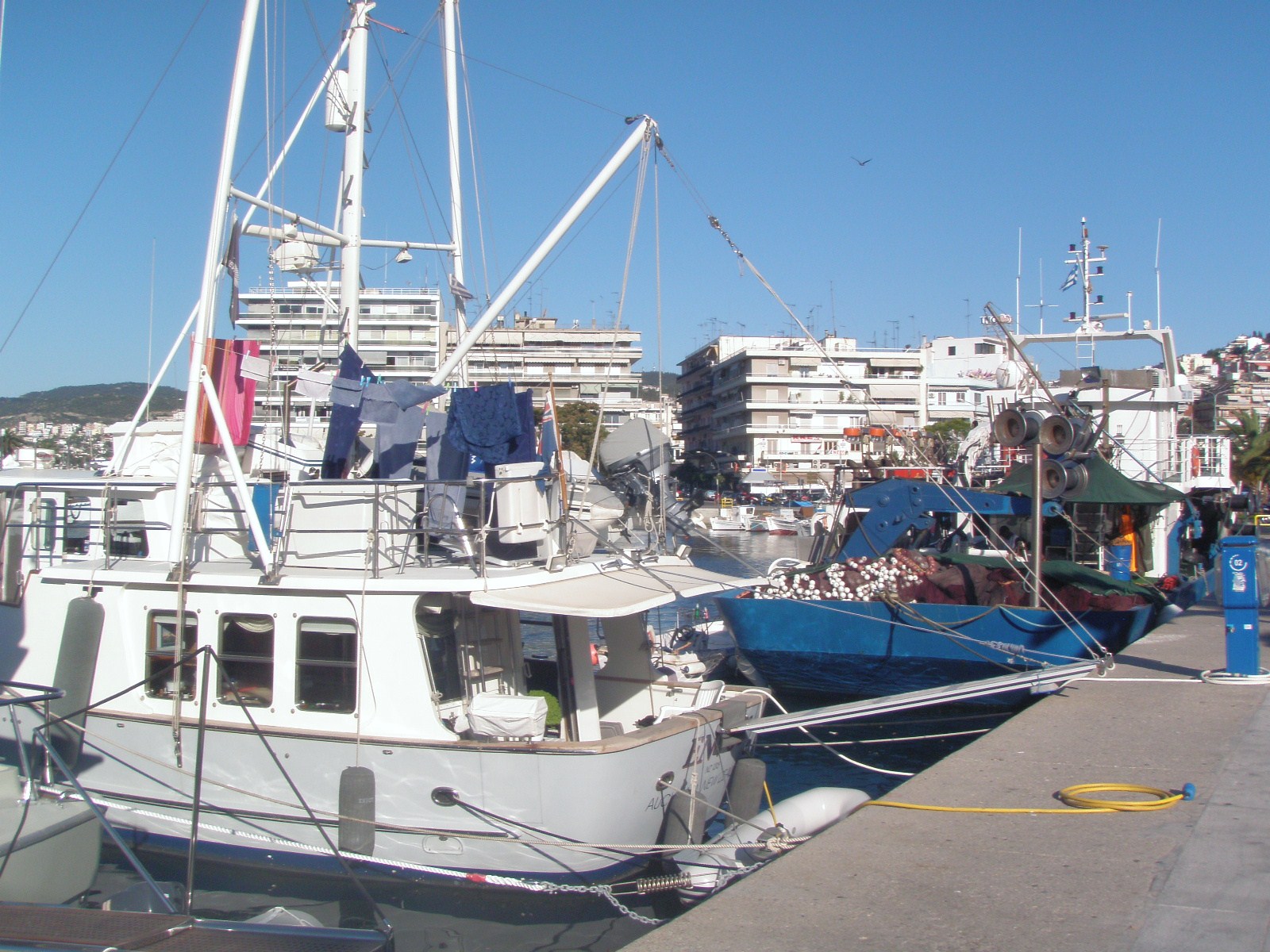
Envoy moored among the busy fishing boats in Kavala Harbour coming and going all hours


Aqueduct in Kavala built by the Turkish Suleyman the Magnificent in 16th century

Wednesday, July 13, 2011

THE THREE FINGERS AND THE INCREDIBLE MONASTERIES NEAR MT ATHOS

On 27 June with Kevin & Diane we left Kavala after a very enjoyable stay there. It’s great to see destinations where normal local people live and work, without hordes of tourists. Those tourists who do visit this area mostly drive down from eastern Europe. Our Greek friends from Blue Cruises wished us “kales thalases”, meaning “have favourable weather and a safe voyage”, and left us their contact details in case of any problems – they are professional skippers and engineers.
We cruised over to the area of Chalkidiki or “The Thee Fingers”, so-called because there are three peninsulas, each about 25NM long, forming two gulfs between them, and another gulf with mainland Greece. The easternmost peninsula is Akti, and at its southern end is the spectacular “holy mountain” of Mt Athos, rising to 2,033m, with ice flows still visible near the cloud-shrouded summit. The Virgin Mary is said to have visited here after the death of Jesus. The Akti Peninsula is a semi-autonomous region of Greece ruled by the monks who inhabit 20 large monasteries, some dating back to the 9th century. Some of these are the size of large villages, and of course over the centuries have been attacked and ransacked numerous times by various pirates and invaders. Access to the peninsula is sealed off, and only 110 visitors (who must be Christian) are allowed each day, after gaining permission which can take up to six months. No females are allowed to visit, and any boat containing a female is not allowed to approach closer than 500m to the shore. Because of this limitation we had to make the 61NM voyage around the peninsula in one day, and several times we were joined by schools of dolphins frolicking around Envoy’s bow. It was really spectacular to see not only the monasteries, but also numerous other monks’ huts and retreats perched on the sides of cliffs, some in the most inaccessible of positions – they sure like their isolation.
Here for the first time we’ve seen a few other cruisers – one night nine other boats in the same perfectly protected bay of Ormos Kriftos, about half the size of Auckland’s Islington Bay. Four of them were rafted together so there was ample space.
In retrospect we should have stayed another night or two there, as the area has several beautiful and secure anchorages.
It’s a tradition when we go boating with Kevin & Diane that Kevin makes pikelets, and this time he made a lunch of them which we enjoyed at anchor off Ormos Sikias.
We finished our time with Kevin & Diane in Porto Koufo, a very protected bay that reminded us of Northland’s Whangaroa Harbour, with its narrow entrance, high rugged cliffs and perfect shelter.
We took on fuel for the second time this year, buying 750 litres at Porto Carras marina at Euro 1.57/L (about NZ$2.86). Here was a large resort with plenty of facilities including a doctor I visited to get an ear infection looked at. She gave me some antibiotic ear drops and asked me to come back 2 days later to have my ears cleaned out. She did an excellent job, and the two visits cost a total of Euro 80 (about NZ$146), which was excellent considering the time she spent.
Nearby we met some British cruisers aboard a yacht called Rosa di Venti, and it turned out they know our friends Alan & Anne from Sula-Mac. Once again a small world.
We did a 49NM cruise south to the Northern Sporades, where we are now en route for Chalkis, on Evia Is near Athens. There we’ll meet the Naiad serviceman coming from Holland to try and fix our stabilisers. He says it will be a 2-3 hour job so here’s hoping he’s right!
There are more boats around now as the holiday season kicks in, but nowhere has it been crowded. The temperature is now in the low 30s with the sea a very warm 26. Although the Aegean is notorious for it strong NW wind – the Meltemi – it doesn’t often reach this NW section, and we’ve had light winds up to about 15 knots.
There is little observance of boating regulations, or common sense here by small boat users, and speedboats, RIBs and jet skis roar around at high speed, very close (5 metres distant) to anchored vessels. This is annoying and of course highly dangerous, especially as there are often people swimming from anchored vessels.
TECHNICAL
Kevin is very knowledgeable about rigging, and he inspected ours, and took some measurements of the mast and boom so that he can calculate if it’s safe to lift our large RIB, weighing about 250kg, up out of the water behind Envoy’s transom using the boom winch The purpose of this would be to avoid barnacles growing on the RIB, which is not anti fouled. Our initial conclusion is this would not be a good idea, at it would place too much strain on the lifting tackle. It would be possible to design and build an A-frame support for the boom so this lift could be done, but I think we’ll just continue to lift out our RIB for a day or two once a week. In any case when Diane and I don’t have visitors we use our smaller RIB, weighing only about 50kg, which we do lift out at the transom without any problems.
LOG (to 10/7/11): 68 days aboard since leaving Marmaris, 929NM cruised for 190 engine hours.

Photos relating to last blog posting

These days wild deer roam the Myrina Castle grounds


View of Envoy anchored in Myrina harbour from the castle above it


View of Myrina's hilltop castle from Envoy's anchored position in the harbour


Ian wheeling the shopping trolley full of supplies


Ian & Patsy enjoy some time ashore


Envoy anchored at Skala Marion, Thassos Is
Greek oil rig between Thassos Island and Kavala


Di, Ian, Patsy & Laurie enjoy a traditional dinner ashore in Myrina

Friday, July 01, 2011

ENVOY VISITS LIMNOS, THASSOS & KAVALA

We arrived at the island of Limnos a day before Ian & Patsy, who were arriving from Malta late at night and staying in a hotel, and sent them a text from our Greek phone with our location, so they could meet us the next day. On the next day, mid-morning turned to early afternoon, and we still hadn’t heard back from them, so I sent further texts using both our Greek & NZ phones. They only got the text from our NZ phone, and it turned out that our original text hadn’t been received at all (it did arrive a day later), so Ian & Patsy had no idea where we were, or how to get to us. Ian & Patsy did finally join us after some consternation - panic over, and we enjoyed a great six days together.
Limnos is a very fertile island, with many farms, but rather devoid of interesting features compared with islands further south. The first night we spent in Moudros Bay - very large and sheltered, but unappealing. This bay was the base for the Allied fleet during the First World War’s disastrous Gallipoli campaign. We met Ian & Patsy at the much nicer, totally unspoiled Ormos Kondio.
Limnos has a strong Greek military presence due to its proximity to the Dardanelles, and we frequently saw fighter jets soaring loudly overhead during their training runs. One night we saw large light flashes on the horizon, and heard distant rumbles as the navy practiced gunnery.
The highlight at Limnos was spending a couple of days anchored in the port of Myrina. In ancient times Limnos was ruled by Amazon warriors, and Myrina is named after one of their Queens. It’s reputed that the beach we anchored off is where the Amazons cut the throats of husbands they had tired of. Although Ian and I were sure Patsy & Di weren’t tired of us, we took the precaution of making sure all Envoy’s sharp knives were well out of sight. Jason and the Argonauts called at Limnos about 1300BC on their way to the Black Sea in search of the Golden Fleece. They spent two years dallying with the Amazons, who by that time had killed all the men on the island, and continued on their quest with their throats intact, though probably somewhat underweight and exhausted - a man’s gotta do what a man’s gotta do!
Myrina is overlooked by the inevitable hilltop castle – this one dates from very early times, was rebuilt by the Byzantines in 1186, and then by the Venetians in 1214. Now it is home to about 200 tame deer who freely roam the interior grassy hillsides.
We had to keep moving as Ian & Patsy were spending only five nights with us, and we had over 100NM to cruise to their departure point. Further north is the island of Nissos Thassos, and finding very little shelter, we anchored off ocean beaches for two nights, using our flopper-stoppers to reduce rolling. We enjoyed one very picturesque fishing village called Skala Marion, and went ashore there, but it wasn’t sheltered enough to stay overnight. Overall we couldn’t recommend N Thassos as a cruising destination, although we believe it’s great for land-based touring.
Between N Thassos and the mainland Greek coast of Macedonia are several active oil rigs, looking rather incongruous against a Med backdrop.
It’s always a bit stressful arriving in a strange harbour for the first time, not knowing if berths are available, where to berth, whether bow lines are provided or we need to use our anchor, if water and power is available, where the authorities are located etc. Some harbours have signs at the entrance advising VHF radio channels to use. Others send a guide boat out immediately a visitor arrives. At Kavala Harbour on the mainland coast there was none of this, and we glided in trying unsuccessfully to call Harbour Control on the radio. We saw a guy standing on the foredeck of a motor yacht. We headed over to him, and I asked Di to go out and ask him where we could berth, figuring he’d be more helpful to Di than to me. Sure enough, he told us it was OK to berth right next to him, and he helped us with our lines.
We berthed stern-to a busy quay which backs on to Kavala’s main street.
Apparently very few foreign boats visit Kavala, and we were the only cruising boat among a harbour filled with fishing boats, and local pleasure boats, so we attracted quite a lot of attention (in fact we’d not seen another cruising boat since leaving Limnos.)
An elderly lady came to see us, having noticed our NZ registration. She was born in Kavala, lived for 50 years in Wellington, and recently returned here to live, preferring the Greek weather to that of Wellington (can’t say I blame her – why wait 50 years!). She still gets a weekly copy of “The New Zealander” delivered. This newspaper is published in Australia for expat Kiwis, and the next day she brought a copy for us. She used to work for Mobil Oil, and knew one of our close friends – Don – who also used to work for Mobil – a small world!
Kavala is an interesting city with quite a history, having been inhabited since Neolithic times – that is the period from 10,000 to 3,000BC. Even St Paul came to visit here, so we were in good company. A prominent feature is a large aqueduct built by the Turks in the 16th century, and still in good repair. The castle here was originally built in the 5th century BC, and modified by subsequent invaders.
The guy who helped us with the lines is called Kostas, and he was really friendly and helpful with advice. Power and water is always an issue in these harbours because of poor maintenance, and Kostas let us connect into his power and water supply. He also gave us a large basil plant, telling us it’s excellent for keeping away mosquitoes. Time will tell on that.
Having spent some time in Greece waters again we’re reminded how cheap the restaurants are here – we’re getting excellent meals for about NZ$30 per head. That includes wine, all you can eat, great atmosphere and service, and even food for the numerous cats who invariably congregate around us. Very often wandering musicians come through the restaurants to serenade the patrons, but this is not for free, and when the tambourine is passed around some contribution is expected.
Ian & Patsy left us here, and the next post will cover Kevin & Diane’s visit.
We’ll be spending the next few weeks heading west along the mainland coast, until we head south to The Sporades.
TECHNICAL
Our fresh water system problem was resolved. It turned out to be that a seal on one of the replaceable filters had moved enough to block about half of the water flow. Now all OK.
We had some further starting issues with the Genset. A local (and seemingly very competent) engineer checked the connections to the relays again, left us with a spare and made up a wiring loom to bypass the state relay if we can’t start the engine. I also learned from him never to touch a capacitor, even with the engine off, as they store enough voltage to give a nasty shock. No other issues right now.
LOG (to 26/6/11): 54 days aboard since leaving Marmaris, 689NM cruised for 143 engine hours.

Sunday, June 26, 2011

We load supplies for Morris & Gail's visit in Foca. Groceries are about the same price in Turkey as in NZ. A separate trolley contained the beer and wine!


Morris buying fruit in Foca, Turkey where fruit is varied, fresh & cheap

Photos from Turkey

Ship at the end of its life awaiting break up for scrap. In the background are ships ashore


Morris trying to catch fish by trolling - no luck, but you've gotta try


Fisherman selling his wares in Candarli. Thousands of commercial fishing boats venture out daily in the Med

Thursday, June 23, 2011

PHOTOS

Castle being renovated at Candarli


Morris, Gail & Laurie having a cooling ale in Candarli


Four out of the five boats at anchor in Foca are from NZ


Eating the small fish Morris bought


Tanker refuelling Envoy with 750 litres of diesel at Mytilini


Gail & Diane enjoying natural hot pool at Bademli Limani

Tuesday, June 21, 2011

ARRIVING IN LESVOS, GREECE

From Ayvalik in Turkey it’s only about 20NM to Mitilini on the Greek island of Lesvos, and here we cleared-in using our friends from A1 Yachting as agents. A Greek Transit Log costs Euro 100, and we also had to pay Euro 30 to the Port Police, Euro 30 to Immigration and Euro 165 to A1. We moored stern-to the town quay which is both atmospheric and supposedly cheap at about Euro 7 per night. A1 charged us Euro 48 for three days, and when I queried this they said the extra Euro 27 was paid as a tip to ensure we obtained a berth. This was strange as there were plenty of berths. We were also charged a hefty Euro 50 for “mooring assistance” for ten minutes assistance on arrival, and none on departure.
One of Mitilini’s main roads passes along the quay so we had lots of noisy motor scooters and considerable pedestrian traffic close-by. Several Australians of Greek descent living in Lesvos noticed our NZ flag, and stopped to say hi to us, and give us tips about things to see.
Lesvos is a beautiful, largely unspoiled island, and of course is famous for being where lesbianism was originated by the poet Sappho in about 600BC. We had read that lesbians from around the world converge on Lesvos, like Muslims to Mecca, and this was very apparent.
In Mitilini we bought our first diesel of the year paying Euro 1.48 (about NZ$2.69) per litre for 750 litres. There is no fuel dock, so the diesel gets delivered by tanker.
We anchored off a small village called Tsonia, and all was peaceful until about midnight when the taverna ashore started playing really high volume music, which lasted until 4am. The Greeks sure know how to party, and we now know a few more Greek songs.
We moved to Sigri, anchoring in a bay overlooked by the picturesque remains of an 18th century Ottoman castle. Sigri is famous for its Natural History Museum, and displays of ancient petrified tree trunks. We found that in prehistoric times, Greece, the Greek islands, and Turkey were all joined to Africa, and even after they separated African mammals roamed the islands. About 20 million years ago intense volcanic activity took place on Lesvos, decimating the forests and eternally preserving many of the tree trunks.
In Sigri there was a very slight swell in our anchorage, so we were able to demonstrate our “flopper-stoppers” to Morris & Gail – it is remarkable how they cushion the rolling motion.
At this stage Diane & I had cruised nearly 500NM, and the sea conditions had so far been so calm that we’d not needed to deploy our paravane stabilisers. This changed when we cruised from Sigri to Mithimna in a 20 knot wind and approximately 1.5m choppy sea. Envoy was going well heading into the seas at an angle of about 30 degrees, but when we needed to change our course and Envoy became parallel with the waves we rolled quite severely, and certainly needed the stabilisers. While Morris held Envoy’s bow to the waves Diane and I winched the “birds” over. They took effect immediately and made for a comfortable trip.
Mithimna is an absolute gem of a harbour, with loads of character, interesting cafes and shops, and of course the inevitable hill-top castle. Most of these castles are on strategic hills that have been fortified for thousands of years, with new civilizations adding to them over time. The fortress of Mithimna is known to have been restored by the Genoese in the 1370s, and taken over by the Ottomans in the late 15th century.
There was no safe anchorage nearby so we berthed in the harbour for a cost of Euro 6.50 per day – with no “mooring assistance charges”. A local stray cat befriended us, and was probably the luckiest cat in Mithimna after Diane had fed it a few times.
Morris & Gil were departing from Mitilini, about 90 minutes drive from Mithimna, so Morris hired a rental car for the last day, and we toured the island and left Morris & Gail to catch the ferry. There are many beautiful mountain villages in Lesvos’s interior, and this made a perfect end to Morris and Gail’s stay.
The next day we made an early start for the 35NM cruise NW to Limnos –the island of the Amazon warriors - to meet Ian & Patsy. The forecast was for 20 knot NE winds so we started off with our stabilisers deployed, and this proved to be a good decision as we had 1.5-2m breaking seas on our beam most of the way handled comfortably. We had to pass across the track used by ships coming from or going to the Dardanelles – to Istanbul and the Black Sea. We monitored them closely on radar, and in one case had to alter course to avoid a tanker approaching us from starboard, requiring us to give way.
TECHNICAL
Our fresh water system has a problem – the water flow suddenly reduced by about half. We’re working through this, and suspect there’s a partial blockage between the water tanks and the 12V pump. We don’t think it’s a pump problem as we can select either of two identical pumps, and the problem is the same with both of them.
LOG (to 15/6/11): 43 days aboard since leaving Marmaris, 554NM cruised for 117 engine hours.

Thursday, June 16, 2011

ENVOY DEPARTS FROM TURKEY

This post covers events up to 5 June, and we’ll post relevant photos within a day or two.
Summer is doing it’s best to arrive, and although the weather hasn’t settled we’ve had temperatures in the mid 20s to low 30s, with the sea mostly about 22d but up to 25d.
We met Morris and Gail, our first visitors for 2011, in the Turkish town of Foca. Our NZ friends Bruce & Leslie arrived there aboard Midi, and amazingly there were also two other NZ yachts there – Silver Fern & Largo Star. It was a real Kiwi anchorage shared with just one Turkish motor yacht.
After replenishing our supplies in Foca we cruised north to Akca Limani, and on the way passed an area where the Turks break-up ships for scrap metal. We counted 27 ships either ashore or at anchor including the British aircraft carrier HMS Invincible. According to the Internet she would take eight months to break-up.
Akca Limani is a sheltered, shallow harbour about 2NM across, with maximum depths of about 6m. We entered using the southern entrance with a depth of only about 3m, and there is a northern entrance with reported depths also of 3m. Morris & I thought the water looked much shallower, so we explored it using the RIB. Sure enough we found it was only about 1.5m deep with many rocks, so we decided to exit using the southern entrance again On arriving at our next destination of Candarli, a small Turkish Coastguard patrol boat roared into the bay, and came alongside. The two occupants came aboard, and after checking our passports and Transit Log, told us they’d had reports of us acting suspiciously with our RIB in Akca Limani. I don’t know what they thought we might have been doing, but after we explained that we were simply checking the depths they were satisfied, and confirmed that the northern entrance was indeed dangerous.
Morris is keen on fishing and while ashore at Candarli we bought some new trolling lures. These have so proven unsuccessful, but Morris also bought some small local fish for dinner. Small is the operative word here, as 10 whole fish weighed 1.5kg before cleaning, and they were similar to NZ sprats or small yellowtail. Morris and I cooked these whole (they were far too small to fillet) wrapped in foil on the BBQ, and although they were tasty it was very hard to remove the bones from the flesh. We definitely prefer NZ snapper.
Morris is a very experienced boatie, and helped me greatly, including anchoring duties. He had the bad luck to strike a couple of the muddiest bays we’ve ever encountered, where the anchor chain was so caked with sticky mud that it looked like a cable. Gail had also volunteered to flake the chain into the anchor locker, and ended up with very muddy hands.
Further north we anchored at the sheltered and delightful Bademli Limani. Here are natural fresh hot water springs along the shore, and some hedonistic souls have built stone baths around some of them. Of course we had to go and enjoy our evening drinks in the hot springs.
Our last Turkish port was Ayvalik, where there is a series of almost land-locked and very sheltered bays. Here we cleared out of Turkey – visiting the Port Police, Customs and Harbour Master, taking nearly five hours but costing only nine Lire (about NZ$7.50). I had been told it was necessary to use an agent to clear out, costing in the range of Euro 30-50, but this proved not necessary.
TECHNICAL
Our guest head is working fine, but the vacuum motor re-charges about every 30 minutes, and should not be doing so more than every approx 2 hours. This indicates one or more of the duckbill valves may need replacing. We’ll do this later because at the moment we get around this by turning the power to the head off after each use. I’m reluctant to pull things apart right now in case we break a pipe fitting or similar.
LOG: 33 days aboard since leaving Marmaris, 392NM cruised for 86 engine hours.

Friday, June 10, 2011

A REALISTIC MED CRUISING BUDGET

We are now in the Greek island of Lesvos with Morris & Gail. All is going well, and I’ll advise more on this in a few days.
Since we posted an article on our blog in early April about the costs of cruising , I’ve had a few off-line requests to advise our views on the actual dollar costs of cruising – so here goes.
In general we find that actual living costs such as food, beverages, household supplies and personal spending are about the same when cruising as when at home, and the cost of owning a boat in the Med in terms of maintenance and insurance is also similar to New Zealand. What bumps up the cost is the travel to and from your boat, meeting regulatory requirements when moving between countries, sightseeing and associated costs ashore – particularly rental cars and accommodation, and the fuel cost resulting from cruising longer distances.
A recent Seven Seas Cruising Association newsletter advised of an American couple cruising on a modern 53ft sailing yacht, who originally estimated they could cruise on a budget of US$35,000 (approx. NZ$44,000) per year. They describe themselves as frugal by nature, and rarely ate ashore or went into marinas. They kept detailed day-by-day records of spending, and their reality was an average cost of US$43,000 (approx. NZ$54,000) per year over a period of four years up to April 2010, cruising the Caribbean, the Pacific, New Zealand and South East Asia. But that was over a period which ended over a year ago, and everywhere costs have significantly increased since then. The Med is no longer a cheap place to cruise, and most people are not frugal, so our advice to any intending cruiser would be to budget to spend not less than NZ$90,000 (approx. US$72,000) per year, not including any costs incurred back home.
I can imagine some readers thinking “that’s far too high an estimate”, so let me elaborate. That includes allowances of NZ$10,000 for diesel, lpg and petrol for your outboard, NZ$20,000 for repairs and maintenance, NZ$15,000 for all insurances, winter berthage and meeting regulatory requirements, and NZ$7,000 for return travel for two. That’s a total of NZ$52,000 (US$42,000) before you tour your first castle, eat a kebab or drink your first Efes (Turkish beer). Bear in mind too that a major technical problem could blow the $20,000 r & m figure out the window.
TECHNICAL
Most importantly we’ve used our water maker five times now for a total of about 17 hours, and all is good. As an example of costs, this was about NZ$5,000 to repair. No other issues to report.
LOG: 38 days aboard since leaving Marmaris, 437NM cruised for 95 engine hours.

Sunday, June 05, 2011

ENVOY ARRIVES AT FOCA, GULF OF IZMIR

We arrived at Foca, about 320 NM from our departure point of Marmaris on 1/6. This is really great, as firstly it’s here that we meet Morris & Gail, and secondly everywhere from here on is new territory for us.
We’ve been cruising loosely in company with NZers Bruce & Lesley Tebbutt from Kawakawa, who have a beautiful sailing catamaran called Midi. Like us they enjoy playing 500, and we’ve had some good contests with the boys winning of course. We’ll cruise further north together to Ayvalik, then we head west to the Greek island of Lesvos, and they head up the Dardanelles. It seems that we have similar plans next year of heading towards the Adriatic.
We went into the marina at Alacati for a couple of days to allow easy access for the engineers fixing our water maker. The cost there is Euro 80 per night including power and water. On Saturday night we went into the very pretty town of Alacati for dinner, and while waiting for a bus, some guys stopped and gave us a lift. This happens quite regularly, including a couple of days later when an old sewage pumping truck stopped, and Diane & I jumped up into the cab for a ride to Cesme. I doubt that I’d be getting lifts if Diane wasn’t with me! Alacati has probably got a bit too trendy and expensive now, and I noticed a bottle of NZ Sauvignon Blanc on the wine list for TLK120 (about NZ$100). I’m not going to go into details re Alicati & Cesme as they’re well covered in last year’s blogs.
TECHNICAL
While we were in Alacati three engineers drove up from Marmaris with our watermaker. It’s quite a distance and the drive took them six hours. To recap, last year we had to cruise without our water maker, because it needed new high pressure membranes, and the delivery time was very long. The service agent then ordered them to arrive in Marmaris early this year, but they ordered the wrong size. So finally we have the right size.
Two of the engineers installed our unit, while the third one watched, until tiring of that he had a sleep in their car. The installation seemed to go OK, and we made fresh water for two hours. We said our thanks and goodbyes, and the guys left to drive back. Then about 30 minutes later, I noticed water starting to leak from the water flow control housing. I phoned the engineers, and they came back. They stripped the leaking housing and checked the seals, finding that four of them were defective – two were old and flattened, while two had physical damage. As the engineers couldn’t speak English I didn’t find out how this happened, but think it happened during re-assembly of our unit in Marmaris. Then we ran it for a further two hours and all was OK with the guys finally leaving about 7pm for the long drive back. Since then we’ve used the unit twice for a total of six hours, and so far so good. This is absolutely great for us, as it’s quite a pain finding and getting water, most of which is not drinkable.
LOG: 28 days aboard since leaving Marmaris, 320NM cruised for 71 engine hours.

Wednesday, June 01, 2011

Di standing by a runabout with three 220hp outboards - small boat, lotsa engines!


Jars of pickles stored in the open outside a Taverna


The wake from the Sea Princess provided a change from the glassy calm conditions

Thursday, May 26, 2011

ENVOY CRUISES TO ALACATI

As I write this we’re cruising 50NM from the Samos Strait to Alicati, near Cesme. 50 miles in one day is a bit longer than our usual routine, and takes us about nine hours, but with Envoy on autopilot there’s nothing we need to do except keep a lookout, and do hourly engine-room checks. This will put us in the right area to meet our first guests, Morris and Gail on 2 June.
The Samos Strait is under a mile wide, and separates the Greek island of Samos from the Turkish mainland making it the closest point Turkey and Greece come together except for their land border near the Black Sea.
We started our journey this morning in still and misty conditions. The normally sparkling turquoise sea was as grey as the mist, making the horizon difficult to detect. So far since leaving Marmaris we’ve not used our paravane stabilisers at all, and again today the sea is glassy calm with the wind under two knots. A cruise ship – the Star Princess has just passed close by (photo to be posted shortly), and it’s wake provided a change from the flat sea. There are very few boats around, and the only other boats we’ve seen in three hours are two Greek fishing boats. All day yesterday, when we cruised 33NM we saw only Coastguard and Navy patrol boats. One of the Coastguard boats called us on VHF to check our name and destination.
The weather has still not settled into summer, and yesterday we even had a brief shower, but the temperature is now in the mid 20s and sea water 21d.
TECHNICAL
Our parts for the water maker have finally arrived in Marmaris, and the engineer is re-assembling our unit in the workshop today, and driving to Alicati tomorrow to meet us and install it. This will be very welcome, as it’s a bit tough on the body obtaining water using jerry cans, although to make it easier we’ve only been filling the 30L containers to 25L. If the water maker works OK we’ll definitely be celebrating!
Our Naiad stabiliser control system has now been tested by Naiad in Holland, and an engineer from Holland is going to meet us in Greece mid-July to get our Naiads operational again.
While anchored off Altinkum’s Didim Marina we got three problems rectified.
All last year we had occasional problems starting our Northern Lights generator. I assumed this was battery-related (as it was with our main Lugger engine), but this proved not to be the case, and this year the starting issue became more common. I checked all the obvious (to me) things like connections to the battery isolating switch and starter motor, but with no improvement, so got a diesel engineer to have a look. Within five minutes he went into the electrics inside a protective box, and found a relay had loose wiring, probably shaken loose with constant vibration. So this was an easy fix.
Our guest head – a Vacuuflush has been playing up again. The bowl did not always hold water, causing the vacuum pump to hunt, and the pump that sends waste into the holding tank had a failed piston and seal. This was all fixed OK too, mostly using spare parts we had on board.
The other job was simply a replacement of the faucet in the main head sink, as the hot water flow had reduced to a dribble.
A couple of weeks ago I noticed our hot water tank had signs of a very minor water leak. The water is heated either by the Lugger engine’s heat exchanger, or electrically using the generator or wing engine. I noticed the leak only occurred when running the Lugger. We belong to the Nordhavn Owners Group, where members exchange information about technical and other matters relating to Nordhavns. I put out an enquiry regarding our leak, and got a reply advising that the coolant level in the Lugger engine may be too low. I topped it up, and after about a week so far so good – the slight leak has gone. I don’t quite understand how this fixed the problem, but it did.
Log: 23 days aboard since leaving Marmaris, 203NM cruised for 50 engine hours.

Saturday, May 21, 2011

Relaxing ashore at Turk Buku


Checking our navigation on the MaxSea system. Envoy's position is the red blip on-screen


Diane doing her lifejacket drill


Envoy anchored in a quiet bay at Pirensun Koyu - note resorts in background


Camels coralled in a disused tennis court


Camels resting, awaiting riders at Camel Beach

Thursday, May 19, 2011

Envoy arrives at Didim

When starting cruising again we always make sure we do the basics like testing bilge pumps, man overboard drill and lifejacket drill. Everybody must know where to find their lifejacket, how to put it on and how to inflate it. It’s all too easy to think “we’ll never need these”, but I’ve seen too many unlikely situations happen to believe that.
I recall an incident one fine Saturday morning where a brand-new forty foot motor vessel was on her maiden voyage. Only about a mile from Auckland’s Half Moon Bay Marina she hit a well-marked rock, and was quickly awash to her gunwales. When we arrived on-scene the occupants were waist deep in water drinking beer, as if in some macabre celebration of their own incompetence, and without a lifejacket to be seen.
It’s warmed up during the last week to mid 20s, with sea water at 20 making swimming conditions pleasant. No more need for parkas and jeans.
We went ashore for a walk at Camel beach, near Bodrum, and like a lot of Turkish resort areas it’s pretty scruffy with poor quality, pot-holed roads, few footpaths, and badly maintained properties. Although they provide plenty of rubbish bins here, nobody seems to use them as the roadsides, grassy areas and beaches are strewn with litter.
In some areas the Turks have over-provided facilities in expectation of tourist numbers that haven’t materialised, and some resorts have been mothballed. Here at Camel Beach is one of those, complete with a large fenced-off area that originally was four tennis courts. Now the bar and dressing rooms are locked up, and the courts are overgrown and now used for corralling the camels! I’m sure this is not what the original architects had in mind!
We spent a few days cruising around the north side of the Bodrum peninsula and today we’re heading further north to Didim. Still no news of our water maker parts arriving.
We mostly cruise at about 1400-1500 rpm on our Lugger, 6 cylinder, 143hp, 6.8L, normally aspirated (i.e, non turbo’d) diesel engine, and this gives us about 6 knots with a fuel economy of about 8L/hr. If our paravane stabilisers are in use our speed decreases about 10%. This rpm range (although commonly also used by other owners to achieve good fuel economy) is a bit low, as the engine is under-loaded and doesn’t reach full operating temperature. It’s recommended (in Passagemaker) that diesel engines be run at about 75% of max rpm for 75% of the time. Failing this it is recommended that the engine be run at about 75% of max rpm for at least half an hour after reaching normal temperature, and again for at least half an hour one hour before switching the engine off. Running for periods at higher rpm, and consequent higher temperatures, reduces soot & carbon build-up, keeps the injectors cleaner and reduces condensation within the engine. Incidentally for this reason it’s not a good idea to run your engine for a few minutes when going down to your boat on the marina during periods of non use. It’s no problem for a diesel engine to be left unused for several months at a time with clean oil.
So why am I saying all this? Because on our cruise towards Bodrum we increased the rpm to 1800rpm, and above 1700rpm felt some heavy vibration – everything on board was rattling. At the same time the autopilot went a bit haywire, and we started going off course about 20d from side to side, leaving an “S”-shaped wake. As mentioned in a previous post we checked the engine vibration levels before leaving Marmaris and they were great - I mean virtually no vibration at any rpm setting. When we reduced rpm to about 1500 again all was OK. After a couple of days at anchor near Bodrum sitting out a gale warning we motored to anchor off Bodrum, and this time there was no vibration at higher rpm at all, and the autopilot was fine too. I can only guess that when we encountered the vibration there was something like a plastic bag or piece of fishing net on the propeller or rudder, and when we anchored it dropped off. Another one of life’s unsolved mysteries.

Wednesday, May 11, 2011

FOLLOW BY EMAIL added to Blog

We’ve added this blogger feature, so now by entering your email address you can receive all future blog updates by email, without the need to look up the blog.
Cool eh!

ENVOY HEADS NORTH-WEST UP THE COAST OF TURKEY

We left Marmaris on 4 May and headed to Bozburun for a few days, where the village is pleasant, and there’s good shelter – needed as there was a Gale Warning of Force 6-8 winds. In our location the wind didn’t get above about 23 knots, and we spent some time cleaning up Envoy from the marina dust, and moving into cruising mode.
The weather still hasn’t settled yet, currently low 20s, cloudy and with cool winds. We’ve started daily swimming, but in a chilly 19d.
Nearby is the Greek island of Simi. Cruising boats have been known to call there without checking out of Turkey to buy bacon, pork, ham, nice cheeses & yoghurts - all of which hard to get in Turkey, plus spirits and wines where there is a larger and cheaper selection.
We met Alan & Jean Ward from the NZ yacht Tuatara. They are a retired couple from Hamilton living their dream and doing a westward circumnavigation. They plan to return to NZ end of 2013, and then circumnavigate NZ.
We also met some Australian friends, Simon & Bronwn, who are visiting friends Rob & Kerry on their yacht Pablo Nuruda. Rob & Kerry have spent nearly 10 years cruising the Med, and are now on their way back to Australia via the Atlantic. We first met them in Melbourne through Simon & Bronwyn before we bought Envoy, and they provided a lot of useful information about the cruising life. Up to now we haven’t carried charts for navigation, relying solely on our electronics, but we came to a good arrangement with Kerry to buy her charts of Turkey, Greece, Croatia, Italy & France. It’s always a good back-up to have a paper chart in front of you (see Technical).
Yesterday we did a nine hour cruise, and anchored off Baglar Koyu, otherwise known as Camel Beach – and yes there are two camels on the beach. This is about five miles west of Bodrum. From here we just keep heading NW.
TECHNICAL
There’s “never a dull moment” on this subject.
Naiad have been in touch re the stabilisers, suggesting they may send an experienced Naiad engineer from Holland to meet us in Greece in July to install the new control box and calibrate the system, so this sounds promising.
I’m going to need to replace the pump that supplies sea water to cool the Naiad hydraulics as the current one is leaking. Fortunately we can fit our spare, and can then get the replaced one rebuilt.
We’ve had a little fresh water in the bilges and seem to have a slow water leak in our aft fresh water tank. Last year we replaced our two forward tanks, but not this one, which is located under the cabin sole in our sleeping cabin. I’m not greatly concerned, as the leak is slow so we can still use the tank, but next winter we’re probably going to need to repair or replace it. Envoy is 21 years old, and now we’ve had problems with all three water tanks, and one of the four diesel tanks.
We’re expecting to hear about water maker parts any day.
On leaving Marmaris I noticed our Northstar GPS wasn’t working properly. This is one of three GPS units that can supply data to our MaxSea laptop-based navigation system. I think the problem is antenna-related, and checking this with Northstar.
A couple of days ago I had problems with our Raystar GPS – it would not provide position information to the MaxSea. After thinking on this for a couple of days I found that a toggle switch that should be in the DOWN position had been accidentally flicked to the UP position, and when this was corrected all was OK.
Our current thinking is that we’d like to fix the Northstar, but also buy a separate GPS/Plotter, so that we have a totally separate system to the MaxSea. Ideally we’d like to find a portable GPS/Plotter that plugs into a 12V power supply, and interfaces with a laptop (to give us a larger screen size) - if anyone can recommend one please do so. Now we have the charts too if all else fails, and can use one of our three still-working GPS units to give us a lat/long to plot on the chart.

Tuesday, May 03, 2011

ENVOY LEAVES MARMARIS MARINA

We’ve just had a great three days with our daughter Amy, who flew in from London to be with us for my birthday (I’m counting backwards now!). Amy will join us again in August for a week. While Amy was here we got a rental car, and used the opportunity to stock Envoy up with groceries etc. The car was cheap at L50 per day (about NZ$42), but petrol is so expensive here that the 1300cc car cost L190 (about NZ$158) to fill up with 45L of petrol.
It’s getting a little warmer – now in the low 20s, but the weather hasn’t settled, and lots of boats have delayed their departure because of that. This has led to a shortage of berths in the marina, and the travel lift is now only launching boats that have an imminent departure date – making quite a few people p’d off.
Tomorrow we do some final shopping, and leave the marina on the start of our 2011 cruise – heading north to meet our first guests Morris & Gail somewhere near Izmir.
TECHNICAL
Today we had a sea trial with a couple of engineers aboard from Demir Marine. This is the very first time we’ve had engineers aboard Envoy under way. The objective was to ensure they were happy with the alignment of the prop shaft with the gearbox – we don’t want a repeat of last year’s gearbox problems. Anyhow Yulmaz is a competent engineer, and he said there was very little vibration, and all is good – so here’s hoping he’s right!
We’ve had no progress with the Naiad stabilisers. The new electronic control system was installed, but the hydraulic system would not centre the fins, and after several hours of experimentation I said “enough is enough”. I spoke with Naiad USA, and they said they would never get this kind of work done except by a factory-trained electrician. We had a competent, and well meaning electrician who’d never worked on Naiads before, and had little information supplied to him. This is not a major issue as last year we cruised safely and comfortably relying on our simple paravane stabilization system, and we’ll do the same this year. The new control system was going to cost over US$4,000 so I just said disconnect it, take it out, and when we can get a factory-trained electronics person to install it, and then if it works, we’ll pay for it.
The relay for the inverter I mentioned in the last post didn’t work – it couldn’t take the high current the inverter puts out. Actually all I wanted was the present isolator switch to be moved from under our bed, where it is obviously hard to access, to the outside of the bed, where I could access it. The electrician recommended the relay – who am I to disagree? Anyway his idea didn’t work so we’re back to my idea which is now working fine.

Sunday, April 24, 2011

ENVOY BACK IN THE WATER AT MARMARIS

Envoy went back into the water on the 20th, just nine days after our return.
The marina is very busy at this time of year, and that day about 30 boats were launched. Ours was at 2200hrs, and it was dark, chilly and drizzling. After Envoy had been hoisted in the slings, and the wooden supports removed we had to apply two coats of antifoul in the areas where blocks had supported the hull. In the water the trusty Lugger engine started in a second, and then we followed a guide boat to our marina berth.
It’s great to be floating again as we can use our own shower, washing machine etc: life on a boat on the hardstand is not much fun at all.
Di has made several trips in to Marmaris town using the Dolmus (bus) to replenish our supplies from the supermarket, as the shop here at the marina has limited availability, and is expensive.
It’s not “summery” here yet – one day will be sunny and low 20s, while the next is overcast, blustery and 16, but we’re happy knowing that we’re moving into summer.
Berthed on the same pier is a 1989 Nordhavn 46 called “Frog Kiss”, and this is hull number one - the first Nordhavn passagemaker ever made. It was great to meet Christine & Patrick, to look over their boat, and compare layouts, storage systems etc. I have already implemented one of their ideas – having a forestay to support the mast during heavy weather. Frog Kiss is the boat that started the Nordhavn domination of the passagemaker market, cemented in place by the fact that of 10 production power boats that have circumnavigated, 8 are Nordhavns (and most of those are 46s). Although we are coastal cruising not passage making, it’s great to know we have a boat that came across the Atlantic and is capable of going anywhere in the world.
TECHNICAL
We’ve ticked off many jobs now, and getting close to being ready to leave – probably in about a week. Everything that was working when we left Envoy is still working.
Before we arrived back here Demir Marine installed two new start batteries – these are Deka brand from USA, AGM Start batteries. These are not Deep Cycle (DC) as DC are recommended only for House Batteries, not for Start. Our electrician friend and battery expert Doug Gooch says that Deka are among the best batteries you can buy, so here’s hoping our occasional engine starting problems last year were battery-related and over now.
The antifouling went well and this time we got two coats rolled on instead of one coat sprayed on, hoping it will give us more thickness and last better. Next year we’ll do this ourselves as it’s nothing very complicated, and we’ll have more time.
We got the above-waterline areas of the hull polished and it came up beautifully. This is a tough job, working on scaffolding and we’ll continue to get Demir to do it, however we’re going to do all of the topsides (watch out guests!).
We removed the gearbox of our Maxwell windlass for a 3-yearly oil change, and that’s all working well – very important to have a reliable windlass.
That brings us to the HRO water maker and Naid stabilisers.
The new high pressure membranes for the water maker were here, but just before installation the engineer, Muradhan, found they’re the wrong size – too big. He phoned me and said, “Laurence we have a problem, you’d better come up to the workshop”. Membranes have to be kept moist until they’re installed, and then the water maker needs to be used straight away. That’s why they couldn’t do the installation until Envoy was in the water. We looked at trying to adapt the unit to accept larger membranes, but without success. The membranes go into a tubular manifold made of Kevlar to resist the high pressures, and there’s no way to duplicate that here. So the correct tubes have been ordered ex USA, and supposedly will be here in two weeks. We’re not going to wait here - Muradhan will meet us somewhere further north to install the membranes. In the meantime we’ll get water from harbours, both directly into Envoy’s tanks, and using our 30L containers if necessary, just like last year.
The new electronic control box for the Naiad stabilisers was also here waiting, and yesterday the electrician, Ozan, installed it. There was progress as the system powered up OK, the hydraulics worked, the cooling system worked – none of which happened before. But the control system still isn’t giving commands to the hydraulics. Ozan has emailed a US Naiad engineer with an outline, and hopefully we’ll make progress in the next few days. Otherwise, like last year we’ll just use our simple, bullet-proof, and effective paravane stabilisers, and save quite a few dollars in the process, as we haven’t paid for the new control box so far.
In the next few days I’m going to change the primary and secondary fuel filters on all three engines, check the fan belts, and replace the Genset impellor (with help).
I’m also getting a Demir electrician to fit a relay ON/OFF isolating switch to our inverter, because when we turn the inverter OFF at it’s control panel, it occasionally somehow switches itself back on. This is not desirable as it could deplete the house batteries, depending on what equipment is ON.

Tuesday, April 19, 2011

INDEX TO ENVOY’S BLOG TO END OF 2010

As our blog has now been running for over four years we decided to provide an Index of major cruising destinations and interesting subjects or events, cross-referenced to the blog dates for the period up to end of 2010. This will make it easier for newer readers to find content of the blog which most interests them.
The Index is in chronological order with most recent posts at the top, and does not include all posts. Generally there are photos related to the post close to it.

2010
- 25 November: Back in Marmaris for the winter, Marmaris marina
- 14 November: Cruising south, Torba, MacGyver, Bozburun
- 28 October: We drag anchor during a gale, Ephesus
- 24 October: Monitoring weather, Eskifoca, Ildir, bilge management
- 7 October: Eskifoca
- 29 September: Cruising north up Turkey’s west coast, Sigacek, Dalyankoy, Cesme,
Chios
- 13 September: Clearing out of Greece and into Turkey, repairs to our Yanmar
- 1 September: Santorini, Astipaelia, Kalimnos, the Schengen Treaty
- 25 August: Rethimno, cruising north to Santorini, improvements to Envoy’s charging
system
-16 August: Chania, German war graves
- 5 August: Gramvousa Is
- 28 July: Ormos Milati, Soudha Bay, NZ war graves
- 20 July: Cruising west along Crete’s north coast
- 11 July: Impressions of Crete
- 3 July: Agios Nikolaos, resolution of gearbox problem
- 27 June: Crete, Sitia, Spinalonga, gearbox problem
- 17 June: Rhodos, Greek cruising tax, Lindos, Karpathos
- 26 May: Vodafone internet connection, unexpected problems with water maker and
hydraulic stabilisers
- 14 May: Envoy finally back in water after 28 months on the hard
- 4 May: Fresh water tanks removed
- 27 April: Problem with leaking fresh water tanks
- 25 April: Life living aboard on the hardstand, about Marmaris Yat marina,
progress on re-commissioning work
- 18 April: Diane’s impressions of Marmaris and current Turkish prices, dentists,
progress on re-commissioning work
- 11 April: Envoy slowly comes to life as jobs get ticked off the list
- 8 April: Impressions of Envoy after our 27 months absence and work needed to start
cruising again
- 31 March: Link to a map showing Envoy’s cruising using Click2Map
- 25 January: Summary of Envoy’s cruising to date and plans for 2010

2009 – Envoy not used so no blog activity

2008
- 25 January: Turkish cruising regulatory requirements, summary of 2007’s cruise
- 6 January: Technical details of leaving Envoy on the hard at Marmaris for a
long period

2007
- 24 November: Guest blogger Frank Curulli’s impressions of turkey, Envoy & Simi
- 10 November: our 2007 cruise ends in Marmaris, Gemiler Buku and visit to ruined
Greek village of Kaya Koy, Envoy accidentally discharges sewerage in Ekincek
- 28 October: Coastguard accuse us of scuba diving in restricted area at Knidos
- 14 October: Gerbeske, Arap Adasi, prices in Turkey, Simi
- 9 October: Gemler Adasi, Fethiye, we catch our first Med fish, Ruin Bay,
first rain in five months, the Endless Summer ends, Ekincek, Dalyan & Caunos
- 1 October: Finike, Kekova Roads, origins of Santa Claus, Kastellorizon,
Kalkan, repairs to our water maker
- 21 September: Antalya, Tekirova, routine engine room checks
- 10 September: Origins of the Turkish flag, Symi, Kokova Roads
- 2 September: Guest blogger – our daughter Amy re the Gulf of Gorgova
- 30 August: The Gulf of Gokova
- 16 August: The Gulf of Gokova, Snake & Castle Island, Cleopatra’s Beach, English
Harbour, getting LPG bottles filled in Greece & Turkey
- 8 August: Cruising in Turkey, Knidos, Datca, Keci Bucu, Bozburun, Bozuk Buku,
Ali Baba’s restaurant, we meet Turkish cruising couple – Ilkay & Meta and make
comparisons with displacement v planing vessels
- 29 July: Poros (Greece) to Bodrum (Turkey), Amorgos, the Monastieri of the Panayia,
Kos, Med weather, bureaucracy of clearing out of Greece and into Turkey
- 16 July: Serifos, sitting out a gale in Paros
- 9 July: Sounion, the Western Cyclades – Kithnos, repair of our
hydraulic stabilisers
- 1 July: Poros and the Gulf of Hydra, a near collision with a ferry, Piraeus
- 18 June: Piraeus, daily routines when cruising, Med marine life, repairing
our gearbox oil leak, planning repairs to our hydraulic stabilisers
- 10 June: Gulf of Corinth – Itea, visit to Delphi, Porto Germano, the Corinth Canal
Aigina
- 31 May: Levkas Canal to Cephalonia – Captain Corelli’s Mandolin and Paxos
- 23 May: Santa Maria di Leuca to Corfu – smoke in the engine room and our hydraulic
stabilisers fail
- 5 May: Aeolians to Calabria
- 27 April: Cefalu - Sicily
- 15 April: Description of Palermo, Sicily
- 9 April: Return trip from Palermo to Ustica
- 5 April: Cruise planning and our overnight cruise to Palermo
- 1 April: Problems berthing in Capri and further problems sheltering from a gale
in Cetraro
- 28 March: Our first cruise from Ostia to Capri
- 20 March: A gale in Ostia marina
- 8, 12 & 17 March: Joining Envoy for the first time in Ostia, our familiarisation
process and preparations for cruising

2006
- December 5: Full description of Envoy

Saturday, April 16, 2011

BACK ABOARD ENVOY IN MARMARIS, TURKEY

We arrived back in Marmaris on Tues 12th after spending a great weekend with our daughter Amy in London in beautiful sunny weather.
TRAVEL
We flew to London using Emirates and were impressed - food and service great, roomy economy class seats, and a generous 30kg per person luggage allowance. This trip we wanted to break our journey rather than go the whole distance non-stop. We had in mind that flying to Dubai was something like halfway, however it’s actually 19hours from Auckland - making for a long flight. Stopping over in Singapore or Seoul might be a better half way option in future. We had a day and night in Dubai – probably enough in our humble opinion. We saw the world’s tallest building – the Burj Khalifa tower at 828m and 160 stories high, and enjoyed looking around the museum in an early 19th century fort. We also had an interesting trip on a ferry down the creek and saw a lot of quite primitive looking dhows – still a major means of importing and exporting goods. Then we went to the Spice Souk (market) and the Gold Souk – where they have the world’s largest gold ring weighing a cool 64 kg. The Gold Souk has over 300 shops, and has been operational since the 1940s – no security in sight, and not even bars on the shop windows. The really amazing thing about Dubai – like it or not - is that 17 years ago there was nothing much there but desert. While you can certainly marvel at the amazing development, there is very little to see of historical interest. However, people based in Dubai are well located to travel elsewhere.
The current population of 1.5m is expected to double by 2025. In Dubai they mostly have immigrant workers on 3 year visas, not only for manual work, but in tourism & hospitality and right across the spectrum. In most cases they cannot get Dubai citizenship. Construction workers earn about US$200 per month and live in huts housing about eight or ten to a room. There’s quite a bit of discontent about the way that low-paid manual workers are treated.
There are no taxes in Dubai, and very few Dubai citizens actually work (because they are so rich and don’t need to – they traded in their camels on Porsches & Ferraris). The government is trying to encourage them to work, and pays them double wages if they agree to take a job. Very sensibly Dubai does not sell any land to foreigners but leases it for 99 years.
Di wanted to make a cup of tea in our hotel room but the kettle didn’t work. She found a saucepan but it was full of rice – not only rice but weevils as well. Put us off our tea (we didn’t need the protein)!
We were going on an afternoon city tour , and being a bit jet-lagged had a lie down for a couple of hours. We awoke to the phone ringing and the concierge saying “your bus is waiting down here”, jumped up from the bed and made it downstairs in three minutes flat.
We flew from London to Dalaman on Thomas Cook airline. This is very much a budget holiday airline with cramped seating, and you have to pay extra for checked luggage, meals and drinks. The cabin baggage allowance is ridiculously small at 1 bag of strictly 5kg, with bag measurements much smaller than other airlines. Also you are only allowed one cabin bag whereas most other airlines allow one bag of 7 kg plus a laptop, plus a ladies handbag.
MARMARIS AND ENVOY
Arriving back aboard Envoy we found everything basically OK except the bilges awash with diesel. I traced the leak to the starboard forward fuel tank, and transferred the remaining diesel from that tank to another using our fuel filtration pump. Then I removed the inspection cover on top of the leaking tank to remove fuel left below the level of the transfer pump inlet. After the tank was dry the drip stopped confirming that this tank was indeed the source of our problem. We borrowed a pump to clean about 60 litres of diesel out of the bilges, and then I had to clean up the residue firstly with a sponge, then with paper towels – quite a long, messy, smelly job. After Envoy is back in the water, and we have changed the fuel filters (which normally results in a bit of diesel in the bilge after bleeding the engines) I’ll need to give the engine room a good clean out with detergent. We plan to leave Marmaris in a couple of weeks, so for now we’ll just not use this leaking tank, but I need to plan for getting the tank repaired during the Turkish winter.
There’s no way this tank can be removed so we’ll either have to get it repaired in-situ, or get a flexible bag to put inside it.
Yesterday our steering system was re-assembled after the bearings had been reconditioned, and the stuffing box cleaned up – all OK there. We also had to get our boom winch control repaired, as that wasn’t working. Our 130 Amp inverter, which provides 110V power from the house battery bank keeps turning itself on - whether we want it or not. It does have an isolating switch located in the storage area under our bed, but that’s obviously difficult to access, so Demir suggested installing a power switch with a relay in an easily accessible location.
Today we expect to start antifouling, and need to get a move on as we only have three working days before launching. After launching we hope to get our Naiad stabilisers and HRO water maker working again – all parts here.
Diane & I are well, and at this stage very busy ticking things of our lists.

Saturday, April 09, 2011

NEW FEATURE ON ENVOY BLOG

Thanks to our friend Drew Davies we have an exciting new feature on our blog - now you can get all blog updates via RSS avoiding the need to check the blog for updates. Go to the right side of the blog and click on the chicklet, "Subscribe in a reader". From there you can select your preferred means to receive Envoy blog updates to your RSS reader, and of course this is no cost. Try it & thank you Drew!

Sunday, April 03, 2011

A favourite photo of Envoy anchored off Cefalu in Sicily, epitomising the cruising life of a great boat, and exotic locations

REGULAR ENVOY BLOGGING STARTS FOR 2011

Diane & I will arrive back in Marmaris on Tuesday 12 April. Envoy goes back into the water on 20 April, and we hope to start our cruising by 1 May. We have confirmation that the parts to (hopefully) fix our HRO water maker and Naiad stabilisers are waiting for us.
A reminder that by clicking the Link on the lower right of our blog “Map of Envoy’s Travels” you can see where we’ve been and where we are. When you get to the map you can use the zoom function on the left side, and the navigating arrows above the zoom.
COSTS OF CRUISING
Diane & I kept an accurate record of our costs during 2010 to assist our writing projects with Pacific Motor Yacht magazine. Different folks have different philosophies about their cruising lifestyles and associated costs, so what we are saying is not what’s “right”, but simply our own experience. Our 2010 costs are listed below in order of magnitude, expressed as a percentage of total costs, and with some comments. We only included cash costs, and not depreciation.
As a general statement actual living costs such as food, beverages, household supplies and personal spending are about the same when cruising as when at home, although spending on clothing is less when cruising. The cost of owning your boat in terms of maintenance and insurance is also similar. What bumps up the cost is the travel to and from your boat, meeting regulatory requirements moving between countries, plus sightseeing and associated costs ashore – particularly rental cars and accommodation.
Maintenance (42%): A commonly mentioned “rule of thumb” about annual maintenance costs is they will be about 10% of the value of your boat. We have always found our costs much less than that on average. During 2010 our costs were very high representing 42% of our total, but there was little maintenance done in 2008 & 2009 –we only had Envoy’s below waterline gelcoat stripped, the hull thoroughly dried using the Hotvac process, and a new epoxy gelcoat laid on. We decided to do this because Envoy was 20 years old, showed signs of minor osmosis, and was not being used so the timing was good. If Envoy had been used during 2008 and 2009 I very much doubt the maintenance cost would have increased, in fact it may have decreased. The cost includes replacement of spare parts used, and keeping Envoy in tip-top condition. If we take the whole period 2008-2010 the total maintenance cost was about 6% of the estimated capital value.
Food, Beverages, Household (13%): This includes all consumables, galley and head cleaning supplies. Food is generally about the same price or slightly cheaper than in NZ while alcoholic beverages are dearer in Turkey.
Going ashore (10%): Includes refreshments, meals, buses, rental cars, petrol for rental cars, accommodation and entry fees. Some tips here are to have drinks ashore to soak up some atmosphere, but eat back aboard. Select restaurants that locals use, back from the expensive water-side ones. Always select from the menu and never allow the waiter to “organise a nice meal for you” without knowing the cost. Shop around for cheap rental cars, or better still use the many bus services available.
Insurance, Marinas, Regulatory (10%): Includes the cost of storing Envoy on the hard for four winter months. Also here are marina costs, cruising permits, immigration fees and vaccinations.
Travel (7%): Travel always costs more than you expect – why?
- the very special fare deals are generally not obtainable for return dates more than 6 months from departure dates
- we got penalised for changing our return date
- we had excess luggage which is both an expense and a major inconvenience
- we stayed overnight on the way there and back, incurring additional hotel, food and transportation charges (as well as more general spending)
Fuel (6%): This included diesel for the three engines, petrol for two outboards and lpg for cooking. We could have reduced this a little by purchasing more diesel in Greece where diesel is cheaper than Turkey – we’ll do that this year.
Misc (5%): Comprised costs such as boat medical supplies, phone & internet, some laundry (in marinas we cannot always use our washing machine), and postage.
Personal (4%): Included buying clothing, cosmetics, medical, dentistry, gifts and similar. This is a cost that would vary enormously depending on the individual.
On-Board Improvements (2%): Making improvements to Envoy as opposed to maintaining existing equipment. Replacing equipment is categorised as maintenance.
NZ Costs (1%): These comprised bills such as house & car insurance, alarm monitoring fees and similar.
Looking ahead this year we expect our maintenance cost (and therefore our total costs) to significantly reduce.
Our next blog will be around 16 April with first impressions after our return.